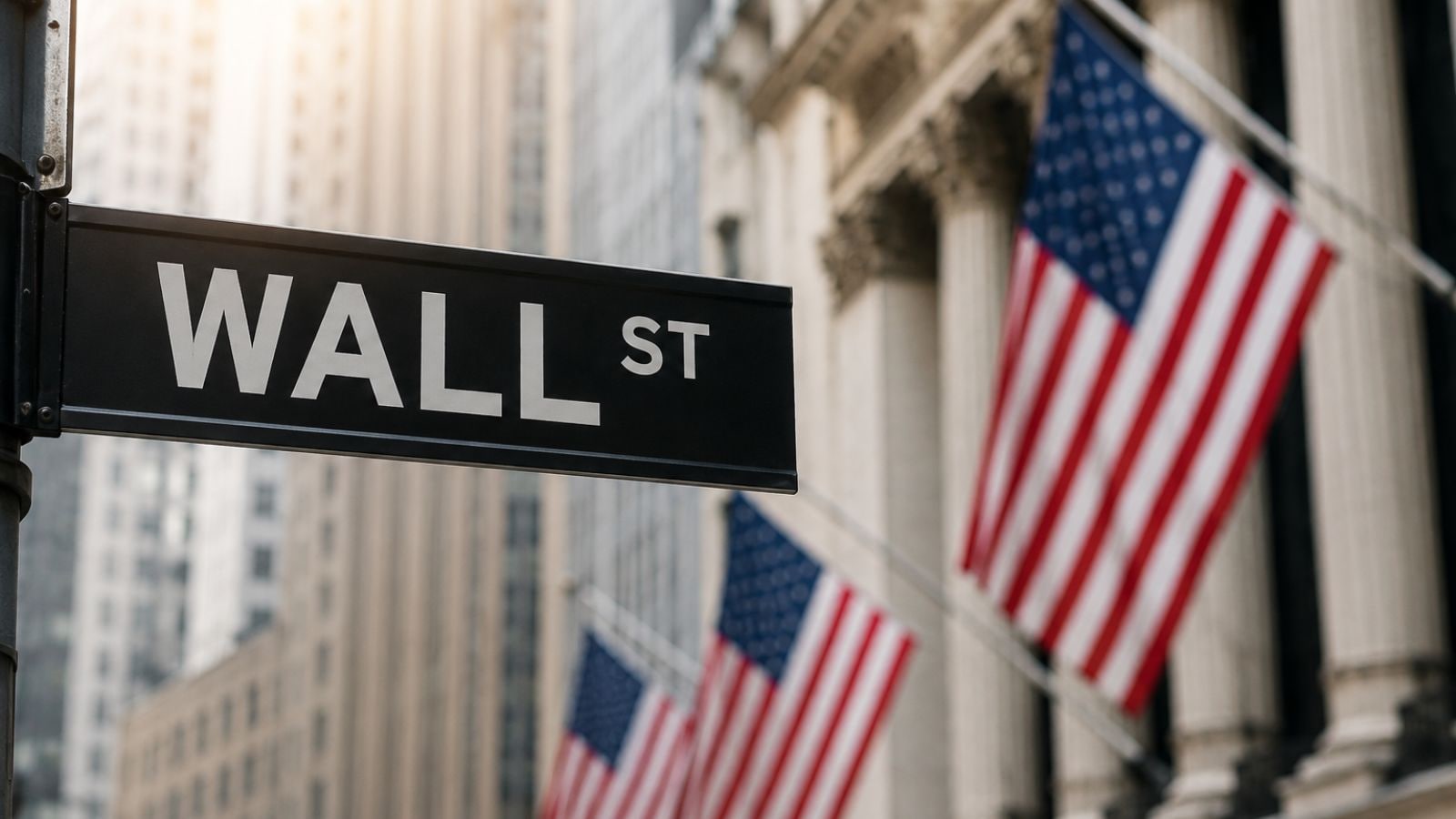
Dawn arrives over lower Manhattan not with a sudden flash of light, but with the slow, bruised purple bleed of a winter sky pressing against the glass towers of Wall Street. Down on the trading floor, long before the bell pierces the morning air, the silence carries a specific kind of weight. It is the quiet of a room full of people holding their breath.
Across town, at a kitchen table in Queens, Elena watches the coffee drip into the pot. She is fifty-four, a nurse who spent thirty years trading shifts for overtime, nursing a quiet dream of a retirement cottage where the salt air might soothe her husband’s stiff joints. Her life savings live quietly inside an index fund, tied to the massive, invisible machine of the American stock market. She does not look at tickers during her morning routine. She does not need to. She can feel the weather in her bones when the market turns cold.
Today, the market opened mixed.
To the algorithms skimming the wire services, those four words are dry code. A blip of green here, a smear of red there. To the human beings whose lives are bound to those numbers, it is the sound of shifting tectonic plates.
Let us look closer at the machinery.
Investors this morning are staring down a paradox that defies simple math. On one side sits the Federal Reserve, an institution tasked with steering a multi-trillion-dollar economy using blunt instruments and careful prose. Jerome Powell and his colleagues are wrestling with an economy that refuses to break the way traditional textbooks say it should. Inflation has cooled from its searing peaks, yet it lingers stubbornly in the corners of grocery aisles and utility bills like smoke after a campfire. The central bank wants to lower interest rates—they have hinted at it, danced around it, measured it in the cautious cadence of central bankers. But the data keeps talking back.
On the other side of the ledger lie Treasury yields.
Think of the yield on a ten-year U.S. Treasury note not as a financial statistic, but as the heartbeat of global capitalism. It is the baseline price of time and risk. When yields climb, gravity takes hold of everything else. Mortgages become punishingly expensive. Car loans stretch family budgets to the snapping point. Corporate boards put expansion plans into deep freeze. And stocks—those high-flying engines of growth—suddenly face a serious rival for investor capital. Why chase the white-knuckle volatility of equities when you can lock in a guaranteed, risk-free return from the United States government that hasn’t looked this attractive in a generation?
When yields rise, equity investors sweat. When yields fall, relief washes over the trading desks.
This morning, those two forces are locked in a silent tug-of-war. The stock market opens mixed because nobody knows which gravity will win. Technology shares twitch upward on the eternal hope of lower borrowing costs, while defensive sectors brace for impact, sensing that the higher-for-longer interest rate reality might be here to stay a little longer than anyone cared to admit.
It is easy to view these movements as abstractions. We talk about the S&P 500 or the Nasdaq as if they were constellations in a distant sky, beautiful and utterly detached from human skin. But every tick of that dial represents a human decision made under uncertainty.
Consider Marcus, a thirty-two-year-old software engineer in Chicago who poured his savings into a startup’s equity pool alongside his public stock portfolio. He has a toddler sleeping in the next room and a mortgage locked in at a rate he feels guilty about even thinking of changing. When the market opens mixed—when tech stocks stumble while utility stocks hold firm—Marcus feels it in the tightness of his chest. He looks at his portfolio app the way an old sailor looks at the barometer when the horizon turns a sickly shade of green. He isn't speculating for sport. He is trying to figure out if he will be able to afford preschool next fall without draining his emergency buffer.
Markets are not rational calculators of future value. They are enormous, pulsing nervous systems composed of millions of Marcuses and Elenas, all reacting to fear, hope, rumor, and raw data.
The Federal Reserve knows this. Every word uttered by a regional Fed president is parsed by Wall Street analysts with the obsessive intensity of medieval scholars decoding ancient prophecy. Did Powell sound too hawkish? Did he emphasize labor market resilience too much? If the job market remains stubbornly strong, wages keep rising. If wages keep rising, consumer spending stays hot. If consumer spending stays hot, inflation refuses to die. And if inflation refuses to die, the Fed cannot cut interest rates without risking a resurgence of price spikes that could ravage purchasing power far more efficiently than a mild recession ever could.
This is the tightrope.
We have lived through an era of cheap money, a long, strange afternoon where interest rates hovered near zero and capital flowed like water downhill. That era is gone. We have crossed a threshold into a harsher, more demanding climate where money has a distinct, painful cost once again. The adjustment has been messy, full of false starts and phantom recoveries.
When the opening bell rings mixed, it is the market confessing its own vertigo. It is the financial system standing at the edge of a plateau, peering into the mist, trying to gauge the distance to the next safe foothold.
Down in Queens, Elena pours her second cup of coffee. The morning news anchor drones on about basis points and yield curves, translating the complicated grammar of high finance into the background noise of ordinary life. She turns off the television. She doesn't need the numbers to tell her that eggs cost more than they did last year, or that her utility bill feels heavier each month. She walks to the window, watching the gray November light catch the bare branches of the oak tree in her yard.
The market will settle by afternoon. It always does. It will swing green or slide red, driven by a sudden block trade, a revised economic forecast, or a stray comment from a central banker three states away. The terminal screens will flash, the closing bell will sound, and the algorithms will tally the day's winners and losers.
Yet out here, beneath the grand sweep of economic history, the real work of living continues entirely unscripted. We build our lives in the spaces between the ticks, balancing hope against the cold arithmetic of tomorrow, waiting for the ground beneath our feet to finally settle into something solid.