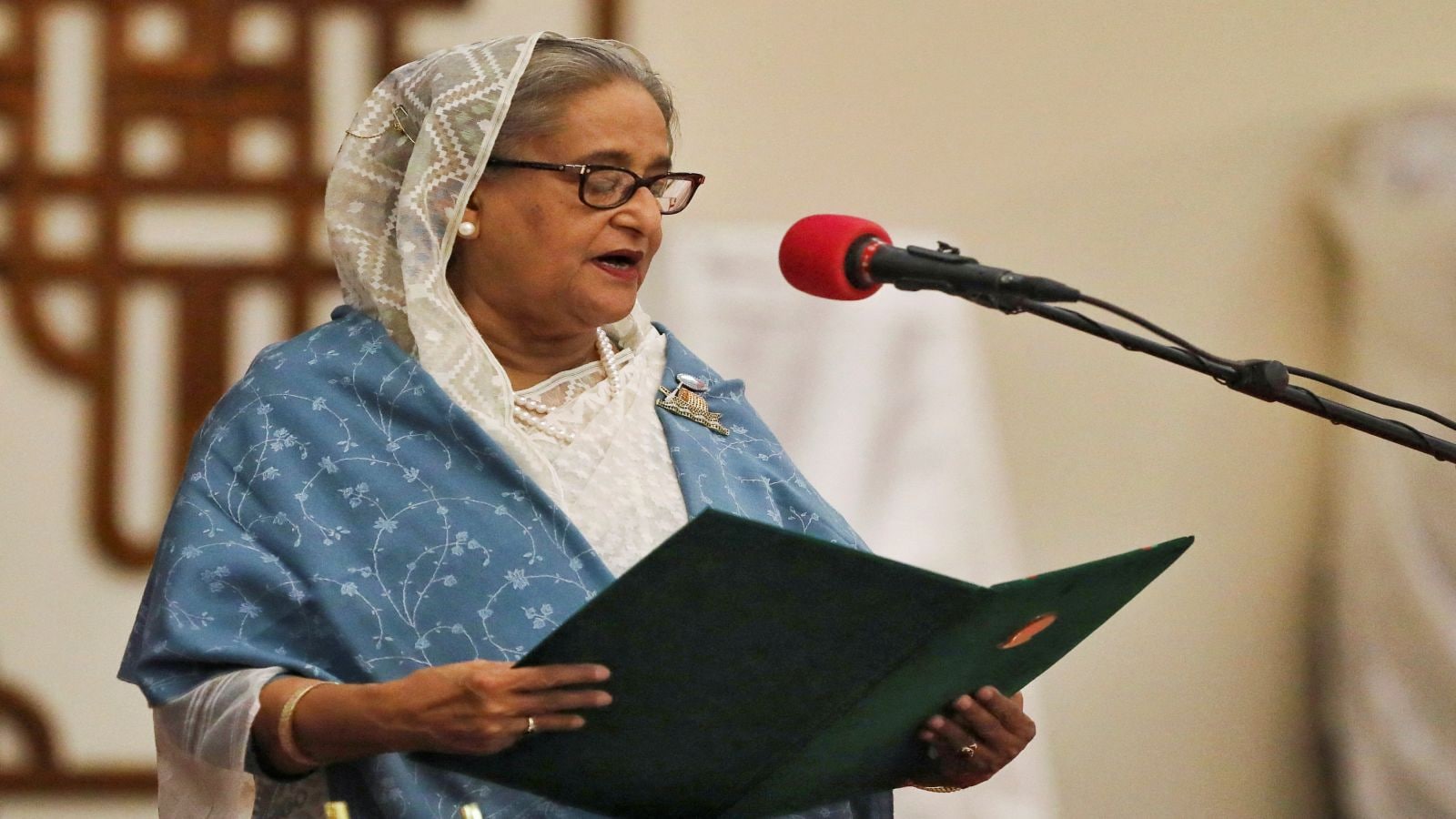
The smell of wet asphalt and burnt rubber lingers in Dhaka long after the monsoon rains wash the blood off the concrete.
If you stand near Shahbagh Square on a humid afternoon, the noise is deafening. Rickshaw bells chime in frantic rhythms. Bus engines roar, belching black smoke into the thick air. Vendors shout the prices of green mangoes and roasted peanuts. On the surface, the capital of Bangladesh looks like it always has—chaotic, vibrant, relentlessly alive.
Look closer at the walls, though.
Every available inch of brick and plaster is covered in graffiti. Bold, jagged Bengali script screams of revolution, memory, and rage. There are stencils of young faces—students who walked out of their dormitories in July 2024 holding nothing more than their phones and their convictions, and never came home. Above their painted eyes, a single warning repeats itself across miles of city blocks, echoed now in the official decrees of the interim government: if Sheikh Hasina crosses back over the border from India, she will be arrested.
To a foreign observer skimming headlines over morning coffee, this reads like standard geopolitical theater. A deposed leader flees; the new regime threatens handcuffs. We have seen this script play out in presidential palaces from Manila to Colombo.
But if you were there when the tear gas choked the narrow alleys of Uttara, or if you have ever watched a mother clutch a blood-stained university ID card while the state television insisted her son was a "terrorist," you know this isn't theater. It is a reckoning. The vow to arrest Sheikh Hasina is not merely a legal maneuver by Dhaka’s new authorities; it is the fragile, load-bearing beam holding an entire nation back from tearing itself apart.
The Weight of Fifteen Years
To understand why the mere possibility of Hasina’s return sends a tremor through 170 million people, you have to understand what living under her rule actually felt like. It did not begin as a nightmare. When she returned to power in 2009, she carried the immense moral capital of her father, Sheikh Mujibur Rahman, the independence hero assassinated in 1975. She promised stability, economic modernization, and secular democracy.
For a decade, the numbers backed her up. Garment factories hummed. Bridges spanned mighty rivers. Per capita income climbed steadily, turning Bangladesh into a darling of international development economists.
Yet, beneath the gleaming concrete of new flyovers, the air was slowly being sucked out of the room.
Consider a hypothetical composite—a man we will call Tariq, though his story belongs to thousands of real journalists, lawyers, and opposition workers across Dhaka and Chittagong. In 2013, Tariq could argue politics loudly over tea at a street stall. By 2018, he checked his shoulder before whispering a mild criticism of rising onion prices. By 2023, Tariq kept two phones: one for his family, and a clean one in case plainclothes officers from the Detective Branch stopped him at a checkpoint.
That is how authoritarianism works in the modern age. It rarely arrives all at once with tanks rolling down the boulevard. Think of it like carbon monoxide poisoning. It is odorless, invisible, and incremental. Each rigged election, each "enforced disappearance" into secret detention centers known darkly as Aynaghar—the House of Mirrors—stripped away another fraction of oxygen. People adapted because human beings are terrifyingly good at adapting to survive. They learned to swallow their anger, lower their gaze, and tell themselves that economic growth was worth the price of silence.
Until the summer of 2024, when a generation born too late to remember the old civil wars decided they would rather choke on tear gas than breathe on their knees.
The Breaking Point
History rarely pivots on grand ideological treatises. Usually, it breaks over an insult.
In June 2024, the High Court reinstated a controversial quota system that reserved 30 percent of coveted government jobs for the descendants of 1971 freedom fighters. To millions of university graduates facing staggering youth unemployment, the message was unmistakable: merit did not matter; loyalty to the ruling Awami League party did.
Students took to the streets peacefully. They asked for reform. Instead, they were met with a fatal miscalculation.
During a press conference in mid-July, Hasina dismissively invoked the word Razakar—a deeply venomous slur reserved for traitors who collaborated with Pakistani forces during the 1971 genocide—to describe the protesting youth. I remember watching the broadcast in stunned silence. Even those of us who had tracked the government's hardening arteries for years felt the temperature in the room drop. You do not call your own children traitors and expect them to go quietly back to their textbooks.
Within hours, campuses erupted. Armed student wings of the ruling party, backed by police and paramilitary forces, descended on unarmed demonstrators. Internet blackouts plunged the country into digital darkness for days, a clumsy attempt to hide the carnage from the world. Over those weeks, according to United Nations preliminary estimates and hospital tallies, more than a thousand people were killed. Children were shot on rooftops. Medics were targeted while pulling the wounded from the streets.
Instead of crushing the movement, the bloodshed fused the entire country together. Rickshaw pullers stood shoulder-to-shoulder with private university students. Factory workers marched alongside retired generals. When millions converged on Dhaka on August 5, 2024, defying a shoot-on-sight curfew, the security apparatus finally fractured.
Hasina did not stay to face the crowd she had governed for fifteen years. She boarded a military helicopter and fled west, landing at Hindon Air Base near New Delhi.
The Exile Across the Fence
Since that August afternoon, Sheikh Hasina has existed as a phantom presence just across the border—geographically close enough to reach in a forty-minute flight, yet legally untouchable behind India’s diplomatic shield.
For Nobel laureate Muhammad Yunus, who stepped into the thankless role of Chief Adviser to lead the interim government, Hasina’s proximity in India is an open wound that refuses to close. Every time a statement attributed to her surfaces online, or rumors swirl of her plotting a political comeback from safe houses in New Delhi or Kolkata, the streets of Dhaka tense up like a coiled spring.
This brings us directly to the core reality behind Dhaka’s uncompromising stance: the vow to arrest her the moment her feet touch Bangladeshi soil is not driven by vindictiveness. It is driven by survival.
Ask yourself what happens if a state lets mass killings go unanswered.
In international law, there is a concept known as transitional justice—the painful, messy process by which a society moves from dictatorship to democracy without collapsing into vigilante bloodlust. Think of it like setting a broken bone. If you do not align the fracture properly and put it in a cast, the limb heals crooked, leaving the patient crippled for life.
Right now, the International Crimes Tribunal in Dhaka—ironically, the very court Hasina’s government originally set up to try 1971 war criminals—has issued arrest warrants for her and dozens of her top lieutenants on charges of crimes against humanity. The interim administration has explicitly stated that she must face trial, and that steps are underway to formally seek her extradition from New Delhi.
If the interim government were to waver, if they hinted at a quiet amnesty or a negotiated return without handcuffs, the streets would ignite again within hours. The families who buried their teenagers in unmarked graves would rightly conclude that the revolution was stolen from them. Worse, they might decide to seek justice themselves, plunging Bangladesh into cycles of mob retribution that no police force could contain.
New Delhi’s Impossible Tightrope
Of course, vows made in Dhaka run straight into the cold granite of geopolitics in New Delhi.
India’s dilemma is agonizing, and it is worth looking at it with clear eyes rather than partisan outrage. For fifteen years, New Delhi bet the house on Sheikh Hasina. Under her watch, anti-India insurgent groups operating out of northeastern Bangladesh were dismantled. Transit routes opened up. Trade flourished. To Indian strategists, Hasina wasn't just a friendly neighbor; she was a vital security buffer in an increasingly volatile region.
When she fled to India, New Delhi offered her shelter out of historical loyalty and strategic gratitude—much as it did in 1975 after her family was murdered.
Now, however, India finds itself holding a diplomatic hot potato that burns hotter by the day.
If Prime Minister Narendra Modi’s government hands Hasina over to Dhaka, it sends a chilling message to every other regional ally from Kathmandu to Malé: India will abandon you the moment the political winds shift. On the other hand, continuing to harbor a leader accused of ordering a massacre against her own people poisons India’s relationship with 170 million Bangladeshis for a generation. Anti-India sentiment in Bangladesh is already at its highest pitch since 1971. Every day Hasina remains a guest of the Indian state, ordinary Bangladeshis view New Delhi not as a neighbor, but as an accomplice protecting their oppressor.
Extradition treaties—including the 2013 pact signed between India and Bangladesh—almost always contain escape hatches. They allow a host country to refuse handover if the offenses are deemed "political in character," or if there are concerns the accused will not receive a fair trial. Lawyers in New Delhi could drag out an extradition request in Indian courts for years, buying time while hoping the political weather in Dhaka changes.
Dhaka knows this. That is precisely why the warning has been phrased with such stark clarity: If she returns, she will be arrested. It is a message aimed as much at New Delhi as it is at Hasina’s remaining loyalists hiding inside Bangladesh. It tells India that there is no backchannel deal waiting to rehabilitate her, no quiet exit ramp where she slips back into Dhaka to rally her party for future elections.
The Fragility of the Morning After
I will admit something that analysts rarely confess when writing about revolutions: the euphoria of victory is terrifyingly brief, and what comes after is deeply uncertain.
Walk through Dhaka today, and you feel both immense pride and a gnawing, low-grade anxiety. The police force, deeply discredited by its role in the July killings, is still struggling to rebuild basic public trust. Inflation stubbornly eats into the wages of garment workers and shopkeepers. Political parties that united to topple Hasina are already beginning to jostle for power, eyeing the next election with sharpened elbows.
Democracy is not a light switch you flip on once the dictator leaves town. It is a slow, exhausting habit you have to practice when the adrenaline wears off and the trash still needs to be collected.
In this fragile interlude, accountability is the only currency that still holds universal value. When officials declare that Sheikh Hasina will be arrested upon return, they are making a solemn covenant with the dead. They are telling a traumatized nation that the law finally applies to the palace just as harshly as it applies to the slum.
Skeptics will argue that pursuing prosecution deepens political polarization. They will warn that cornering the Awami League leaves millions of its traditional supporters alienated and desperate. Those fears are not trivial; history is littered with revolutions that devoured themselves in endless purges.
Yet, sweeping blood under the rug has never brought peace to South Asia. Every time Bangladesh has chosen political convenience over real accountability—from the military coups of the 1970s to the partisan street battles of the 1990s—the rot has simply festered underground until the next explosion.
The Empty Chair
Late one evening, not long after the regime fell, a group of students gathered near the central Shaheed Minar monument. They were painting over a faded political poster, replacing it with the names of classmates who had died in the protests. One young woman, her fingers stained blue and white from the paint tins, paused to look down the empty avenue.
She didn't talk about extradition treaties, geopolitical realignments, or the nuances of the International Crimes Tribunal. She simply said that for the first time in her adult life, she wasn't afraid of the sound of a siren at night.
That quiet freedom is what hangs in the balance. Sheikh Hasina may remain miles away behind guarded gates in India, a solitary figure watching the country she once commanded move on without her. Whether she ever actually steps off a plane in Dhaka to face a judge remains an open question, tangled in the cold calculations of regional diplomacy.
What is no longer in question is the boundary line drawn in the dust of Dhaka’s streets. A nation that bled to wake up has made its terms clear: the ghost may hover at the border, and she may whisper from afar, but if she ever comes home, the doors of the courthouse will be waiting—and this time, they will lock from the outside.

