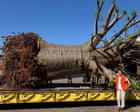
They were never meant to leave the red dust of Limpopo.
For centuries, five African baobabs stood silently in the arid bushveld near Musina, their silver-gray trunks swelling like ancient stone pillars against the blistering South African sun. They survived droughts that cracked the earth open. They outlasted empires, border wars, and the slow, grinding march of modern industry. Then, in the span of a few frantic weeks, heavy machinery arrived to tear them from the soil, severing root systems that had anchored them since before the printing press existed.
The plan was simple, at least on paper. Dig them up. Load them onto flatbed trucks. Ship them across the ocean to become the living centerpieces of a luxury development in Georgia.
Then the courts stepped in. A legal battle erupted, halting the export permit and leaving five massive, uprooted trees stranded in a holding yard—bleeding moisture, baking under canvas tarps, and dying in slow motion.
Stop.
Think about what it takes to move a building. Now imagine that building is alive, weighs upwards of forty metric tons, breathes through bark that looks like elephant hide, and has no taproot to steady itself once its lateral anchor lines are severed. When an export gets blocked at the eleventh hour, the bureaucracy celebrates a legal victory, environmental activists breathe a sigh of relief, and the headlines move on to the next outrage. Meanwhile, on the ground, someone has to figure out how to put five centuries-old giants back into the earth before they rot from the inside out.
The Anatomy of an Uprooted Ancestor
To understand why this rescue mission borders on the miraculous, you have to understand what a baobab actually is.
If you have never stood beside Adansonia digitata in the wild, picture a tree designed by someone who got the blueprints upside down. Its branches look like gnarled roots reaching blindly into the sky. Its trunk isn't solid hardwood like an oak or a teak; it is a massive, fibrous sponge engineered to hoard up to 120,000 liters of water during brief summer rains so the tree can survive years of relentless desert heat.
That spongy biology is both its superpower and its fatal flaw when humans get greedy.
When developers target mature baobabs for high-end botanical gardens or private estates abroad, they aren't buying timber. They are buying instant antiquity. You cannot fake a thousand-year-old silhouette. You cannot rush the slow, glacial expansion of a trunk that takes centuries to reach a ten-meter girth. And because South African law strictly protects indigenous baobabs—requiring specialized permits from the Department of Forestry, Fisheries and the Environment before a single shovel touches the dirt—getting them out of the country requires navigating a labyrinth of conservation regulations.
In the Limpopo case, the initial excavation went forward under the assumption that export clearance was a formality. Conservationists and local heritage groups disagreed, arguing that stripping mature, keystone organisms from their native ecosystem for private display violated the spirit of environmental protection laws. The legal challenge froze everything.
Except biology does not wait for a judge's gavel.
Consider a hypothetical scenario to grasp the sheer physiological panic happening inside those five trunks. Imagine you are a marathon runner who has spent six months training in a cool, humid valley, and suddenly someone locks you inside a greenhouse with your legs bound, cutting your water supply by ninety percent while the glass magnifies the midday sun. Your body begins consuming its own muscle tissue just to keep your organs functioning.
That is precisely what happens to an excavated baobab. Once the surrounding soil is cleared and the lateral roots—which often spread wider than the tree is tall—are pruned back to fit onto a transport rig, the tree enters severe metabolic shock. Without soil contact, the exposed root ends dry out and die. Worse, the high moisture content inside that massive, succulent trunk becomes a ticking time bomb. If the bark is bruised during lifting, fungal pathogens invade the soft, wet wood. Rot sets in silently beneath the surface, turning a centuries-old monument into hollow mush within months.
Dust, Hydraulics, and Midnight Sweat
I have spent enough time around large-scale tree translocations in southern Africa to know that the people who actually save these plants do not work in air-conditioned offices. They smell like diesel exhaust, red clay, and stale coffee. They read the health of a tree by pressing the back of a calloused hand against its bark to feel for temperature drops that signal internal decay.
Let us introduce a composite character—we will call him Pieter, though in reality he is an amalgam of the arborists, crane operators, and botanists who get called in when conservation crises turn physical.
Pieter arrives at the holding site just before dawn, when the Limpopo bushveld is still cool enough to catch your breath. The five baobabs lie propped on timber cribbing, their root balls wrapped in damp hessian and shade cloth. The air smells sharp—a mix of crushed sagebrush, warm dust, and the faintly sweet, earthy scent of exposed tree sap.
"You don't plant a baobab," Pieter tells his crew, squinting up at a trunk that dwarfs their sixty-ton mobile crane. "You introduce it to a hole and pray it decides to stay."
The logistics alone are punishing. Every hour the trees spend above ground increases the mortality risk. Yet rushing the replanting is equally lethal. If you drop a forty-ton tree onto poorly drained soil, monsoon rains will pool around the severed roots and drown it. If you fail to orient the trunk properly, the side of the bark that spent three hundred years facing the shaded south suddenly gets blasted by the harsh afternoon sun, causing severe sunscald that splits the outer layer like burned skin.
Watch how the sequence unfolds when the clock is ticking:
- Site selection and excavation: Engineers cannot simply dump the trees anywhere. They must scout virgin bushveld with matching geology—well-drained, sandy loam free of clay pans that trap water—and dig massive, flat-bottomed basins wide enough to accommodate future root expansion.
- Wound sterilization: Before a tree is lifted, specialists scrub every cut root end and bark abrasion, applying breathable anti-fungal sealants that stop rot without suffocating the living tissue.
- The lift: Heavy nylon slings—never steel cables, which slice through soft baobab bark like cheese wire—are rigged around the lower trunk. Two cranes work in tandem, lifting and tilting the giant from horizontal to vertical with millimeter precision.
- Backfilling and bracing: Once seated in the pit, crews pack sifted topsoil around the root ball by hand and shovel, eliminating air pockets while securing heavy guy-wires to prevent high winds from toppling a tree that currently has zero subterranean grip.
It is grueling, unglamorous work performed in temperatures that regularly crest forty degrees Celsius. There is no applause when the crane hooks release. Just a tense, multi-year vigil to see if green leaves emerge when the spring rains arrive.
Why Five Trees Matter More Than You Think
At this point, a skeptical reader might ask a fair question: There are thousands of baobabs across southern Africa. Why pour immense legal, financial, and physical resources into saving five specific trees?
It is a reasonable doubt. Looking at the vast expanse of the Limpopo valley, five trunks seem like a rounding error.
Except nature does not operate on spreadsheets. In an arid ecosystem, a mature baobab is not merely a plant; it is an entire apartment complex, grocery store, and water tower rolled into one organism. Ecologists call them keystone structures for a reason. When you rip a single five-hundred-year-old baobab out of the veld, you aren't just removing wood. You are evicting dozens of species that cannot survive without it.
Look closely at any ancient baobab at dusk and the invisible stakes become unmistakable:
- The night shift: As twilight falls, large, white, waxy flowers unfurl on long stalks, releasing a musky, fermented scent that draws fruit bats from kilometers away. Those bats pollinate the trees while feeding, sustaining populations that disperse seeds across the entire region.
- High-rise sanctuaries: Hollow cavities in old trunks shelter barn owls, hornbills, and bushbabies, offering thermal insulation that keeps them alive during freezing desert nights and scorching afternoons.
- Emergency hydration: During brutal droughts, elephants strip and chew the fibrous bark to access the water stored inside, surviving dry spells that would otherwise wipe out whole herds.
Beyond the ecology lies something harder to quantify, though anyone who has lived in rural southern Africa feels it in their bones. These trees are living archives. Local Venda and Tsonga communities have gathered beneath their canopies for generations to hold village councils, conduct ceremonies, and mark territorial boundaries. Every scar on the bark tells a story—lightning strikes from the nineteenth century, rub marks from extinct herds of wild cattle, initials carved by travelers who turned to dust long ago.
To treat a tree like that as movable patio furniture for an overseas resort is more than an ecological miscalculation. It is a form of cultural erasure.
The Strange Economics of Botanical Poaching
The blocked export of the Musina five exposes an uncomfortable truth that conservationists have been warning about for a decade: the global appetite for "trophy nature" is booming.
We tend to think of wildlife trafficking in terms of rhino horn, elephant ivory, or pangolin scales—items smuggled in suitcases through dark corridors. The trade in mature trees operates right out in the open, dressed up in the respectable language of landscaping, botanical curation, and luxury real estate. Billionaires and mega-resorts want instant grandeur. They do not want to plant a sapling and wait two hundred years for shade; they want a fully formed ancient forest delivered on a flatbed trailer before the ribbon-cutting ceremony.
And where there is seven-figure demand, middlemen will always find creative ways to stretch permit loopholes.
Historically, South African authorities allowed limited salvage operations when trees stood directly in the path of approved infrastructure projects—a new highway, an open-pit mine, or a dam reservoir. The logic was sound: better to relocate a condemned tree than bulldoze it into firewood. Over time, however, "salvage" became a convenient gray zone. Critics argue that commercial operators began stretching the definition, identifying remote specimens on private farms or communal land and framing profitable international exports as rescue missions.
The legal intervention that halted the Musina export drew a hard line in the sand. It signaled that courts and conservation watchdogs are no longer willing to rubber-stamp the removal of indigenous heritage simply because someone holds a checkbook and a heavy-duty crane.
Yet winning in court is only half the battle. In fact, it is the easier half.
A Bet Against Time
Walk out to the replanting site today, and you won't see a triumphant Disney ending. You will see five bruised, battered giants standing motionless in freshly turned earth, surrounded by drip-irrigation lines and guy-wires anchored into concrete deadmen.
To the untrained eye, they look dead. Baobabs spend up to nine months of the year completely leafless, conserving every drop of internal moisture while waiting for the summer rains. When a tree has been excavated, stored, trucked, and replanted, that dormancy stretches into a nerve-wracking silence. Arborists have to watch for subtle cues—the faint green swelling of a leaf bud at the tip of a high branch, the firm resistance of bark when pressed with a thumb, the absence of dark, weeping sap stains that signal bacterial rot.
It takes three to five years before anyone can declare a replanted baobab truly safe. During that window, a single severe frost, an unexpected fungal bloom, or a prolonged dry spell can undo months of grueling rescue work.
We do not yet know if all five of the Musina baobabs will survive their ordeal. Nature does not sign guarantees, and centuries-old organisms do not forgive trauma easily.
Still, standing beneath those massive, scarred trunks as the late afternoon sun turns the Limpopo dust into gold, something shifts. The air feels heavier, quieter, anchored once again by living weight that belongs to this soil and nowhere else. A fruit bat flickers out from the shadows of a high branch, testing the evening breeze, waiting for the first blossoms to open.