Coffee cups do not normally rattle on the twelfth deck of a floating resort.
Picture yourself standing at a teak railing just after breakfast, watching the flat, muddy waters of a busy American shipping channel slide past. Below you, eighteen stories of steel, glass, and carpeted hallways hum with the quiet rhythm of three thousand people on vacation. Someone nearby is complaining about the Wi-Fi. A child drops a plastic spoon. Everything feels permanent, engineered to shrug off the ocean itself.
Then you look up.
A wall of rusted red steel—hundreds of feet long, carrying tens of thousands of tons of liquid cargo—is no longer passing beside you. It is growing larger.
Silence.
That is the detail survivors always mention first when a tanker crashes into a luxury cruise ship in US waters, and the cell phone videos start flooding social media feeds before the lifeboats are even lowered. You expect an explosion, a Hollywood screech of tearing metal. Instead, there is a terrible, slow-motion inevitability. You watch two buildings move toward each other at the speed of a brisk jog, and your brain refuses to do the math until the hull groans like a dying whale.
The Physics of a Slow-Motion Wreck
To understand why those viral videos look almost surreal—why people keep filming from their balconies until the exact second the steel crumples—you have to abandon everything you know about car crashes.
On a highway, momentum is loud and over in a heartbeat. On the water, momentum is a silent, mathematical tyrant.
Consider a hypothetical scenario based on standard maritime weights in busy ports like Houston, New Orleans, or San Diego. A modern cruise ship displaces roughly 140,000 gross tons. A loaded chemical or oil tanker gliding up the same channel easily weighs 50,000 to 80,000 tons. Even when both vessels are crawling at six or seven knots—barely faster than you can run—the kinetic energy stored in those hulls is astronomical.
Stopping a vessel that size is not like hitting the brakes on a sedan. Think of trying to stop a loaded freight train by dragging your sneakers on the gravel. When a captain orders engines full astern, a ship of that mass can still slide forward for more than a mile before the water finally wins the argument.
By the time a passenger on the Lido deck notices the bow of a tanker swinging across the channel, the collision happened ten minutes ago in terms of physics. Nobody on either bridge can undo it.
I have spent enough hours around commercial waterfronts and maritime safety briefings to recognize that specific, stomach-dropping helplessness. You stand on solid deck plates that suddenly feel like thin ice, watching an object the size of a city block refuse to turn. The smell hits you right after the impact—not always fire, thank God, though with tankers that fear sits in the back of every throat, but the sharp, metallic tang of sheared paint, bruised salt water, and diesel exhaust suddenly thrown into reverse.
What Happens Inside the Hull
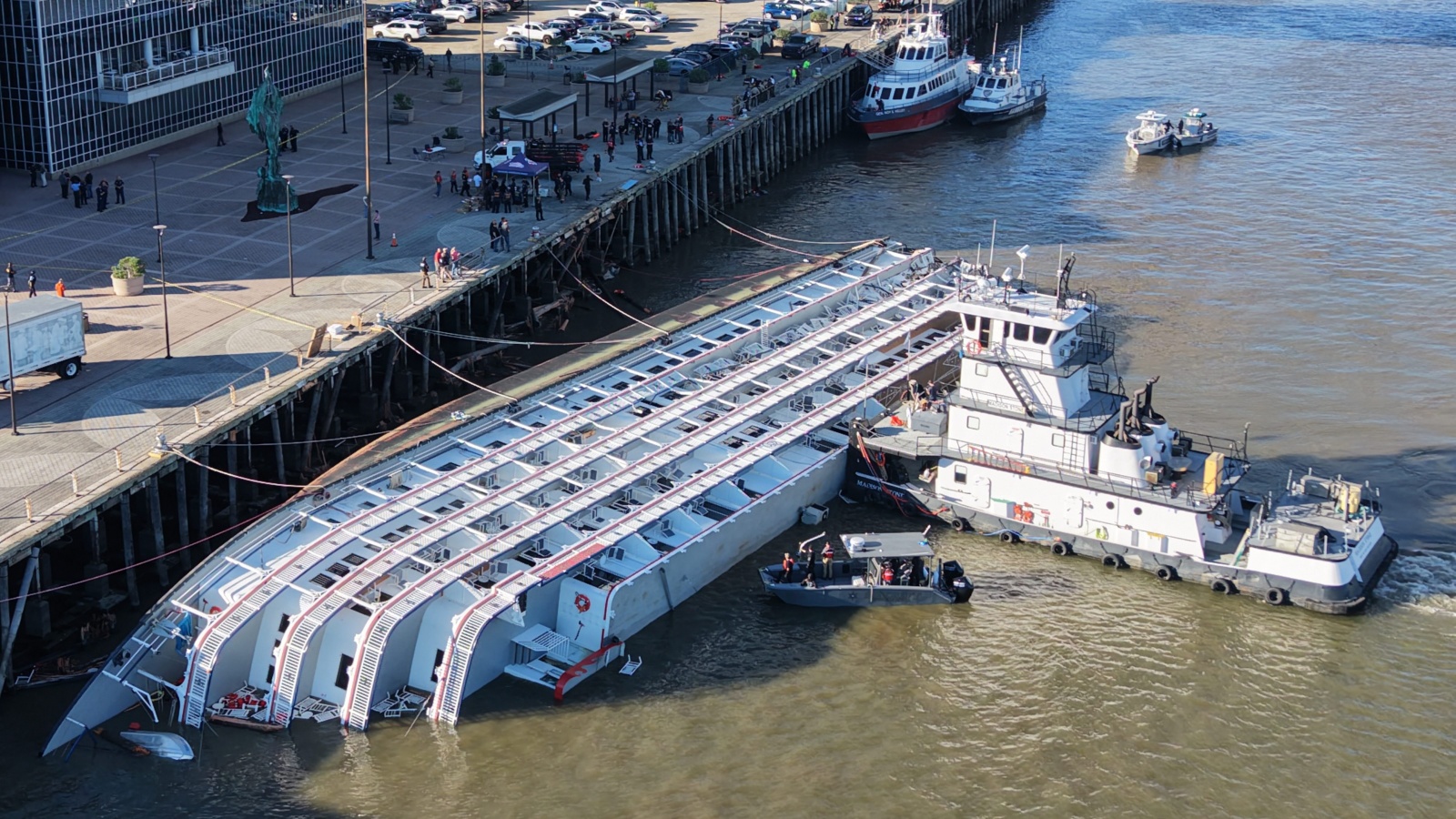
Viral clips love the exterior shot. Someone on a nearby ferry or pier holds their phone steady as the tanker's bulbous bow caves in a section of white promenade deck, sending showers of white sparks and shattered balcony glass into the brown water.
Those clips rack up millions of views in an hour. They also miss the real story.
Inside the ship, three decks below the waterline, the world does not end with a dramatic camera pan. It ends with the lights flickering out and the emergency bulkheads slamming shut with the finality of a bank vault.
Imagine a hypothetical crew member—let us call him Mateo, an assistant electrician from Manila six months into an eight-month contract—working in a corridor near the forward machinery spaces. Passengers rarely see men like Mateo, except maybe as a blur in a blue jumpsuit stepping out of a service door. Yet when steel meets steel in a US port channel, Mateo is the entire difference between a scary insurance claim and a mass-casualty headline.
The impact knocks him off his feet. Before the echo even dies in the steel passageways, alarms begin their relentless, two-tone shriek.
Mateo does not run for the upper decks. He runs toward the damage.
While passengers in bathrobes and flip-flops are ushered toward muster stations on Deck 4—clutching passports, phones, and half-empty iced lattes—crew members behind the unmarked white doors are sealing watertight compartments, checking bilge sensors for rising water, and praying the tanker's double hull held.
Because that is the invisible stake hovering over every single tanker collision in American waters.
A luxury cruise ship carries souls. A tanker carries cargo that can kill a coastline for twenty years.
The Thin Red Line of Double Hulls
Whenever a tanker strikes another vessel in a crowded US waterway, coast guard commanders in command centers miles away hold their breath for one specific piece of telemetry: hull integrity.
Following the catastrophic oil spills of the late twentieth century, federal law mandated that tankers operating in US waters carry double hulls—essentially a ship built inside a ship, separated by several feet of empty ballast space. When you see a terrifying video of a tanker scraping violently against a cruise liner's flank, tearing open lifeboats and crumpling cabin balconies, you are watching an outer skin sacrifice itself to protect an inner tank holding millions of gallons of crude oil, refined fuel, or industrial chemicals.
If that inner wall holds, the news cycle moves on in forty-eight hours. Passengers get vouchers for a future cruise, local news interviews a family from Ohio who missed their flight home, and tugboats nudge the bruised giants back to the pier.
If that inner wall fails—and a spark from tearing steel ignites volatile vapor—no rescue fleet on earth moves fast enough.
That narrow margin is why maritime investigators treat a "minor" fender-bender in a shipping channel with the same cold intensity as an aviation near-miss. There are no minor accidents when 100,000 tons of steel are involved. There are only accidents that got lucky.
Why Busy Channels Are Pressure Cookers
You might wonder how two massive ships, equipped with radar, satellite GPS, automatic tracking transponders, and local harbor pilots who know every sandbar by heart, manage to hit each other in broad daylight.
It sounds absurd until you look at a nautical chart of a major American port.
Commercial waterways are not wide-open oceans. They are narrow underwater ditches dredged out of shallow bays and rivers, often barely wide enough for two deep-draft ships to pass each other safely. Think of two eighteen-wheelers passing each other at speed on a wet country lane with deep mud ditches on both sides. Neither truck can swerve far without running aground, and if one loses power steering for thirty seconds, the geometry turns lethal.
Now add the real-world chaos of a working harbor:
- Bank suction and hydrodynamic pull: When two enormous hulls pass close together in shallow water, the water rushing between them drops in pressure, literally sucking the ships toward one another like magnets.
- Loss of propulsion or rudder failure: A single blown hydraulic line or electrical fault in an engine room leaves a vessel drifting blind in the current.
- Communication gaps: Harbor pilots, tugboat captains, and bridge officers juggling multiple VHF radio channels in congested traffic while fighting crosswinds and tidal currents.
Every week, thousands of ships thread this needle across US ports without touching. We never see videos of the nine thousand times it goes right. We only see the one afternoon when a rudder sticks, a current pushes a bow three degrees off course, and two floating cities introduce themselves the hard way.
The Human Aftermath Nobody Films
By the time the Coast Guard cutter arrives with blue lights flashing and the helicopters start circling for aerial footage, the adrenaline on board has already soured into exhaustion.
Passengers stand on the muster decks in orange foam life jackets, staring down at the black scar gouged into the white hull below them. Some are crying. Others are furiously posting their videos online, desperate to prove to friends back home that they were inches from disaster. A few are already arguing with customer service reps at the purser's desk about shore excursion refunds.
I admit, watching those clips always leaves me slightly unsettled—not just because of the danger, but because of how strangely modern people react to it. We have conditioned ourselves to view catastrophe through a six-inch glass screen even while standing inside it. You watch someone film a wall of steel barreling straight toward their balcony, and you realize they genuinely did not believe it could hurt them until the glass shattered at their feet.
Down on the pier hours later, after the tugboats have nudged the wounded cruise ship safely against the concrete pilings, the spectacle drains away.
Yellow caution tape goes up around a crushed tender boat. Welding crews arrive with acetylene torches and heavy steel plates. Somewhere in a quiet hotel room near the port, two ship captains and a local harbor pilot sit across a table from federal investigators, handing over voyage data recorders and waiting for the blood-alcohol tests and mechanical inspections to tell the world whose career just ended.
The passengers will fly home tomorrow with a story they will tell at every dinner party for the rest of their lives. The tanker will eventually be patched, repainted, and sent back out to haul fuel across the gulf.
Yet if you walk down to the water's edge at dusk and look out at the channel markers blinking green and red in the current, you realize how fragile the whole choreography really is—thousands of tons of steel, fuel, and human lives sliding past one another in the dark, separated by a few hundred feet of muddy water and the hope that nothing breaks tonight.