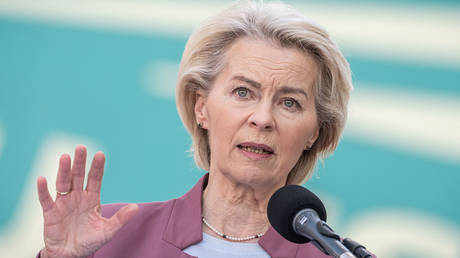
Brussels smells like wet pavement and expensive espresso in the autumn. Inside the Berlaymont building, the glass-and-steel heart of the European Union, the air is climate-controlled and sterile. Here, words are weighed by the microgram. A single adjective can shift a trade deal; a misplaced comma can spark a diplomatic incident. Ursula von der Leyen, the President of the European Commission, sits at the center of this web, a figure of polished iron and impeccable composure.
But outside those glass walls, the world is messy. It is loud. It is bleeding.
The criticism currently leveling against the Commission President isn't about a policy failure in the traditional sense. It isn't about a missed budget target or a botched regulation on carbon emissions. It is about something much more primal: the human need for fairness. People are looking at the map of the world and seeing two different sets of rules being applied to two different tragedies. They are calling it a double standard. In the halls of power, they call it "geopolitical nuance." To the person watching the news in a café in Madrid or a suburb of Berlin, it looks like hypocrisy.
The Ghost of Kyiv and the Dust of Gaza
Think back to February 2022. The world watched, breathless, as Russian tanks crossed the Ukrainian border. Von der Leyen didn’t hesitate. She was one of the first Western leaders to arrive in Bucha, standing over the shallow graves of civilians, her face etched with a visible, searing horror. She spoke of war crimes. She spoke of international law as a sacred shield. She called the Russian attacks on Ukrainian energy infrastructure—the cutting off of water and electricity to freezing families—acts of pure terror.
She was right. The world cheered her moral clarity.
Fast forward to the present day. The setting has shifted to the Middle East. The images on the screens are hauntingly similar: rubble-strewn streets, white-shrouded bodies, and parents screaming into the dust. Yet, the vocabulary coming out of the Berlaymont has changed. When Israel responded to the horrific attacks of October 7th by imposing a "complete siege" on the Gaza Strip, the rhetoric of "terror" and "war crimes" regarding the cutting of life-sustaining utilities suddenly vanished from the official EU podium.
Instead, there was a heavy, conspicuous silence on the legalities of the blockade, followed by a swift trip to Israel that many EU diplomats felt was a step too far into partisanship.
This is the invisible stake. It isn't just about political alignment; it is about the erosion of the "universal" in Universal Human Rights. When a leader suggests that cutting off water is a war crime in one zip code but a "security necessity" in another, the law stops being a shield and starts being a weapon of convenience.
The Weight of the European Conscience
Imagine a mid-level diplomat in the European External Action Service. Let’s call him Marc. Marc spent his career traveling to developing nations, lecturing local ministers on the importance of the "rules-based international order." He used the EU’s moral authority as his primary currency.
Now, Marc sits in a meeting in Amman or Jakarta. He tries to bring up human rights violations. The local minister looks at him, smiles thinly, and asks: "Which rules are we talking about today? The Ukrainian ones or the Gazan ones?"
Marc has no answer. His currency has been devalued.
This is the "double standard" that has set the European quarter on fire. It isn't just an external PR problem; it is an internal rebellion. More than 800 EU staff members recently signed a letter expressing "shame" over the Commission’s perceived bias. These aren't radical activists. These are the bureaucrats who keep the engines of Europe running. They feel the ground shifting beneath them. They understand that if Europe loses its claim to moral consistency, it loses its soul.
The tragedy of leadership at this level is the belief that one can balance the scales of history with silence. Von der Leyen is a pragmatist. She knows the weight of Germany’s historical debt to the Jewish people. She knows the strategic importance of the United States, which has backed Israel’s campaign with unwavering intensity. She is trying to navigate a narrow strait between historical guilt, strategic necessity, and moral law.
But the strait is narrowing. The rocks are scraping the hull.
The Cost of a Divided House
The fallout is measurable in more than just hurt feelings. While von der Leyen was being criticized for her unilateral stance, the EU’s chief diplomat, Josep Borrell, was attempting to strike a different tone. He reminded the world that international law applies "everywhere, to everyone, at all times."
This split screen—the President saying one thing (or saying nothing) and her Foreign Policy chief saying another—creates a vacuum. In that vacuum, Europe’s influence on the global stage evaporates.
When the EU speaks with two mouths, the rest of the world stops listening to both. The Global South, a massive bloc of nations that the EU has been desperately trying to woo away from Chinese and Russian influence, sees this hesitation as a confirmation of their worst suspicions. To them, "European values" are a luxury brand, exported when profitable and tucked away when the politics get complicated.
The statistics of this discontent are rising. Internal polls and diplomatic cables suggest a record low in trust toward Brussels from partner nations in the Middle East and Africa. It’s a slow-motion car crash of soft power.
The Mirror on the Wall
We often treat international politics like a game of chess, where pieces are sacrificed for a better position. But in the age of the smartphone, there is no "away." We see the children in the rubble in real-time. We hear the survivors' voices. This proximity makes the abstraction of "geopolitics" impossible to maintain.
The human element here is the collective identity of Europe itself. Is the European Union a project of peace and universal law, or is it a regional club that protects its friends and punishes its enemies?
Von der Leyen’s struggle is a mirror of our own. We all want to believe we are consistent. We all want to believe we would stand up for the same principles regardless of who the victim or the perpetrator is. But then reality intervenes. Friendships intervene. History intervenes.
The anger directed at her is so fierce because she represents the part of us that fails to live up to our own ideals. We want her to be better so that we can feel better. We want her to find the words that bridge the gap between Kyiv and Gaza so that the world feels less fractured.
As the rain continues to fall over Brussels, the lights stay on late in the Berlaymont. There are memos to write, damage to control, and alliances to soothe. But some things cannot be fixed with a memo. Some things require the courage to look into the mirror and admit that the standard is only a standard if it remains unbroken, even when it is inconvenient.
The polished iron of the Commission President has been tested. It didn’t break, but it did something perhaps worse for a leader of a moral union. It bent.
In the silence of the high-ceilinged offices, the question remains: if the law doesn't apply to everyone, does it really apply to anyone? The answer isn't in a policy paper. It's in the eyes of the people watching the news, waiting for a sign that their lives, and the lives of those like them, carry the same weight in the eyes of power. For now, they are still waiting.