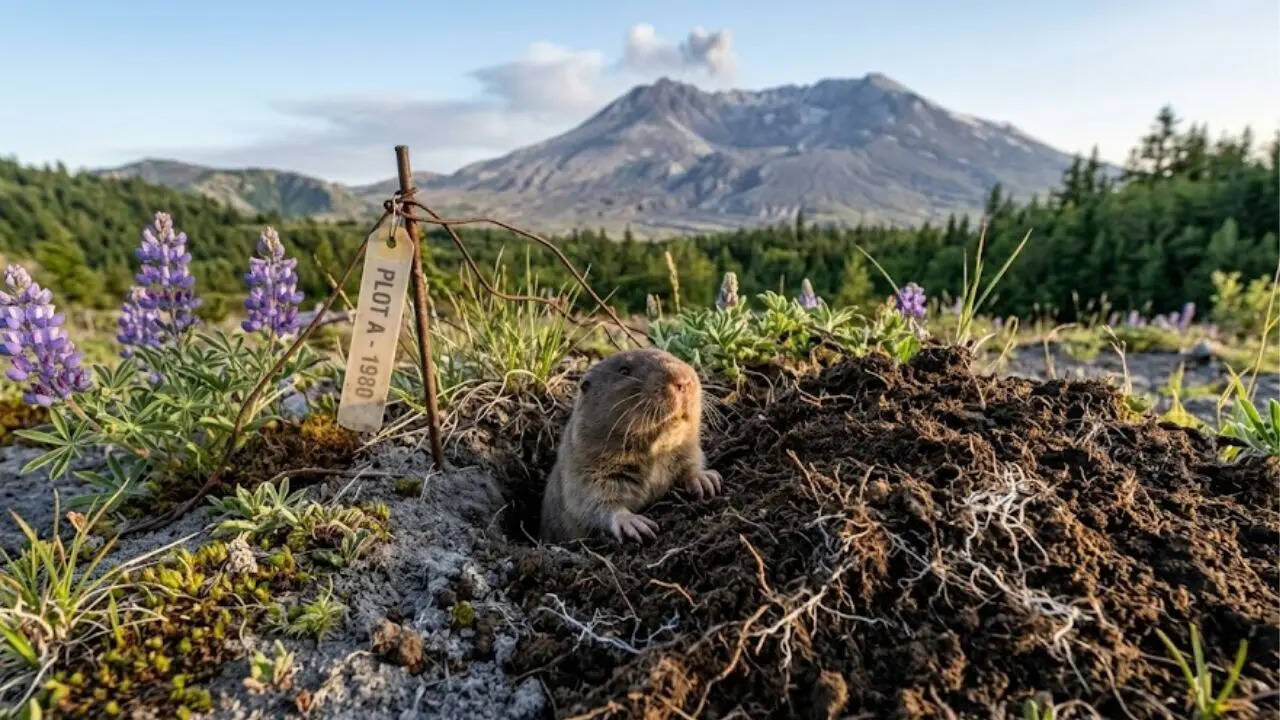
Ecologists love a mascot. Give them a furry face and a story about "nature's resilience," and they’ll peddle a narrative that feels like a Saturday morning cartoon. The latest darling? The Northern Pocket Gopher. For over four decades, we’ve been fed the same tired script: after Mount St. Helens blew its top in 1980, the gophers were the tiny, subterranean engineers that "saved" the blast zone.
They dug. They moved dirt. They brought seeds to the surface. Success, right?
Wrong.
The obsession with these rodents isn't just sentimental; it’s scientifically narrow-minded. By hyper-focusing on the "miracle" of the gopher, we are ignoring the brutal reality of volcanic succession and the terrifyingly slow pace of true ecological recovery. If you think the mountain is "back," you aren't looking at the data. You’re looking at a PR campaign for a rodent.
The Soil Disturbance Fallacy
The standard argument, popularized by researchers like Charlie Crisafulli, suggests that gophers acted as biological catalysts. By churning up the volcanic tephra—the sterile, gray ash—they supposedly mixed it with the "legacy" soil underneath, jumpstarting nitrogen cycles.
Let’s look at the actual physics of a blast zone.
The 1980 eruption didn't just dump some dust. It created a pyroclastic flow that sterilized the earth. In the most impacted areas, the "pumice plain," the heat reached 1,300 degrees Fahrenheit. Nothing survived. The gophers that "transformed" the land were largely those on the fringes or in areas with deep snowpack protection.
The idea that a few thousand rodents digging holes can offset millions of tons of sterile debris is a matter of scale that most people fail to grasp. We are talking about an area of 230 square miles. To credit gophers with the "transformation" of this landscape is like crediting a single ant with the construction of the Great Pyramids. It’s a cute story, but it’s mathematically insignificant when compared to the real driver of recovery: anemochory.
Anemochory—the wind-borne dispersal of seeds—did 99% of the heavy lifting. Lupine seeds didn't need a gopher to find a home. They needed a breeze and a crack in the rocks. The gophers were just the beneficiaries of a process that was happening with or without them.
The Nitrogen Fixation Obsession
If you ask a traditional ecologist why the gophers matter, they’ll point to the Lupinus lepidus (prairie lupine). They claim gophers created the perfect seedbeds for these nitrogen-fixers.
Here is the truth nobody admits: The lupines were a colonizing force that functioned perfectly well in raw volcanic ash. Nitrogen fixation is a chemical process handled by bacteria (Rhizobium) living in the root nodules of the plants. The gopher didn't invent the bacteria. It didn't synthesize the nitrogen. At best, it provided a slightly softer bed of dirt.
We have built a cult of personality around the gopher because it’s easier to explain to a donor or a taxpayer than the complex, invisible microbial chemistry actually happening in the soil. We prefer a hero with whiskers over a hero that is a microscopic prokaryote.
The "43 Years" Trap
The competitor headline screams about transformation over 43 years. This is a dangerous misunderstanding of geological and ecological time.
In the world of volcanic recovery, 43 years is a blink. It’s a heartbeat. To suggest the land is "transformed" implies a return to some state of equilibrium. It hasn't. The blast zone is still a fragile, highly unstable environment.
By celebrating the "success" of the gopher, we are encouraging a "job well done" mentality that leads to reduced funding for long-term monitoring. We see some green on a satellite image and assume the wound has healed.
I’ve seen this before in corporate environmental consulting. A company spills chemicals, plants some fast-growing grass, and calls it "remediation." It’s a cosmetic fix. Mount St. Helens is currently in the middle of a massive, messy, and often failing experiment in primary succession. Some areas are thriving; others are stagnant. The gophers haven't changed the fundamental fact that it will take centuries, not decades, to see a climax forest return to the pumice plain.
Stop Humanizing the Rodent
The "People Also Ask" section of your brain probably wants to know: Are gophers good for the environment?
The honest answer? Nature doesn't care about "good."
Gophers are destructive. They destroy root systems. They contribute to erosion on unstable slopes. In a stable forest, they are a nuisance. In a post-eruptive wasteland, we label them "pioneers." This is a classic case of narrative framing. We project our own values onto a blind rodent that is simply trying not to starve in a pile of ash.
The gopher didn't "decide" to help the mountain. It survived by sheer luck and continued its instinctual behavior. If we want to actually learn from Mount St. Helens, we need to stop looking for heroes and start looking at the harsh, unfeeling mechanics of survival.
The Data the "Feel-Good" Articles Miss
Let's talk about the biological legacy.
The only reason anything grew back quickly in certain spots was not "transformation" by gophers, but the presence of biological legacies—living organisms, seeds, or organic matter that survived the blast. This is the "hidden wealth" of the ecosystem.
- Refugia: Small pockets of life protected by topography.
- Snowpack: The literal shield that saved the gophers in the first place.
- Subterranean Dormancy: Fungi and bacteria that were already there.
The gophers are a byproduct of survival, not the cause of it. If the eruption had happened in late summer instead of May, when the snow was gone, the gophers would have been vaporized. Would the mountain have failed to recover? Of course not. It would have just taken a different, perhaps slower, path.
The Unconventional Advice for Future Disasters
We are obsessed with "intervening" or "finding the helper." When a wildfire or a volcano strikes, our first instinct is to look for the success story.
Instead, we should be doing the following:
- Abandon the "Recovery" Timeline: Stop measuring success in decades. If you’re not thinking in centuries, you’re not doing ecology; you’re doing gardening.
- Focus on the Microbes, Not the Mammals: The real transformation is happening at the molecular level. Spend the research budget on soil genomics, not tracking gopher tunnels.
- Accept the Barrenness: There is a profound scientific value in a "barren" landscape. By rushing to celebrate the greening of the mountain, we ignore the unique lessons that only a sterile environment can teach us about how life originates.
The gopher story is a security blanket. It makes us feel like the world is resilient and that even after a cataclysm, a small friend will come along to fix it.
The reality is much colder. The mountain is recovering through a brutal, competitive, and highly inefficient process of trial and error. The gophers are just along for the ride, digging through the debris of a world they don't understand, while we write fables about their brilliance.
Stop looking for the miracle. Start looking at the physics.
The mountain doesn't need a hero. It needs time.