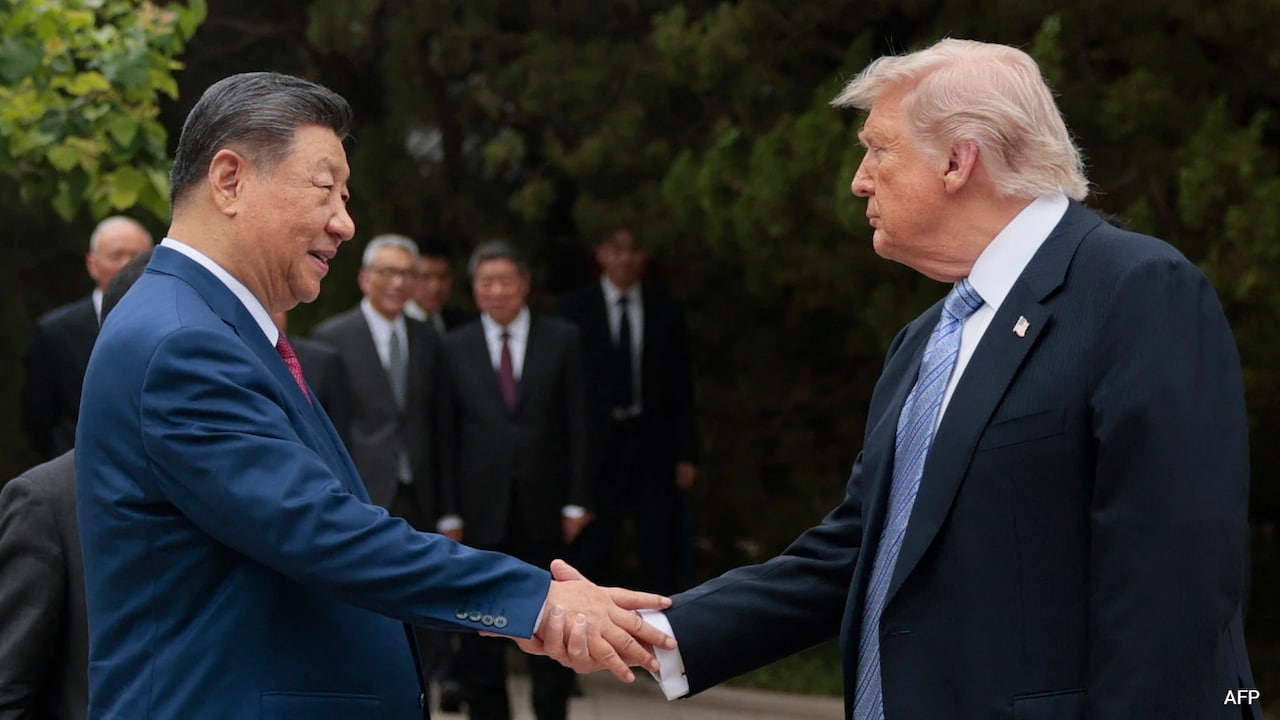
The press corps loves a good showdown. Every time Washington and Beijing exchange tariff threats or trade barbs over silicon wafers, the headlines declare a new geopolitical ice age. But underneath the theatrical friction between Donald Trump and Xi Jinping lies a quieter, more cynical reality. Neither superpower wants a rupture. What they want is a managed standoff, a carefully calibrated rivalry that satisfies domestic hardliners while preserving the transactional trade flows both economies desperately require.
Look past the diplomatic communiques regarding artificial intelligence guardrails, supply chain decoupling, and unspoken friction over Tehran. The structural drivers of this relationship are far more complicated than a simple clash of ideologies. We are watching two systemic heavyweights negotiate a permanent partition of global influence, using export controls and naval patrols as bargaining chips.
When Washington slaps restrictions on advanced logic chips destined for Chinese data centers, national security officials frame the move as an existential defense of American technical dominance. Yet, semiconductor manufacturers in Silicon Valley find ways to route less advanced silicon through third-party intermediaries, while Beijing quietly subsidizes domestic legacy chip foundries to insulate its industrial base. Both sides know the rules of the game. Washington gets to claim it locked the door, and Beijing gets to pick the lock at its own pace.
The Silicon Wall and Its Discontents
Artificial intelligence sits at the very heart of this friction. Leadership in neural networks and automated systems is not just another industrial sector; it is the infrastructure of future power. When the White House restricts high-end GPU shipments, the strategic calculation is simple: starve the competitor of compute capacity.
The flaw in this strategy is historical arrogance. Trade embargoes rarely kill an industry; they merely force domestic substitution. Chinese tech giants have spent billions reorienting their engineering talent toward algorithmic efficiency, squeezing better performance out of restricted hardware architectures. Meanwhile, American chip designers watch billions in high-margin market share evaporate into the accounts of foreign competitors who gladly step into the vacuum left by export bans.
Neither side can afford a total technological divorce. American consumer electronics rely on complex assembly ecosystems anchored in Guangdong province, while Chinese industrial automation depends on Western software frameworks and specialized machinery. The rhetoric of self-reliance is a political necessity, but the operational reality remains an awkward, deeply entangled marriage of convenience.
The Middle East Proxy Trap
Trade and technology flashpoints are only the visible surface. Beneath them runs the murky current of geopolitical alignment, highlighted by Beijing's diplomatic and economic lifeline to Tehran.
For decades, American foreign policy treated Middle Eastern energy corridors as an exclusive security domain. When Beijing brokered a surprise diplomatic détente between Saudi Arabia and Iran, it signaled a fundamental shift. China no longer views the region through the lens of military intervention; it views it as a service station for resource security. By purchasing sanctioned Iranian crude at a steep discount, Beijing keeps its industrial engine humming while shifting the geopolitical risk burden entirely onto Washington.
American strategists find themselves trapped in a frustrating paradox. To secure global shipping lanes in the Red Sea and the Persian Gulf, the United States spends billions deploying carrier strike groups, effectively subsidizing global trade security for every nation on Earth—including China. Beijing takes the discounted oil, secures its maritime supply routes without firing a shot, and lets Washington play world policeman.
Trump understands the transactional nature of this dynamic better than most traditional diplomats. His foreign policy has never been about ideological conversion; it is about leverage, tariffs, and extraction. If Beijing wants access to the American consumer market, it has to offer concessions somewhere else, whether through agricultural purchases or diplomatic pressure on regional proxies.
The Illusion of Decoupling
Talk to supply chain executives who actually have to move freight across oceans, and they will tell you that total economic decoupling is a corporate fantasy. Corporations spent thirty years optimizing for cost efficiency, building hyper-lean logistics networks that cannot be unraveled by executive order or congressional fiat.
When tariffs go up, companies simply shift final assembly points to Vietnam, Mexico, or India. The underlying components often originate in the same Chinese industrial parks, merely stamped with a new country of origin before clearing customs. It is a massive administrative theater that enriches customs brokers and logistics consultants while adding friction and cost to everyday goods.
This brings us back to the core paradox of the relationship. Trump and Xi are locked in a high-stakes poker game where both players know the other's hand. They need external enemies to justify domestic consolidation of power. In Washington, getting tough on Beijing is one of the few remaining bipartisan consensus issues in a deeply polarized capital. In Beijing, pointing to American containment efforts gives the party apparatus a convenient scapegoat for domestic economic slowdowns and youth unemployment.
The friction is real, but the objectives are controlled. Neither leader wants an actual kinetic conflict over Taiwan or a total financial embargo that would trigger a global depression. Instead, they have settled into a brutal, enduring rhythm of managed hostility. They will posture for the cameras, slap tariffs on steel and solar panels, restrict the flow of advanced microelectronics, and then quietly send trade delegations to negotiate the fine print behind closed doors.
The real story is not that tensions are flaring. The real story is how both superpowers have weaponized that friction to maintain control at home while preserving the fragile, indispensable trade balance that holds the global economy together.