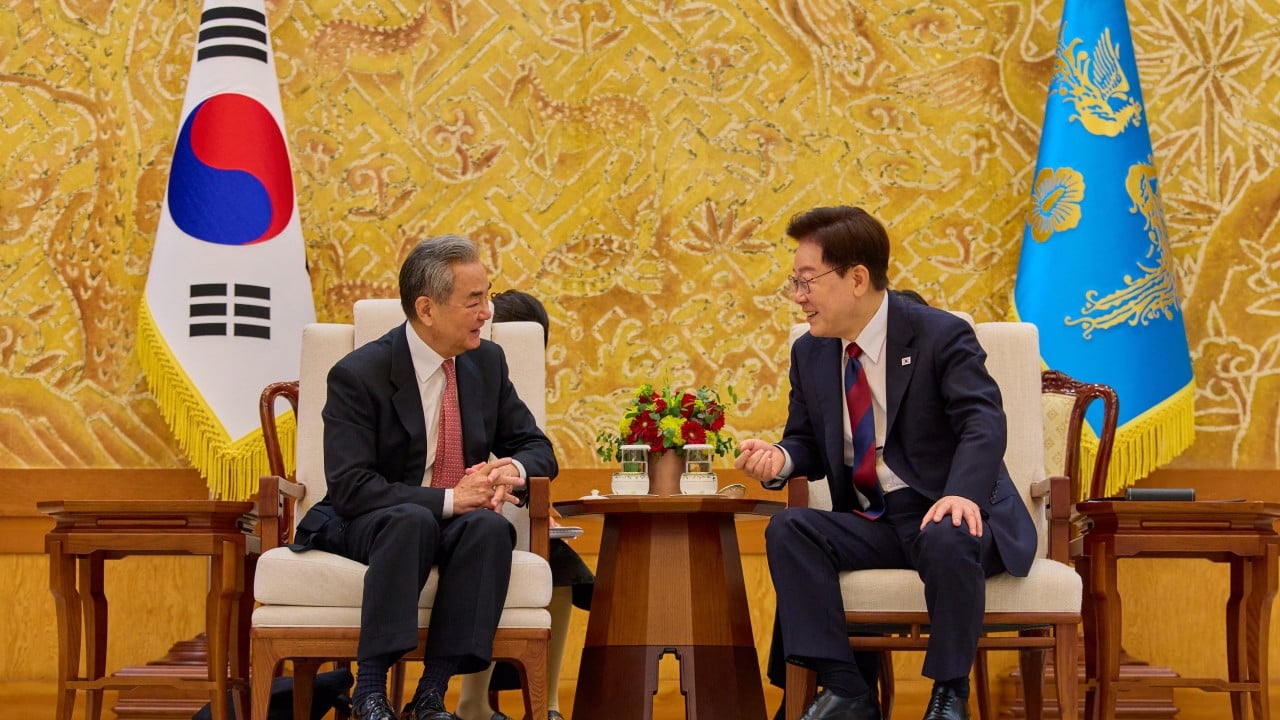
Foreign Minister Wang Yi’s recent arrival in Seoul signifies far more than standard diplomatic theater. While official channels paint a picture of restored harmony, the subtext of this visit reveals a frantic realignment triggered by Washington’s erratic behavior. As President Donald Trump forces a substantial reduction in joint military exercises and pressures the South Korean administration over massive, unfulfilled investment pledges, the traditional security architecture of East Asia is fracturing. Wang’s presence in the South Korean capital is the first tangible sign that Seoul is actively hedging against the long-term reliability of the United States.
For decades, the alliance between Seoul and Washington functioned as the immovable object of regional stability. That certainty has evaporated. The sudden order from the White House to scale back military drills, reportedly linked to American demands for financial support in the ongoing conflict in Iran, has blindsided the South Korean government. When the security guarantor begins to act like a transactional creditor, the partner under the umbrella looks for cover. Beijing has spent years waiting for this exact moment of American overreach.
The diplomatic rhetoric coming out of the Blue House this week suggests a complete recovery of relations, a phrase designed to soothe domestic anxieties while signaling independence to the outside world. Yet, beneath the polished statements, the reality is a cold, calculated move toward strategic autonomy. President Lee Jae Myung is playing a high-stakes game. By inviting Wang, the South Korean leadership is effectively telling Washington that their commitment to the alliance is not an unconditional check. They are exploring a third path, one where economic integration with China provides a buffer against the volatility of American politics.
Beijing, for its part, is not interested in mere platitudes. Wang’s agenda is sharp. The push to complete second-stage talks for a free trade agreement is the primary objective. By pulling Seoul closer into its economic orbit, China intends to diminish the leverage the United States holds through its military presence. This is not about friendship; it is about infrastructure. If China can embed itself into South Korea’s critical supply chains, the prospect of a future American administration demanding a hard break becomes significantly more difficult for Seoul to execute without committing economic suicide.
The underlying tension remains, despite the warmth of the current meetings. Deep-seated grievances, such as the decade-long, often informal, restrictions on South Korean cultural exports to China, persist. While Beijing may offer a temporary easing of these barriers to sweeten the diplomatic deal, the underlying power dynamic is uneven. China has demonstrated repeatedly that it is willing to weaponize trade and cultural access whenever political interests diverge. Relying on such a partner is a gamble, yet the current leadership in Seoul clearly views it as a safer bet than the uncertainty of a mercurial Washington.
Consider the hypothetical scenario where the United States demands an immediate withdrawal of semiconductor technology access from Chinese partners as a condition for continued military protection. In the past, Seoul would have had little choice but to comply. Today, the calculus has shifted. The South Korean economy is increasingly dependent on the Chinese consumer market, and the current administration is testing the waters to see if it can withstand American pressure by anchoring its security and economic policies to a regional balance.
The irony is that this movement toward Beijing is a reaction to the vacuum left by the current occupant of the White House. By demanding that South Korea serve as a piggy bank for other global military adventures, Washington has inadvertently incentivized Seoul to seek a more independent, regionally focused policy. It is a classic geopolitical miscalculation. A policy intended to project strength and efficiency has instead fractured the foundational trust required to maintain a front against competing regional powers.
As these talks conclude, the focus will turn to the upcoming Asia-Pacific Economic Cooperation summit in Shenzhen. This gathering will serve as the true test of the newfound rapprochement. If the planned summit between President Lee and President Xi Jinping produces concrete movement on stalled economic sectors and a formal easing of the cultural embargoes, the shift will be irreversible. The era of the undisputed American-led security bloc in East Asia is ending. In its place, a complex, fragile, and intensely competitive system is emerging, one where the participants prioritize immediate survival over long-term alignment. The shift is already underway, and the architects of the old order appear entirely unable to halt the momentum.