Silence on an island like Île aux Cochons is not the absence of sound. It is an overwhelming absence.
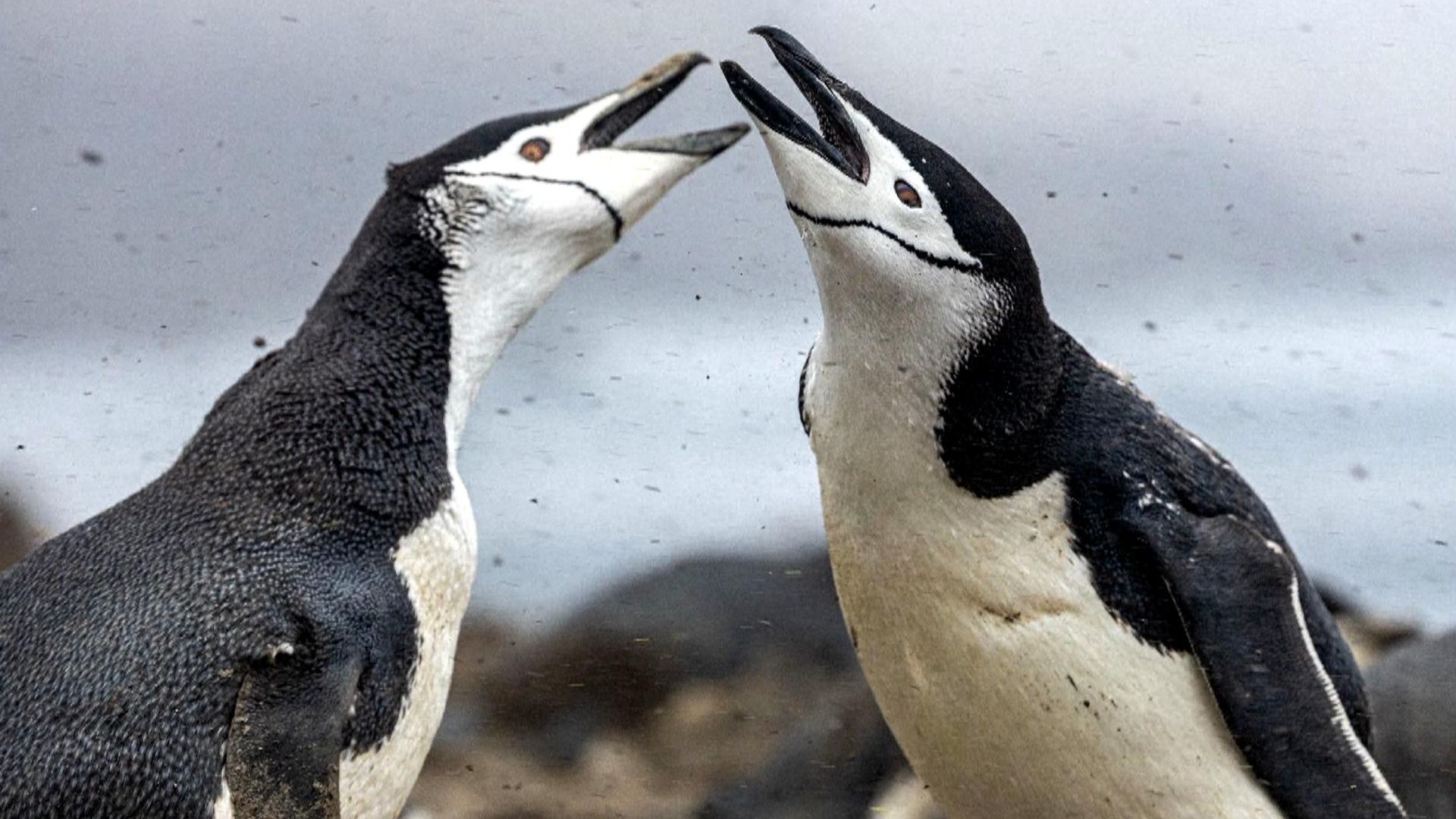
To stand on the wind-scoured slopes of the Crozet Archipelago in the southern Indian Ocean years ago was to stand inside a living engine. Half a million pairs of king penguins crowded shoulder to shoulder across the coastal plain, a surging, breathing checkerboard of black, white, and golden-orange feathers. The vocalizations rose in a deafening, oceanic roar—a chaotic symphony of trumpeting calls, defensive snaps, and the high-pitched peeps of hungry chicks vibrating through the damp air. The smell was unmistakable, a potent atmospheric cocktail of guano, krill, and wet feathers carried miles out to sea by the howling westerly winds.
Today, that roar has dropped to a whisper.
According to long-term monitoring and satellite analyses, the massive king penguin colony on Île aux Cochons has shrunk by an astonishing two-thirds in just fourteen years. Hundreds of thousands of birds have simply vanished. No mass graves. No dramatic Hollywood reckoning. Just a slow, creeping evacuation of life from a place that once seemed invincible.
We tend to view the earth as a series of infinite margins. We imagine that wild places possess a resilient bounce, an eternal elasticity that absorbs whatever pressure we apply. But nature does not always announce its unraveling with a sudden crash. Sometimes, it happens in the dark, out of sight, while the rest of the world argues over headlines that matter very little in the grand ledger of survival.
Consider what happens next when an ocean ecosystem wobbles.
The Calculus of Distance
To understand why the kings are leaving, you have to look at the food.
A king penguin is not a casual hunter. It is a missile of muscle and blubber, built to dive a thousand feet beneath the surface of the freezing ocean in total darkness, hunting for lanternfish and squid. Raising a single chick requires an extraordinary caloric investment. Parents must shuttle back and forth between the nesting grounds and the Polar Front—an ocean boundary where nutrient-rich cold waters collide with warmer subantarctic currents, creating an explosion of marine life.
For generations, the geography of Île aux Cochons offered a luxury of proximity. The Polar Front was close enough for parents to make the round trip, fill their bellies, and return before their chicks starved in the rookery.
Then the ocean shifted.
Climate change is not a conceptual weather report. It is a thermal expansion. As the waters of the Southern Ocean warm, the Polar Front drifts further south, retreating toward the frozen rim of Antarctica. For a human, moving the grocery store ten miles down the road is an inconvenience solved by a car. For a king penguin, pushing that foraging boundary outward by tens or even hundreds of miles turns a routine commuting trip into an impossible marathon.
Imagine swimming through liquid ice, day after day, burning more calories than you catch, only to return to a starving chick that has already given up the wait.
The math becomes brutal. When the energetic cost of foraging exceeds the caloric return, a colony stops reproducing. Adults abandon their eggs. Chicks perish in the mud. And the colony begins to implode from the inside out, hollowed out by invisible thermal boundaries.
The Mystery of the Missing Millions
For years, scientists were baffled by the rapid decline.
When researchers first published data showing the catastrophic drop at Île aux Cochons—noting that the population had plummeted from roughly 500,000 breeding pairs down to fewer than 60,000—speculation ran wild. Was it disease? Did avian cholera sweep through the packed rookery like a medieval plague? Were invasive predators like feral cats or rats overwhelming the chicks?
To test these hypotheses, let us use a hypothetical scenario to ground the investigative process. Imagine a forensics team arriving at an abandoned mining town. The houses are intact, the furniture is in place, but the people are gone. You look for signs of violence. You check for structural fire, for poison in the well, for an invading army. When you find none of those things, you realize the truth is far more terrifying: the well simply dried up.
Sub-Antarctic islands are remote, hostile, and notoriously difficult to study. Researchers relied on a combination of historical expedition counts, high-resolution aerial photography, and satellite imagery spanning decades to piece together the puzzle. What they found ruled out localized disease as the sole culprit. The decline was too synchronized with broader oceanic shifts.
The oceanographic conditions that feed the southern Indian Ocean had changed. El Niño events and long-term climatic oscillations altered the currents, pushing the prey base out of reach. While Île aux Cochons suffered the most dramatic collapse, other colonies in the region began showing stress. The giant engine was sputtering.
The Warning Light on the Dashboard
We live in an era that demands immediate gratification and visible proof. If a building collapses, we see the dust. If a forest burns, we see the smoke.
Yet the most profound ecological crises of our time are happening out in the deep blue, where the casualties sink quietly beneath the waves. Penguins are sentinel species. They are the proverbial canary in the coal mine, or in this case, the seabird on the basalt rock. They integrate the health of the entire marine food web into their physical bodies. When they starve, it means the invisible machinery of the ocean is breaking down.
The shrinkage of the Île aux Cochons colony is not just a localized tragedy for bird lovers. It is a flashing red light on the planetary dashboard. It tells us that the invisible structures holding up the richest marine ecosystems on Earth are buckling under anthropogenic pressure.
There is a strange comfort in believing that Antarctica and its surrounding subantarctic islands are too big, too cold, and too remote for human hands to touch. We map our cities and our highways, but we treat the oceans as a vast blue backdrop, a cinematic setting that requires no maintenance.
The king penguins are showing us the cost of that illusion.
The Cost of Silence
Walking away from the history of Île aux Cochons leaves you with a lingering, hollow sensation.
The wind still blows across the subantarctic grass. The waves still crash against the black basalt cliffs. The sky above the southern Indian Ocean remains vast, indifferent, and blindingly clear.
Only the sound is missing.
That massive, roaring heart of the southern seas has slowed down. And the real question we must face is not whether the penguins can adapt to a world we are rapidly rewriting, but whether we have the courage to read the warning before the silence becomes permanent.