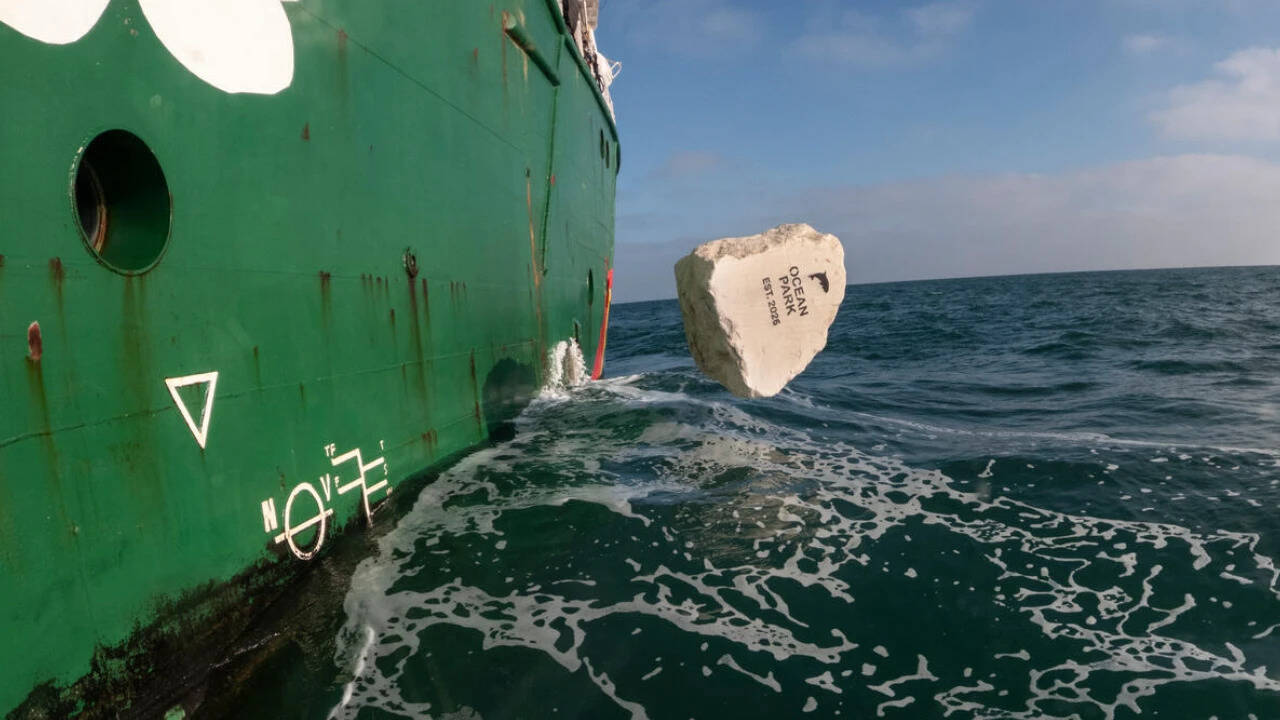
In early 2021, Greenpeace activists aboard the vessel Esperanza dropped 18 granite boulders onto the seabed of the Dogger Bank, directly inside the construction zone of what was slated to become the world’s largest offshore wind farm. The stunt was designed to block industrial bottom-trawling vessels from scraping the ocean floor, yet it immediately threatened to delay and complicate a £12 billion renewable energy project backed by major utilities SSE Renewables, Equinor, and Eni. The incident exposed a bitter, unresolved fault line in modern environmentalism, pitting marine conservationists against clean energy developers over who gets to claim the seabed.
To understand why an environmental group would physically obstruct a flagship green energy project, you have to look below the surface of the North Sea. The Dogger Bank is not just a convenient shallow sandbank for driving steel monopiles into the earth. It is a massive, submerged geological feature covering roughly 17,600 square kilometers, designated as a Special Area of Conservation under European and British law. For years, marine biologists and campaigners argued that the United Kingdom government’s designation of the zone as a Marine Protected Area existed almost entirely on paper.
The Paper Park Paradox
Designating a stretch of ocean as protected sounds like a legislative victory. In practice, without strict enforcement mechanisms, it often amounts to little more than drawing lines on a nautical chart. Following the United Kingdom’s exit from the European Union, Greenpeace argued that Westminster finally possessed the unilateral legal authority to ban destructive fishing practices within its own territorial waters, specifically the Dogger Bank.
Bottom trawling is brutal. Heavy weighted nets dragged across the seafloor indiscriminately scoop up marine life while pulverizing delicate benthic ecosystems, sandbanks, and reefs that serve as critical nursery grounds for fish and foraging sites for seabirds and marine mammals. Greenpeace contended that while the UK government dragged its feet on enacting a formal ban, Dutch, Danish, and British super-trawlers continued to rake the protected zone with impunity.
So the activists took matters into their own hands. Using heavy-lift cranes on the Esperanza, they lowered boulders weighing several tonnes each onto the seabed. The tactic was crude, effective, and legally fraught. By placing physical obstacles on the ocean floor, they created snag hazards capable of tearing apart multimillion-pound trawling gear, effectively turning a portion of the Dogger Bank into a no-go zone for industrial fishing boats.
The problem was geography. The boulders were not dropped in an empty expanse of open water. They landed right in the middle of the Dogger Bank Wind Farm development footprint.
A £12 Billion Collision Course
The Dogger Bank Wind Farm is an engineering marvel of staggering proportions. Planned in three massive phases—Dogger Bank A, B, and C—the project was designed to generate 3.6 gigawatts of electricity, enough to power roughly six million British homes annually. With a capital expenditure hovering around £12 billion, it represented the crown jewel of the UK’s net-zero strategy and a massive bet on offshore wind economics.
Offshore construction operates on razor-thin weather windows and unforgiving engineering tolerances. When you are installing wind turbines taller than the Eiffel Tower in the middle of the North Sea, every square meter of the seabed must be mapped, surveyed, and cleared before a single piece of hardware touches the water.
Unmapped boulders are an offshore engineer's nightmare.
During the installation of subsea export cables and inter-array cables, specialized cable-laying vessels tow heavy plows or trenching machines along the seabed to bury high-voltage lines safely beneath the shifting sands. If a trenching plow strikes an undocumented multi-tonne granite boulder, the resulting damage can snap cables, wreck hydraulic equipment, and halt operations for months. Vessel day rates in the offshore wind sector routinely run into the hundreds of thousands of pounds. A single unexpected delay cascades through the entire supply chain, jeopardizing turbine installation schedules, grid connection deadlines, and financing covenants.
Even worse, Dogger Bank had already cleared unexploded ordnance from World War II at tremendous expense. Having an environmental activist group deliberately re-contaminate a surveyed construction corridor with unmarked obstructions forced project developers to confront immediate safety and operational risks.
The Marinization of Energy Conflict
The Dogger Bank standoff is not an isolated incident. It is an early symptom of a structural collision that will define energy infrastructure for the next three decades. As nations race to decarbonize, the sheer spatial footprint of renewable energy is colliding with ecological preservation.
Historically, energy extraction was concentrated. A coal mine or an offshore oil rig occupied a relatively compact geographic footprint while delivering immense energy density. Wind and solar power operate on the opposite principle. Because ambient energy flows are diffuse, capturing them at utility scale requires vast amounts of land and sea.
This reality forces a harsh trade-off that many policymakers prefer to ignore:
- Climate mitigation demands the rapid deployment of massive offshore wind arrays, subsea interconnectors, and coastal substations.
- Biodiversity protection requires leaving vast stretches of marine habitat untouched by industrial noise, electromagnetic fields, and seabed disturbance.
When Greenpeace dropped those boulders, they did not oppose the wind farm itself. In fact, the organization publicly stated its support for renewable energy. Yet their action demonstrated a willingness to subordinate the logistical security of a £12 billion clean energy asset to immediate marine habitat enforcement.
From the perspective of the developers—SSE Renewables and Equinor—the move was reckless. They had spent years navigating exhaustive Environmental Impact Assessments, securing marine licenses, and consulting with fisheries and conservation bodies. To them, Greenpeace was bypassing democratic and regulatory processes through vigilante seabed modification, creating maritime navigation hazards that could endanger seafarers and submarine infrastructure alike.
The Regulatory Vacuum
Why did it come to dropping rocks off the back of a ship? The answer lies in the sluggishness of maritime governance.
Marine spatial planning in the North Sea has struggled to keep pace with technological ambition. For decades, the sea was treated as an infinite commons governed by loose agreements between shipping lanes, fishing quotas, and oil and gas leases. When offshore wind arrived at gigawatt scale, it introduced a permanent, industrial landlord to the ocean floor.
Governments quickly auctioned off seabed leases to wind developers, collecting billions in option fees while rushing to meet statutory carbon targets. At the same time, those same governments signed international treaties pledging to protect 30 percent of their oceans by 2030. Nobody adequately reconciled the two agendas.
In the case of Dogger Bank, the UK’s Marine Management Organisation (MMO) was tasked with balancing competing interests while drafting new post-Brexit fisheries bylaws. Bureaucratic timelines move in years. Super-trawlers move in hours. Greenpeace exploited that gap, betting that the public relations spectacle of defending marine life against government inaction would outweigh any backlash from disrupting an offshore wind site.
They also provided the exact coordinates of the boulders to the maritime authorities. That detail mattered. By logging the locations with the UK Hydrographic Office, Greenpeace attempted to shield itself from accusations of creating hidden navigational traps, shifting the burden onto authorities and developers to chart the obstacles and work around them.
Engineering Around Activism
For the consortium building Dogger Bank, the response had to be clinical rather than ideological. Offshore project managers cannot afford to get dragged into a media war with an activist group; their sole mandate is delivering megawatts to the National Grid on time and on budget.
Dealing with seabed obstructions requires a methodical, expensive protocol:
- Geophysical re-surveying: Side-scan sonar and multibeam echosounders must be deployed to verify the exact dimensions, orientation, and settlement of the foreign objects on the seabed.
- Route micro-siting: Engineers evaluate whether cable corridors can be shifted by tens or hundreds of meters to bypass the boulders without infringing on turbine foundation exclusion zones.
- Mechanical clearance: If a boulder sits directly on a critical path that cannot be rerouted, specialized subsea grab vessels must be chartered to lift and relocate the stone—an operation that mirrors the very boulder-clearance campaigns developers already conduct for natural glacial erratics.
The irony was lost on no one in the offshore industry. The North Sea is naturally littered with boulders left behind by retreating glaciers during the last Ice Age. Wind farm developers routinely spend tens of millions of pounds clearing natural boulders from cable routes, often relocating them to designated areas nearby where they actually function as artificial reefs. Greenpeace had essentially imported granite from quarries on land to replicate a geological feature that engineers spend fortunes removing.
Who Owns the Ocean Floor
Beneath the immediate drama of cranes and coastguard warnings lies a fundamental legal question that remains dangerously murky in international maritime law. Who holds liability when an activist group alters the physical geography of a leased seabed?
Under the terms of a Crown Estate seabed lease in the UK, developers are granted exclusive rights to construct and operate wind energy infrastructure within a defined polygon. However, the water column above and the surface of the sea remain subject to the ancient public right of navigation and fishing, unless explicitly restricted by safety zones.
This jurisdictional split creates a massive gray area. A protest vessel can legally sail right over a multi-billion-pound subsea construction zone. Until an activist physically drops an object to the seafloor, enforcement agencies have limited grounds to intervene unless the vessel breaches a tightly defined 500-meter safety zone around an active installation rig.
Once the boulder hits the bottom, jurisdiction shifts from maritime navigation to marine licensing. Dropping materials onto the seabed without a permit is technically an offense under the Marine and Coastal Access Act. Yet prosecuting high-profile environmental groups carries steep political costs for governments eager to project green credentials. Prosecutors must weigh the statutory breach against the certainty of handing Greenpeace a courtroom platform to put government marine policy on trial.
The Precedent Set in Cold Water
The Dogger Bank boulder drop ultimately did not stop the wind farm. Construction pressed forward, massive monopiles were driven into the sand, and the world's largest offshore wind turbines began rising out of the North Sea. Furthermore, in 2022, the UK government finally implemented a formal ban on bottom trawling across the Dogger Bank Marine Protected Area, handing Greenpeace the policy victory it had sought all along.
To the casual observer, the episode looked like a clean win for direct action. The trawlers were eventually banned, the wind farm survived, and the activists walked away with global headlines.
Industry insiders view the outcome with far greater unease. The incident shattered an unspoken truce between mainstream environmental organizations and the renewable energy sector. For twenty years, wind and solar developers operated under the assumption that green NGOs were natural allies who would champion their projects against fossil fuel incumbents and NIMBY opposition.
Dogger Bank proved that alliance is conditional. As renewable infrastructure scales into the tens of gigawatts, moving further offshore into deeper waters and stretching across thousands of miles of rural transmission corridors, the friction between building clean energy and preserving untouched ecosystems will only intensify. Every subsea cable landing, every onshore converter station, and every offshore turbine array alters the physical environment.
If direct-action groups decide that sabotaging or obstructing surveyed construction zones is a legitimate lever to force regulatory concessions from slow-moving governments, the risk profile of mega-scale clean energy projects changes overnight. Lenders price political and operational uncertainty directly into the cost of capital. Higher financing costs make renewable electricity more expensive, slowing down the very energy transition required to keep the oceans from warming and acidifying in the first place.
Greenpeace dropped eighteen rocks onto the Dogger Bank to save a marine ecosystem from fishing nets, leaving the offshore wind industry to calculate the true cost of sharing the seabed with allies who play by entirely different rules.