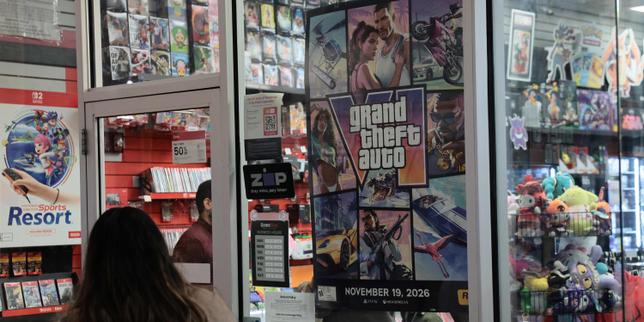
Everyone in the video game press is currently popping champagne over a single, blindingly loud number.
Three point seven nine billion dollars. In twenty-four hours.
Mainstream outlets are tripping over themselves to crown Grand Theft Auto VI the undisputed savior of interactive entertainment. They look at that $3.79 billion figure—a number that makes the opening weekends of Avengers: Endgame and Avatar look like independent art-house runs—and see proof that the AAA video game industry is invincible. They are telling you that big-budget blockbusters are healthier than ever, that single-player experiences are immortal, and that Rockstar Games just single-handedly cured the industry's post-pandemic hangover.
They are completely wrong.
If you look past the blinding glare of the press releases and analyze the unit economics of modern game development, GTA VI’s historic launch isn't a victory lap for the industry. It is an extinction-level event disguised as a gold rush. That $3.79 billion haul doesn't prove the AAA model works; it proves that a single anomaly has sucked all the oxygen, capital, and player attention out of the room, leaving dozens of major studios to suffocate in the vacuum.
The Illusion of Industry Health
When a single product generates $3.79 billion on day one, commentators treat it like a rising tide lifting all boats. In reality, it is a tsunami flattening everything on the coastline.
I have sat in boardrooms where executives burned tens of millions of dollars chasing the "Rockstar model." They see the headline revenue, ignore the decade-long development cycle, and greenlight bloated, 400-hour open-world projects that their studios lack the infrastructure to survive. The lazy consensus assumes GTA VI’s success validates massive budgets. It does the exact opposite. It exposes just how fragile every other publisher’s balance sheet really is.
Let’s look at the actual mechanics of consumer spending. Gamers do not have infinite wallets, and more importantly, they do not have infinite hours. When tens of millions of players drop seventy, eighty, or a hundred dollars on a single title—and then proceed to lock themselves into Vice City for the next six months—that money and time are cannibalized directly from the rest of the market.
Publishers spent the entire year terrified of GTA VI's release window for a reason. Delays and quiet quarters weren't strategic masterstrokes; they were acts of self-preservation. Nobody wanted to launch a $150 million action-adventure game within ninety days of Rockstar's juggernaut because they knew their marketing budgets would be incinerated on contact. When one company monopolizes global mindshare to this degree, the middle class of video games doesn't just struggle—it vanishes.
Gross Revenue Is a Vanity Metric
To understand why Wall Street analysts are quietly sweating behind their congratulatory tweets, you have to stop looking at gross bookings and start looking at amortized development costs and opportunity cost.
Gross revenue is the favorite toy of public relations departments because it ignores time and risk. Take-Two Interactive and Rockstar Games spent well over a decade building the infrastructure, engine upgrades, and asset pipelines required to bring Leonida to life. When you factor in ballooning headcounts across multiple global studios, marketing campaigns that rival presidential elections, and the sheer cost of capital over ten-plus years, the break-even point for a modern prestige title reaches stratospheric levels.
Now apply that math to anyone not named Rockstar.
Take-Two owns an intellectual property with a twenty-five-year cultural moat. They can afford to spend a decade in the dark without releasing a mainline entry because Grand Theft Auto V and GTA Online printed billions of dollars in high-margin recurring revenue to subsidize the wait. Almost no other publisher on earth has that safety net.
When Sony, Electronic Arts, or Ubisoft tries to replicate this scale without a decade-long cash cow funding the R&D, a single miss doesn't just hurt quarterly earnings. It triggers studio closures, mass layoffs, and stock sell-offs. We already saw the carnage across 2023 and 2024, when thousands of developers lost their jobs despite record industry-wide revenue. GTA VI’s $3.79 billion day-one spike is going to make annual year-over-year comparisons look catastrophic in twelve months, creating an artificial "crash" narrative that will spook institutional investors all over again.
The Death of Creative Risk
Every time a cultural behemoth shatters records, corporate executives learn the exact wrong lesson.
After The Dark Knight made a billion dollars, Hollywood decided every movie needed to be grim and gritty. After Fortnite took over the world, every publisher forced their single-player studios to build live-service extraction shooters—resulting in high-profile, nine-figure disasters like Concord and Suicide Squad: Kill the Justice League.
GTA VI’s $3.79 billion opening day will trigger the exact same herd mentality, only worse.
- The "Hyper-Realism" Trap: Studios will pour millions into photorealistic sweat physics and volumetric cloud rendering while starving narrative designers and gameplay programmers of resources.
- The Scope Creep Death Spiral: Middle-management will demand massive, seamless maps packed with busywork, ignoring that Rockstar’s secret sauce isn't map size—it's obsessive, handcrafted systemic density that cannot be outsourced or rushed.
- The Consolidation Squeeze: Private equity and mega-publishers will conclude that only billion-dollar franchises are worth funding, starving experimental, mid-budget ($20 million to $50 million) games of financing.
Think about what we lose when capital concentrates entirely at the top. Some of the most vital, inventive games of the last decade—titles like Hades, Baldur’s Gate 3, Helldivers 2, and Elden Ring—succeeded because they leaned into distinct artistic visions, tight mechanical loops, or player-friendly monetization rather than trying to out-spend Rockstar. Yet, the financial gravity of a $3.79 billion launch pulls institutional money away from bold mid-tier bets and straight into safe, sterile sequels.
What People Are Actually Getting Wrong About GTA VI
If you look at the questions dominating search engines right now, the public is focused entirely on the surface-level spectacle. Let’s dismantle the biggest misconceptions circulating around this launch.
"Does GTA VI prove single-player games are more profitable than live-service games?"
No. Anyone claiming this is a pure single-player victory is ignoring Take-Two’s entire business model. The single-player campaign is the world’s most expensive, most effective customer acquisition funnel. The $3.79 billion day-one blitz covers the upfront production cost and establishes the install base; the real multi-billion-dollar profit engine is the next decade of GTA Online microtransactions, subscription tiers, and user-generated content ecosystems. Single-player is the hook, not the whole business.
"Will other publishers raise game prices to $80 or $100 because of GTA VI?"
They will try, and most of them will fail miserably. Rockstar possesses extreme price inelasticity—fans would have paid $120 for the standard edition without blinking because GTA is a once-in-a-decade cultural event. When an average publisher tries to charge $80 for an annualized sports title or a derivative open-world sequel, consumers simply wait six weeks for a 40% discount. Mistaking Rockstar's pricing power for an industry-wide baseline is financial suicide.
"Is GTA VI too big to fail?"
Rockstar succeeded despite its massive scale, not because scale guarantees safety. Imagine a scenario where GTA VI launched with severe technical instability on consoles, or where its humor completely missed the cultural mark after a decade of social shifts. At a budget rumored to sit well north of a billion dollars, even a 20% shortfall in day-one conversions would have wiped billions off Take-Two’s market cap overnight. There is zero margin for error at this altitude.
The Contrarian Playbook for Surviving the Rockstar Era
If you are a studio head, an investor, or simply a player trying to make sense of where gaming goes from here, stop worshipping the $3.79 billion anomaly. You cannot out-Rockstar Rockstar. Attempting to beat them at hyper-detailed, satirical open-world crime simulators is like trying to build a rival search engine in your garage to take down Google.
To thrive in the shadow of GTA VI, the industry has to move in the exact opposite direction:
- Shrink the Scope, Deepen the Mechanics: Stop building 100-square-mile empty sandboxes. Build 10-square-mile sandboxes where every single object, NPC, and system interacts meaningfully. Players are exhausted by bloat; they are starving for friction and agency.
- Weaponize Speed and Iteration: While AAA giants spend eight years locked in development hell, nimble teams using modern engines can ship three distinct, polished titles in the same timeframe. Speed reduces financial exposure and lets developers respond to what players actually want today, not what was trendy in 2019.
- Price for Value, Not Ego: Embrace the $30 to $50 sweet spot. Games like Helldivers 2 and Palworld proved that lowering the barrier to entry creates viral word-of-mouth velocity that no $200 million Super Bowl ad campaign can buy.
There is an obvious downside to this contrarian approach: you will never hit $3.79 billion in twenty-four hours. You won't dominate mainstream news cycles, and you won't break Guinness World Records.
What you will do is build a sustainable, profitable business that doesn't require betting the entire company on a single roll of the dice every ten years.
Stop Celebrating the Monopoly
Take-Two and Rockstar earned every penny of their historic payday. They executed a high-wire act with a level of craft and patience that practically no other publicly traded corporation can stomach.
But applauding the artist is not the same thing as celebrating the economics. A healthy entertainment ecosystem looks like a thriving metropolis—packed with corner bistros, mid-sized theaters, experimental clubs, and a few towering skyscrapers. Right now, the video game industry is turning into a desolate wasteland dominated by a single, blindingly bright monolith.
Enjoy your trip to Vice City. Just don't be surprised when you finally log off in six months and realize half your favorite studios went bankrupt while you were playing.