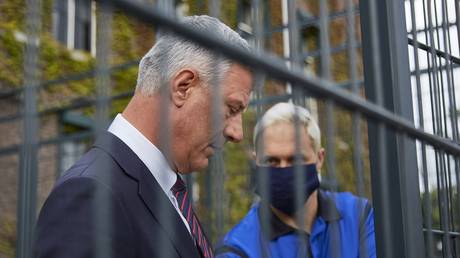
Hashim Thaçi built his entire political identity on leading Kosovo out of the shadow of Serbian rule. For decades, he was the face of the state, transitioning from guerrilla commander to prime minister and eventually president. That era ended in a sterile courtroom in the Netherlands.
When the Kosovo Specialist Chambers handed down its judgment, the political landscape of the Western Balkans shifted overnight. Thaçi received a 25-year prison sentence after being convicted of war crimes. It is a staggering fall from grace for a man who signed his country's declaration of independence in 2008. But beyond the immediate shock, this verdict forces a reckoning with a dark chapter of the late 1990s that both sides of the ethnic divide have spent years trying to rewrite.
Breaking Down the Judgment
The numbers tell a grim story of wartime atrocities. Alongside Thaçi, three other prominent figures from the Kosovo Liberation Army faced the judges. Jakup Krasniqi also received 25 years, Kadri Veseli was handed an 18-year sentence, and Rexhep Selimi received 13 years.
The judges convicted them on multiple war crimes counts, including illegal arrest, arbitrary detention, cruel treatment, torture, and murder. The panel determined that at least 385 people were unlawfully detained, hundreds were subjected to torture, and 96 murders were directly tied to a systematic effort to target political opponents and perceived collaborators.
Yet context matters here. The court acquitted all four men of crimes against humanity. Prosecutors failed to convince the judges that these acts constituted a widespread or systematic attack against a civilian population on a national scale, narrowing the legal scope of the conviction strictly to specific violations of the laws of war. Even so, the individual sentences are severe enough to ensure that the accused will spend the remainder of their active years behind bars, given that their time served since surrendering in 2020 counts toward the final tally.
Why the Trial Happened Abroad
Many outsiders wonder why Kosovo's top wartime leaders were tried in The Hague rather than in Pristina. The answer lies in the fragile reality of post-war justice in the Balkans. Domestic courts in Kosovo have long struggled with political interference, witness intimidation, and an environment where former guerrillas wield immense social and institutional influence.
Recognizing these vulnerabilities, international pressure led to the establishment of the Kosovo Specialist Chambers in 2015. Funded largely by the European Union and staffed by international judges and prosecutors, the court operates under Kosovo law but sits in the Netherlands to ensure safety and neutrality.
This setup was never popular at home. To most ethnic Albanians, the Kosovo Liberation Army fought a purely defensive war against the brutal ethnic cleansing campaigns waged by Slobodan Milošević's regime. Asking an international tribunal to sit in judgment over the men who led that fight felt, to many locals, like a moral inversion that equated the victims with the aggressors.
Inside the Courtroom Battles
The trial itself was an arduous ordeal that dragged on for years. Opening statements began in April 2023, following nearly three years of pre-trial detention after Thaçi abruptly resigned the presidency in November 2020 to face the indictment.
Prosecution teams faced monumental hurdles. Witnesses frequently went silent, changed their stories, or refused to testify out of fear for their safety and that of their families. The prosecution relied heavily on internal documents, intercepted communications, and the structural command responsibilities of the defendants.
The defense argued that the accused did not exercise absolute control over rogue elements in the sprawling, decentralized guerrilla network. They portrayed the charges as a politically motivated distortion of a legitimate national liberation movement. But the judges rejected this argument, ruling that Thaçi, as head of the Political Directorate and a key member of the General Staff, actively formulated and implemented a common purpose that enabled detention facilities and targeted opponents. The court detailed specific instances where Thaçi personally participated in the interrogation of detainees and the dissemination of false propaganda to cover up abuses.
The Immediate Reaction on the Streets
The verdict triggered fierce backlash across Kosovo. Prime Minister Albin Kurti called the judgment an unacceptable injustice, echoing widespread public sentiment. In Pristina, supporters had spent weeks plastering portraits of the former commanders across billboards, alongside digital clocks counting down the final hours to the court's decision.
When the sentences were read, peaceful protests quickly gave way to anger. Masked demonstrators hurled stones at the compound of the European Union Rule of Law Mission, smashing windows and clashing with security forces. Veterans associations and political figures lined up to denounce the court, vowing that the historical legacy of the KLA could never be tainted by a foreign tribunal.
Across the border in Belgrade, the reaction was entirely different, though equally tense. Serbian officials monitored the proceedings closely, hoping the convictions would validate long-standing claims about wartime abuses committed by Albanian forces. Yet, relations between the two countries remain deeply frozen. Years of EU-mediated normalization talks have yielded few tangible breakthroughs, and this verdict threatens to harden nationalist sentiment on both sides, pushing diplomatic reconciliation even further out of reach.
What This Means for Kosovo's Political Future
You can't understand modern Kosovo without recognizing the shadow cast by the generation of men who fought the war. For over two decades, politics in Pristina revolved around the rivalry between former KLA commanders and newer political movements that managed to break their monopoly on power.
With Thaçi, Veseli, Krasniqi, and Selimi permanently sidelined, an entire page of political history has turned. The generation of leaders who fought in the 1990s is exiting the stage, leaving a younger cadre of politicians to navigate the country's future.
This transition presents both a risk and an opportunity. Without the towering figures of the liberation era dominating the political arena, governance can theoretically become more institutionalized, transparent, and focused on everyday economic challenges rather than historical grievances. Corruption, high youth unemployment, and the ongoing diplomatic standoff with Serbia require pragmatic leadership that doesn't rely on wartime credentials for legitimacy.
At the same time, the deep societal trauma exposed by the trial won't vanish overnight. Many citizens feel that justice has been weaponized against their national identity. Healing that wound requires transparent governance that proves democracy can deliver better lives than nationalism ever could.
The Broader Lesson for International Justice
The Hague tribunal's handling of the Kosovo case offers a sobering lesson on the limits and costs of international criminal law. These trials take too long, cost astronomical sums, and often leave local populations feeling alienated rather than vindicated. When justice is administered thousands of miles away in a sterile Dutch courtroom, it struggles to resonate with the people who actually lived through the trauma.
Yet, accountability remains essential. War crimes, regardless of who commits them, leave scars that refuse to heal until perpetrators are named and judged. The court rejected the narrative that liberation movements enjoy immunity from international humanitarian law. That precedent matters. It signals to future conflict actors that victory on the battlefield does not grant a permanent exemption from the rule of law.
The defense teams have already announced plans to mount robust appeals, meaning this legal saga is far from over. Reparations proceedings for victims and survivors are scheduled to begin shortly, opening yet another difficult chapter in the quest for closure. For now, Kosovo must look past the courtroom drama and confront the hard work of building a society that answers to the future rather than the past.