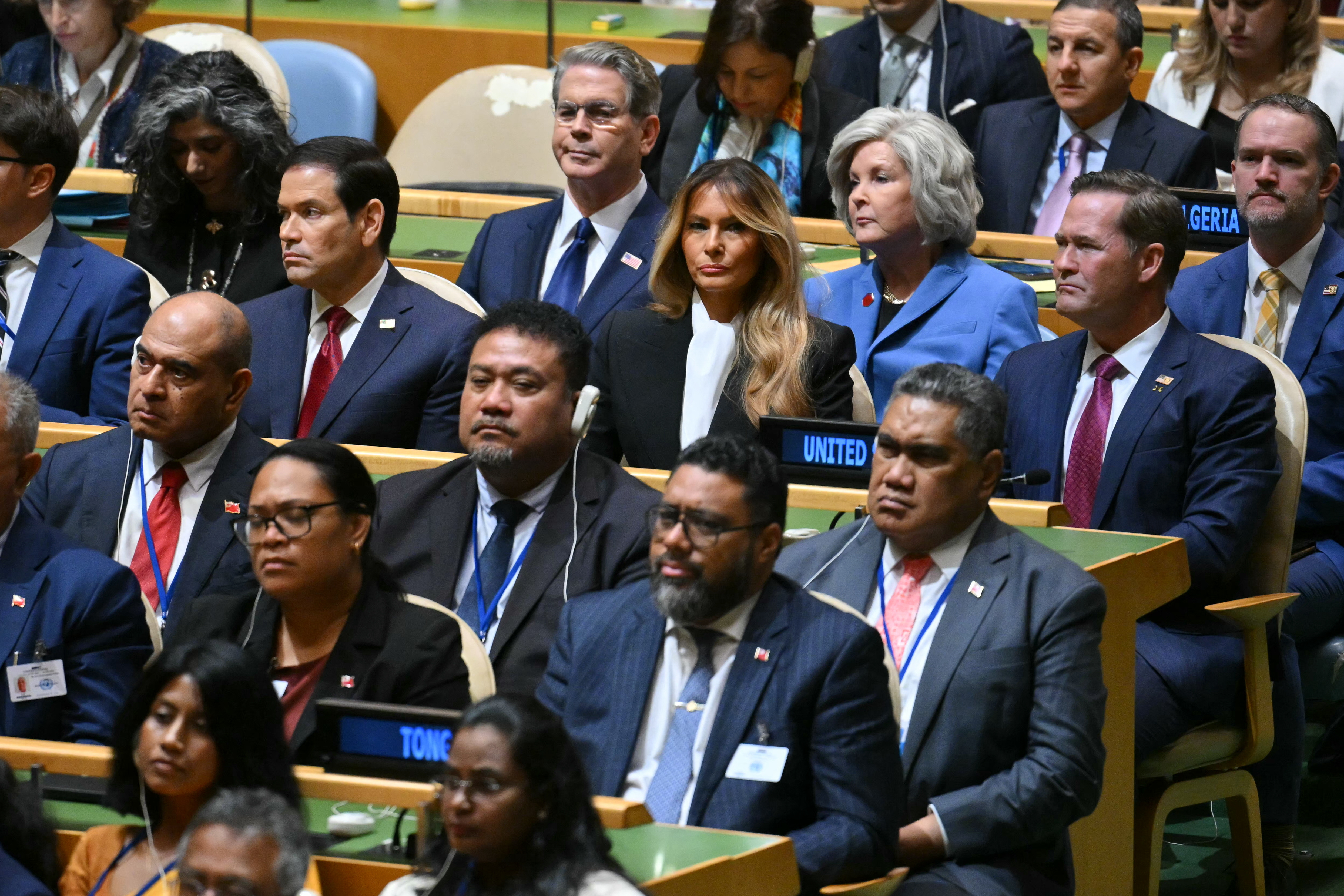
Marble echoes. You hear it before you even see the flags.
Footsteps bounce off polished stone in the corridors of the United Nations, carrying the low hum of translators, security radios, and hurried conversations between diplomats who have spent decades learning how to say "no" without raising their voices. Into that room steps a U.N. ambassador carrying the weight of the Trump administration's foreign policy—a doctrine defined by sharp edges, skepticism toward drift, and an insistence that American power should look unmistakable rather than apologetic. Expanding on this idea, you can also read: Why Trump’s War on the Media Is Entering a Dangerous New Phase.
When a figure like Mike Waltz speaks about Iran and Venezuela from that stage, the headlines tend to arrive cold. A policy shift here. A warning there. A debate over sanctions, sovereignty, and containment.
Cold facts are tidy. They sit neatly in columns and summaries. They rarely smell like diesel fuel idling at a border checkpoint or taste like salt on a sleepless night. Analysts at NPR have provided expertise on this trend.
To understand why foreign policy arguments over Iran and Venezuela matter beyond cable news panels, you have to follow the sound waves out past the East River. Past the press briefings. All the way to the places where a sentence spoken in New York changes what a family can afford for dinner or whether a young person packs a single bag at dawn.
The Distance Between a Speech and a Kitchen Table
Diplomacy often sounds like chess played in slow motion. Ambassadors move pieces across a board made of resolutions, speeches, and economic restrictions, speaking of deterrence and pressure as if those words existed in a vacuum.
They do not.
Consider a hypothetical scenario. Picture Mateo, a hypothetical delivery driver in Valencia, Venezuela, leaning against a dented truck while the afternoon heat presses down on the asphalt. Mateo has never set foot in the Security Council chamber. He does not parse the fine print of foreign policy strategy. What Mateo notices is simpler and harsher: the price of spare parts, the shifting value of money in his pocket, the sudden scramble when fuel lines stretch or trade routes tighten.
Now shift the lens—again, in a hypothetical scenario—to Shirin, a hypothetical pharmacist in Shiraz, Iran, counting boxes behind a counter as evening settles over the street. When tensions flare between Washington and Tehran, or when U.N. rhetoric sharpens around Iran's regional posture and nuclear ambitions, Shirin feels the ripples long before any treaty is signed or broken. Supply chains kink. Currencies wobble. Everyday life becomes an exercise in quiet improvisation.
Mateo and Shirin are fictional stand-ins, created to make an abstract truth visible. Yet the mechanism they illustrate is real. Statecraft is not an indoor sport. Every sanction, every diplomatic ultimatum, every shift in how the United States confronts Tehran or Caracas presses against real economies and real households.
Sometimes pressure aims to force a government's hand without firing a shot. Sometimes it hardens resistance instead. Watching from the outside, it is easy to argue about strategy on paper while forgetting how heavy that paper feels when it lands on someone else's doorstep.
Why Hard Talk Collides With Global Institutions
The United Nations was built for friction. Dozens of countries with rival histories, clashing interests, and competing grievances share the same building, bound together by charters, committees, and a habit of careful phrasing.
Trump's foreign policy has long challenged that polite equilibrium. Where traditional diplomatic habits often prize incremental consensus and patient process, a more confrontational approach asks a blunt question: What happens when polite consensus stops producing results?
From the vantage point of a U.N. ambassador aligned with that approach, speaking plainly about Iran and Venezuela is not about winning applause in a hall full of skeptics. It is about drawing bright lines. It is about signaling that Washington views certain actions—whether destabilizing regional behavior tied to Iran or authoritarian governance and economic collapse in Venezuela—as problems that cannot be smoothed over with wishful thinking.
Think of it like tuning a guitar string that has gone slack for years. If you pluck a loose string, you get a dull thud. If you tighten it too fast, it snaps. Finding the right tension is delicate work, and people standing in the same room can argue fiercely over whether the instrument is finally coming into tune or straining toward a break.
I will be honest: foreign policy at this scale is confusing. Even seasoned observers disagree on what works. Critics worry that aggressive rhetoric and sweeping pressure can isolate the United States, rally adversaries around a common grievance, or push fragile situations closer to crisis. Supporters counter that hesitation invites aggression, arguing that clear resolve is the only language certain actors respect.
Neither side holds a crystal ball. Anyone who claims certainty about how Tehran, Caracas, or other capitals will respond over time is selling confidence where humility belongs. Real history is messy. Leaders misread signals. Economies bend in unexpected ways. Alliances shift when people least expect them.
Two Crises, Different Geographies, Shared Stakes
Putting Iran and Venezuela in the same sentence is easy. Understanding how they actually work takes more care.
Iran sits at a strategic crossroads of the Middle East, with deep historical roots, complex domestic politics, regional alliances and rivalries, and decades of friction with Washington. Debates over Iran touch energy markets, maritime security, proxy conflicts, and nuclear concerns—issues that reverberate across neighboring states and global trade routes.
Venezuela sits in the Western Hemisphere, bound to the broader Americas by geography, trade, and human movement. Political turmoil, economic strain, and governance disputes in Venezuela have sent shockwaves across the region, shaping migration flows, energy discussions, and questions about democratic norms and outside influence.
Lumping two distinct countries into a single talking point can flatten what makes each place unique. Tehran is not Caracas. The Persian Gulf is not the Caribbean basin.
Still, foreign policy thinkers often connect them through broader themes: how Washington confronts governments it views as hostile or destabilizing, how economic pressure is weighed against humanitarian consequences, and how the United States balances unilateral resolve with international partnerships.
Let's sketch another hypothetical scenario to see how that plays out inside a mission in New York. Imagine a hypothetical junior diplomat—call her Clara—sitting at a desk late at night, sorting through cables, speech drafts, and reactions from fellow delegates. One delegation urges restraint and dialogue. Another presses for tougher measures. Meanwhile, Clara's inbox fills with notes from colleagues tracking border crossings, shipping delays, and human rights reports.
Her job is to translate broad directives into arguments that hold up under scrutiny. That tension—between a capital's demand for decisive action and the complex web of global reactions—is where a U.N. ambassador lives every single day.
The Hidden Cost of Perpetual Standoff
Long-running standoffs carry a quiet tax. Over time, crisis begins to look normal. News cycles move on to the next flashpoint, leaving behind half-finished stories and unresolved strain.
For ordinary people in affected countries, prolonged tension narrows horizons. Savings lose purchasing power. Families plan around shortages instead of seasons. Young people weigh whether to stay and adapt or leave and start over somewhere unfamiliar.
For the country applying pressure, prolonged confrontation brings its own costs. Sanctions can blunt influence if partners find workarounds or if targets dig in deeper. Sharp rhetoric can clarify a position in the short term while making quiet backchannels harder to open later.
None of this means doing nothing is painless. Inaction has its own ledger of consequences, sometimes just as severe. That is the agonizing bind at the center of foreign policy: leaders rarely choose between a clean success and an easy failure. More often, they choose between imperfect options with uneven costs.
What Gets Lost When We Only Watch the Podium
When we read coverage of a U.N. ambassador speaking on Iran, Venezuela, and Trump's foreign policy, it is tempting to treat the whole affair like a boxing match. Who landed the sharper line? Who looked tougher? Who sounded more defiant?
Spectacle is easy to watch. Substance is harder to measure.
A tough speech at the podium does not automatically reopen a shuttered clinic, stabilize a currency, calm a border, or end a regional dispute. By the same token, quiet diplomacy behind closed doors does not always deter bad behavior on its own. Real outcomes depend on follow-through, credibility, coalition building, and an unflinching grasp of local realities.
Listen closely to how leaders talk about these places. Do they speak only in slogans, or do they reckon with what happens the day after a policy is announced? Do they account for the people caught in the middle—shopkeepers, nurses, students, commuters—whose lives are shaped by decisions made thousands of miles away?
Power is real. Military strength matters. Economic weight matters. Moral clarity matters, too, when it is paired with honesty about limits. Yet power without empathy can turn blind, and empathy without strategy can turn powerless.
Somewhere between the marble halls of New York and the crowded streets of distant cities, the true test of any foreign policy plays out. Not in the applause after a speech, nor in the heat of an argument on television, but in whether people's lives grow safer, freer, and more stable over time.
The microphones click off. The cameras pack up. Out on the avenue, cabs still honk through the damp air, and somewhere far from the glass towers of Manhattan, another morning begins under the weight of choices made elsewhere.


