Rain taps a steady, silver rhythm against the tram windows in Basel on a crisp autumn morning. Inside, commuters fold damp newspapers, breathe warm coffee steam, and glance past headlines about borders, sanctions, and alliances that seem miles away until a train stalls or a supply chain shudders.
Neutrality.
For generations, that single word has carried the weight of a mountain range in the Swiss imagination, promising calm while storms gather across the continent. Yet in late September 2026, that familiar word became a fault line running straight through living rooms, village squares, and parliamentary halls.
To make the stakes tangible, consider a hypothetical scenario involving Lukas, a civil emergency coordinator in Basel who spends his weeks practicing cross-border disaster response and crisis drills with European counterparts. In a drill simulating a major infrastructure failure along the Rhine, minutes matter more than speeches. If Lukas cannot pick up a phone, share technical protocols, or train alongside neighboring teams during calm weather, chaos arrives first when an emergency hits.
Now pair Lukas with Nadia, a hypothetical legal researcher in Geneva who studies how armed conflicts test international law. Nadia knows that wars rarely arrive in neat textbooks. When a major European war breaks out, staying out of the fighting does not automatically shield a country from cyber disruption, energy shocks, broken trade routes, or moral pressure from every side.
Both Lukas and Nadia live inside the tension that brought millions of Swiss citizens to the polls on 27 September 2026.
The Ballot Behind the White Dove
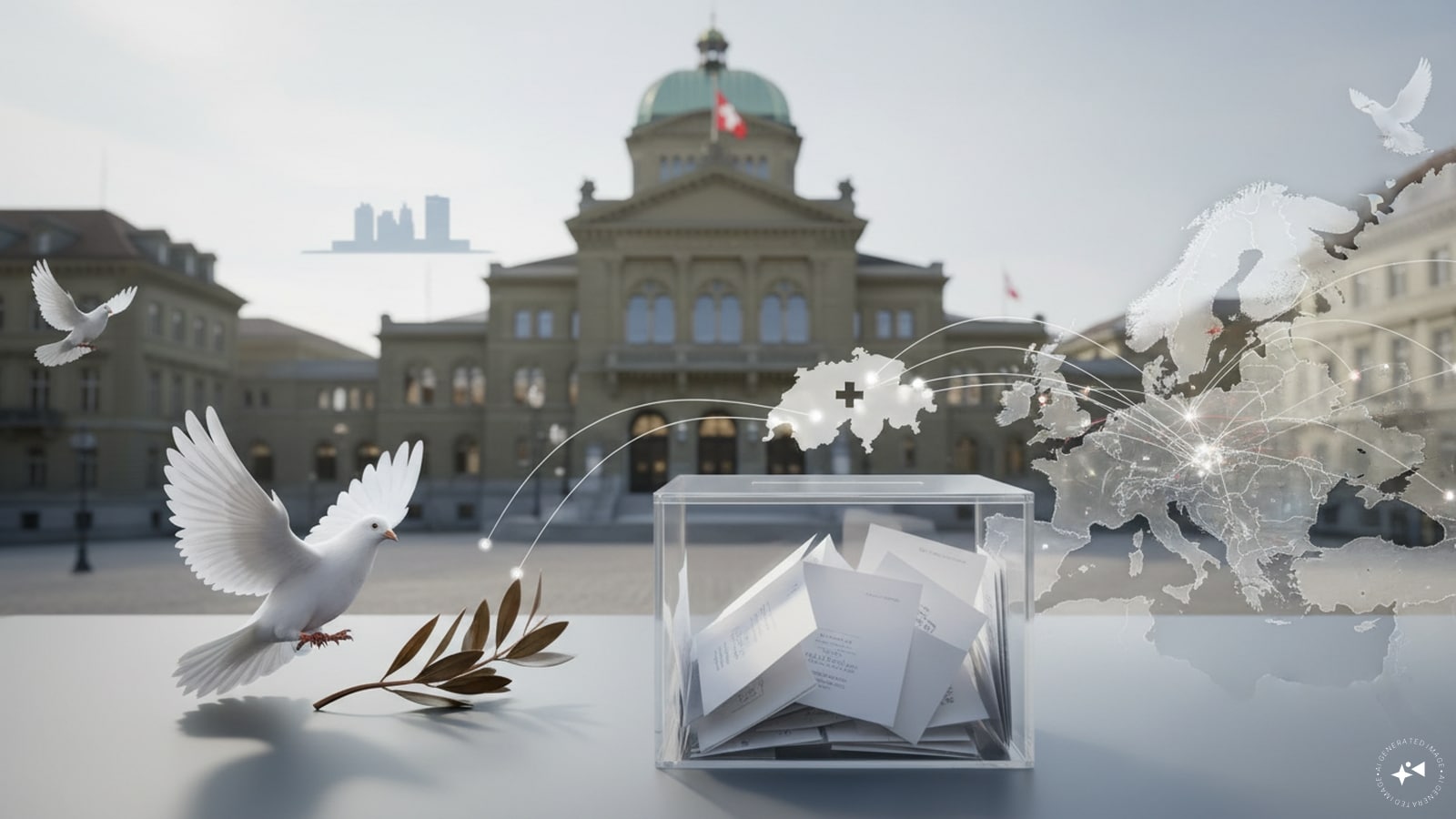
On that Sunday in September 2026, Swiss voters weighed the Federal Popular Initiative titled "Safeguard Swiss neutrality"—widely known as the Neutrality Initiative—championed by the Swiss People's Party (SVP) and the campaign group Pro Schweiz.
The result was unmistakable. Voters rejected the proposal by 70.16% No (1,854,861 votes) to 29.84% Yes (789,082 votes), on a participation rate of 47.07%. Not a single canton voted in favor; twenty full cantons and six half cantons turned it down.
Numbers on a screen can look tidy, almost clinical. In reality, each percentage point held an argument about fear, identity, and survival.
Supporters of the initiative wanted to write a much stricter, narrower version of neutrality directly into the Swiss Federal Constitution. Under their proposal, Switzerland would have been barred from joining or cooperating with any military or defense alliance unless the country itself came under attack. It would also have prohibited Switzerland from joining economic sanctions unless those sanctions were enacted by the United Nations, leaving only narrow exceptions to prevent circumvention of measures.
Think about what that would have meant in plain terms. Peacetime cooperation with NATO would have been choked off. Future governments would have lost the flexibility to align with European partners on sanctions when a neighbor invades another state.
But why did a campaign wrapped in white peace doves and promises of safety lose so decisively across every single canton?
Two Stories of What Neutrality Means
Consider another hypothetical character to see how genuine emotion divided the country: Martin, a retired precision machinist in Aargau who has spent forty years making parts that demand tolerance to a fraction of a millimeter. Martin hung a poster in his garden reading "No war, Yes to Swiss neutrality". He did not wake up wanting to help foreign autocrats. He woke up worrying that drifting closer to Western defense circles or imposing sanctions might paint a target on a country he loves.
That worry is real. For many ordinary people, neutrality feels like a quiet pact with fate: we do not meddle in your wars, and you leave our valleys alone.
Here is a metaphor that helps clarify the clash at the heart of the vote: imagine neutrality not as a stone wall built once in the past, but as a cloak worn through changing weather. Lock the cloak into a rigid iron shell, and it may feel unbreakable on a calm day—yet when wind and sleet whip sideways, a stiff shell cracks while a flexible garment can bend and hold warmth.
Opponents of the initiative—including the Federal Council, parliament, and the major parties outside the SVP—argued that locking neutrality into a rigid constitutional cage would strip Switzerland of its room to maneuver in an unsettled world. Even more pointedly, critics noted that Russia's foreign ministry had praised the initiative while attacking Switzerland over its adoption of European Union sanctions, leaving supporters struggling to shake the perception that their strict rulebook would serve Moscow's interests rather than Swiss independence.
Consider what happens next: if a small country ties its own hands by constitutional decree before a crisis unfolds, every rival abroad knows in advance what Switzerland cannot do. Predictability can steady nerves, yet total rigidity hands leverage to whoever pushes hardest.
Why Peacetime Cooperation With NATO Felt So Personal
One of the sharpest questions in the debate—and one that trips up plenty of observers outside Switzerland—is what peacetime cooperation with NATO actually looks like. Does cooperating with NATO mean surrendering neutrality or signing up to fight foreign wars?
No. Not under Switzerland's current framework.
Switzerland is not a NATO member, and Swiss law excludes participation in combat operations for peace enforcement. Swiss units deployed abroad—such as contributors to the UN-mandated Kosovo Force (KFOR) in the Balkans, or earlier a small number of Swiss staff officers who supported the UN-mandated International Security Assistance Force in Afghanistan from 2004 to 2007—operate under international mandates and are manned by volunteers.
Swiss ties with NATO grew gradually after the Cold War, beginning with joining the Partnership for Peace (PfP) in 1996 and the Euro-Atlantic Partnership Council (EAPC) in 1997, later guided by an Individually Tailored Partnership Programme. Through those channels, Switzerland has shared expertise in civil emergency planning, crisis management exercises, search-and-rescue training, humanitarian law, and arms control. In March 2025, Switzerland also joined NATO's Science & Technology Organization (STO) Science & Technology Enhanced Partnership to pursue joint research and development.
Picture two neighboring fire departments in a valley full of timber houses. They do not share a single command structure, and neither forces the other to march into a blaze against its will. Yet during quiet months, they test hoses together, map access roads, and practice how to keep sparks from jumping across the ridge.
Cutting off peacetime cooperation with NATO would have meant walking away from those shared maps and safety drills while Europe's security environment grew harsher. For voters like Lukas in our hypothetical scenario, severing practical cooperation in peacetime looked less like protecting peace and more like choosing to fly blind.
Centuries of Stone and Shifting Borders
To understand why the debate cut so deep, it helps to step back into the history that shaped Swiss neutrality in the first place.
Swiss neutrality is not a modern invention or a whim of a single decade. Its roots stretch back centuries—often traced to the sobering lessons after the Battle of Marignano in 1515 and the peace settlements that followed—before major European powers formally recognized Switzerland's permanent neutrality in 1815. In 1848, neutrality was written into the Federal Constitution, and in 1907 the Hague Conventions codified the international law of neutrality.
Still, legal scholars and diplomats draw a vital line between two ideas that people often blur together:
- The law of neutrality sets strict binding rules during an armed conflict between other states: a neutral country cannot join the war, cannot supply military support or war material from state stocks to belligerents, and cannot allow warring forces to use its territory.
- Neutrality policy covers the broader political and security choices a government makes in peace and crisis to keep its neutrality credible and protect the country's security, independence, and prosperity.
That distinction is where honesty matters most. Let us admit something plainly: when Russia launched its full-scale invasion of Ukraine and Bern decided to adopt European Union sanctions, many Swiss citizens felt a genuine knot in their stomachs. Had Switzerland crossed an invisible line? Could a country impose sanctions on an aggressor and still claim the same credibility as a neutral go-between?
There is no easy, painless answer to that question, and pretending otherwise would insult anyone's intelligence. World politics does not hand out pure, cost-free choices. Staying silent when a neighboring region's security order is torn apart carries a price; taking a stand and adopting sanctions carries another price, including diplomatic friction and lost goodwill in certain capitals.
Following the September 27, 2026 vote, Foreign Minister Ignazio Cassis stressed that the outcome was not a vote against neutrality itself, stating that Switzerland was neutral yesterday, is neutral today, and will remain neutral in the future. In the Federal Council's view, neutrality is an instrument—a means to protect security, independence, and good offices—rather than a rigid dogma that ties the country's hands regardless of circumstance.
At the same time, tough-minded observers point out a sobering reality beyond Swiss borders: voting to keep neutrality flexible at home does not automatically guarantee that every warring party abroad will treat Bern as its preferred mediator. Trust in diplomacy is earned repeatedly in a crowded, shifting world where other capitals also step forward to host talks or broker ceasefires.
What Voters Actually Protected on September 27
When 70.16% of Swiss voters said no to the Neutrality Initiative, they were not tearing up their history. They were refusing to freeze a living tradition into brittle stone.
Think again about Nadia in Geneva and Martin in Aargau. Nadia sees a world where cyber threats, hybrid pressure, and regional wars spill across borders without asking permission, requiring agile diplomacy and practical security partnerships. Martin still wants quiet valleys, strong local defense, and a country that avoids entanglement in foreign wars. The vote did not erase Martin's desire for peace; it affirmed a different path to keeping it—one where elected leaders and citizens retain judgment rather than surrendering it to an inflexible constitutional straitjacket.
Armed neutrality in Switzerland has always paired self-reliance with pragmatic awareness of the outside world. A nation surrounded by neighbors in a turbulent continent does not stay safe by closing its eyes or severing peacetime ties with partners who help keep European stability intact. It stays safe by remaining capable, clear-eyed, and adaptable enough to meet the century it actually lives in.
Outside a Geneva conference hall or a Bern railway station, evening falls early in autumn, casting long amber light across cobblestones and wet tracks as people head home to family dinners—carrying a hard-won reminder that peace is never preserved by standing frozen in place, but by choosing wisely when the wind begins to rise.