Seventy thousand voices hit a wall of brass, bass, and pyrotechnics at five thousand feet above sea level.
Inside a professional football stadium, sound does not just travel. It vibrates through your sternum, rattles the fillings in your teeth, and turns ordinary air into a physical shove. For a human athlete wearing shoulder pads and a helmet, that roar is fuel. For a prey animal built over millions of years to hear a twig snap three hundred yards away and bolt before a predator takes a second breath, that roar should be a siren screaming run.
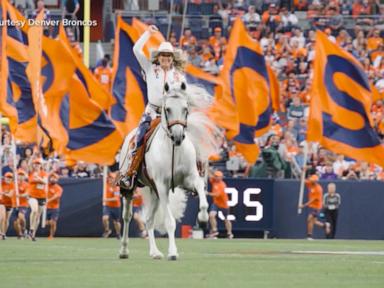
Yet every autumn Sunday in Denver, a white horse steps out of the tunnel, ears flicking, nostrils flaring, and runs straight toward the noise.
People call him a mascot. A novelty. A great thirty-second clip for a highlight reel or a broadcast cut. When you watch a horse gallop down the sideline waving a bright orange flag, it looks effortless, almost cinematic, like something lifted out of a western and dropped onto lush green turf.
It isn't.
There is a quiet, heavy truth behind every live animal ambassador in modern sports. Every time a horse enters an arena packed with cameras, cannons, drones, and deafening chants, someone is negotiating a truce between ancient instinct and modern spectacle. If you only see the horse as a prop, you miss the whole story—the hours of unglamorous trust-building, the physical toll of travel and turf, the razor-thin margin between a thrilling tradition and a terrifying accident.
I have stood close enough to working horses in loud environments to feel the heat coming off their necks and smell the sharp tang of sweat and leather when their nerves start to fray. When a thousand-pound animal decides something is dangerous, no amount of wishing makes it small. You do not argue with equine physics. You earn the right to guide it long before the gates ever open.
Why A Prey Animal Belongs Nowhere Near A Stadium
Start with a simple biological mismatch that most fans never stop to examine.
Horses are flight animals. Their eyes sit on the sides of their heads, giving them a wide panoramic view of the world—and blind spots right in front of their noses and directly behind their tails. Their nervous systems are tuned for survival, not applause. A flapping tarp, a sudden shadow on the grass, a cheerleader's pom-pom hitting the turf, or a burst of flame from a sideline rig can register to a horse as an immediate threat.
Now place that biology inside a bowl of concrete and steel holding tens of thousands of people. Add stadium speakers pumping music at levels that can easily top ninety or one hundred decibels, helicopters or camera booms overhead, and turf that feels nothing like open pasture.
To make that work safely—for the horse, the rider, the players, and the fans—nothing can be left to chance. A live equine ambassador is not a wild bronco tamed overnight for Sunday television. Behind the scenes sits a disciplined system of conditioning, desensitization, veterinary oversight, and daily relationship work.
Consider what happens next: a horse has to learn that loud noises do not mean danger, that unfamiliar ground does not mean a trap, and that the rider's cues matter more than the chaos surrounding them. That kind of calm is not installed like software. It is built brick by brick, day after day, through repetition, patience, and fairness.
Even then, I will admit something that makes traditionalists uncomfortable: there is always a degree of uncertainty when living creatures perform in high-stimulation spaces. Anyone who claims a live animal in a stadium is one hundred percent predictable is selling comfort rather than honesty. A horse can have an off day just like a quarterback. A gust of wind, a slick patch of grass, or a sudden spike in crowd volume can test months of preparation in half a second.
That uncertainty is the invisible stake running underneath every cheer.
A Morning Before The Crowd Arrives
To see what that stake looks like on the ground, let's trace a hypothetical morning several hours before kickoff. This scenario is invented to illustrate the behind-the-scenes rhythm, though it reflects the real demands placed on handlers who work horses in high-pressure venues.
Picture a handler named Maya standing beside a horse trailer at dawn. The air is crisp, smelling of cold metal, hay, and damp earth. Inside, the horse shifts weight from one hind leg to the other, listening to the muffled thrum of distant city traffic.
Maya doesn't rush. Rushing is the enemy of trust. She opens the ramp slowly, speaks in a low, steady cadence, and lets the horse step out at a measured walk. Before anything flashy happens, there are basic checks: leg warmth, hydration, hooves, posture, eye softness. If a horse is tight, sore, or overly wired before the gates even open to ticket holders, the plan changes. A good handler answers to the animal's state, not to a production schedule.
Later, inside the quiet bowl of the stadium—empty except for a few crew members testing lights and microphones—they walk the perimeter. A speaker crackles. A flag snaps in the breeze. The horse stops, head raised, eyes wide, taking in the sheer scale of the room. Maya stays calm, keeping her seat balanced and her hands quiet, letting the horse process the environment without forcing submission through harshness.
Think of that conditioning like teaching a child to swim in choppy water. You don't toss them into the deep end during a storm and yell at them to float. You start in the shallows, let them feel the buoyancy, build confidence step by step, and stay close enough that they never feel abandoned when a wave hits.
Without that slow, patient foundation, the stadium would chew an unprepared horse up. With it, the horse learns a remarkable thing: I know this person. We have been here before. I am safe.
Tradition, Spectacle, And The Weight Of A Symbol
Why do sports franchises go to all that trouble when a person in a fur suit or a digital graphic on a giant screen would be vastly simpler and cheaper?
Because a live animal carries a weight that fabric and pixels cannot fake.
Historically, horses and human drama have been braided together for centuries. From chariot races and jousting tournaments to cavalry charges and frontier lore, the horse has long stood for speed, power, freedom, and untamed spirit. In American sports culture—especially out West, where ranching and open range shape the regional identity—a galloping horse isn't just decoration. It is a living bridge to mythology.
When the crowd sees a bright white horse charging down the field, something older than football wakes up. It feels primal. It feels alive. You can hear the difference in the stadium when that energy hits: the cheer shifts from routine game-day noise to something sharper, more visceral.
At the same time, it is worth asking a fair question that more fans are asking today: does a live animal belong in an entertainment spectacle at all?
That is not a trivial question, and brushing past it would make this story hollow. Modern audiences are far more attuned to animal welfare than past generations were. People rightly ask whether travel stresses the horse, whether noise strains its ears or nerves, and whether the animal is there for its own good or for human excitement.
The honest answer sits in the tension between those two realities. A well-cared-for equine ambassador lives a life most horses could only dream of—top-tier veterinary care, tailored nutrition, attentive daily handling, and a bond with people who treat it like royalty. Yet it still lives inside a human world built for human entertainment. Calling it "just a mascot" minimizes the responsibility involved; pretending there is zero stress ignores the animal's point of view.
The real test of any live-animal tradition isn't whether it looks cool on camera. It's whether the people responsible for the horse put the horse's wellbeing ahead of the show every single time.
What You Don't See When The Camera Cuts Away
Broadcast television loves the peak moment. The camera locks onto the horse mid-stride, mane flying, flag streaming behind, crowd roaring in the background. Three seconds later, the network cuts to a commercial or a replay.
Everything before and after those seconds disappears from the screen.
Yet those unseen minutes are where the true skill lives. Turning a horse in tight quarters near camera crews, stopping cleanly without sliding on turf, reading subtle ear flicks while thousands of people scream, and walking calmly back out of the glare require quiet mastery. A horse doesn't care about television ratings, playoff implications, or ticket prices. It responds to pressure, release, rhythm, and trust.
And trust is fragile if you abuse it. If a handler relies on fear or force to get a big reaction, the cracks eventually show—in pinned ears, stiff strides, bolted exits, or panicky eyes. True partnership looks much softer on the surface. It looks like a horse choosing to listen even when the world around it is losing its mind.
Look closely next time you watch a live equine ambassador on the sidelines. Don't just watch the speed. Watch the ears. Watch the neck. Watch how quickly the horse breathes after the noise dies down. Those small details tell you whether you are watching a stunt or a relationship.
Seventy thousand voices can shake the steel beams of a stadium and still lose out to a quiet voice at the end of a rein.
The next time that white flash breaks into a run along the sideline, the roar will rise again—and for a heartbeat, the loudest thing in the room will be the trust holding it all together.