Silence.
That is the first thing you notice when a crowd of hundreds suddenly realizes that the glass wall separating human curiosity from wild vulnerability is not nearly thick enough.
To understand what happens in the split second a casual afternoon turns into a tragedy, consider a hypothetical visitor standing at the edge of an outdoor zoo exhibit. Let us call him Arthur. Arthur is not a villain. He is not reckless by nature, nor does he harbor any ill will toward the massive, glistening creature gliding effortlessly beneath the surface of the water just feet away from his sneakers. He is simply a man squinting against the afternoon glare, adjusting the brim of a synthetic sun hat while trying to get a clearer view of a famous animal. A sudden gust of wind catches the fabric. His hand shoots out, grasping at empty air, and the hat flutters downward like a dry leaf, landing squarely on the ripples of the pool.
It takes less than three seconds for a harmless piece of fabric to become a lethal hazard.
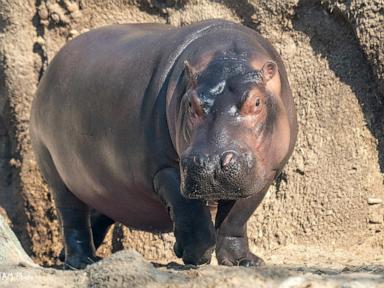
When reports began circulating about a fatal incident at the Cincinnati Zoo involving Fiona—the world-famous Nile hippopotamus who captured global affection after surviving a premature birth in 2017—and a dropped hat, the immediate reaction was disbelief. How could something as soft, light, and utterly mundane as a hat threaten an animal that weighs well over a thousand pounds and possesses one of the most powerful jaws in the animal kingdom?
The answer lies in a biological mismatch that zoos spend millions of dollars trying to manage, yet can never entirely eliminate.
The Architecture of an Unintended Trap
A hippopotamus does not see the world through the cautious, analytical lens of a human observer. To a hippo, anything entering its territory from above is either a threat, a toy, or food. Because they lack hands to inspect an object, they investigate the world with their mouths.
In the wild rivers of sub-Saharan Africa, a hippopotamus encounters reeds, river mud, branches, and aquatic plants—materials that either break down naturally or pass harmlessly through a massive, four-chambered stomach designed to ferment tough vegetation. Their digestive tract is an evolutionary marvel built specifically for cellulose and organic matter. It is entirely unequipped for modern human manufacturing.
Synthetic fabrics, plastic brims, metal grommets, and elastic bands do not dissolve in stomach acid. When swallowed, a seemingly harmless cap acts like a cork in a bottle, or worse, a tangle of wire in a finely tuned engine. If the material lodges in the esophagus, it restricts breathing. If it travels further into the gastrointestinal tract, it causes a catastrophic blockage, twisting tissue, cutting off blood supply, and triggering a cascade of internal failure that even the most advanced veterinary surgical teams struggle to reverse in an animal of that immense size.
Anesthesia alone is a high-wire act for a hippopotamus. Their massive bulk presses down on their lungs when they lie sedated, making oxygen delivery perilous, while their thick skin and dense layers of fat complicate every incision. A foreign object that a dog might pass with a trip to the emergency vet becomes a life-threatening crisis for a megafauna species.
Why Fiona Meant So Much to So Many
To grasp the emotional weight of a tragedy involving Fiona, you have to remember what the world felt like when she arrived. Born six weeks premature in January 2017, weighing just twenty-nine pounds—roughly twenty-five pounds lighter than the lowest recorded birth weight for a surviving Nile hippo—she was not expected to live through her first week.
Veterinarians, neonatal specialists from a nearby children’s hospital, and round-the-clock keepers fought to keep her alive. They tube-fed her, hydrated her collapsed veins, and celebrated every ounce she gained. Millions watched through screens as she learned to walk, took her first tentative steps into the water, and grew into a vibrant, expressive ambassador for her species.
She ceased to be merely an exhibit. She became a shared emotional touchstone, a symbol of resilience for people navigating their own quiet battles in hospital rooms and living rooms across the globe. When people stood at the railing of Hippo Cove in Cincinnati, they did not feel as though they were looking at a wild mammal native to East African rivers. They felt as though they were visiting an old friend.
And therein lies the invisible danger.
The Paradox of Intimacy
I have spent years reporting from behind the scenes of conservation facilities, walking the damp concrete corridors beneath public viewing decks, and speaking with keepers whose boots never quite dry. If you spend enough time in those spaces, you begin to notice a subtle psychological shift that happens to visitors the moment an animal becomes famous.
Familiarity breeds a dangerous kind of comfort.
When we feel an emotional connection to an animal, our instinctive vigilance drops. We forget that the barrier between us is not a living room window, and that the creature on the other side is governed by ancient, uncompromising biology rather than human common sense. We lean over the rail to snap a photo. We hold toddlers aloft on the ledge. We wear loose hats, carry unsecured phones, and tuck water bottles into shallow pockets.
Keepers see the aftermath of these small lapses every single week. Across accredited zoos worldwide, veterinary logs are filled with quiet, unpublicized recoveries of foreign objects from animal enclosures: sunglasses, pacifiers, plush toys, coins, hair ties, and baseball caps. Most of the time, alert staff spot the item within seconds, distract the animal with high-value food rewards, and retrieve the object before it is swallowed.
Sometimes, the water is too murky. Sometimes, the animal is too fast.
The Weight of a Split Second
Consider what happens next when an object disappears beneath the surface before a keeper can intervene. There is no immediate dramatic collapse. Often, the animal swims away as if nothing has happened. Hours, or even days, may pass before subtle signs of distress emerge—a refusal to eat, lethargy, a change in posture that only a keeper who knows every nuance of the animal’s daily rhythm would recognize.
By the time clinical symptoms appear, the clock is already ticking furiously.
Imagine the quiet agony of the care team in those hours. These are people who have spent years memorizing the exact cadence of an animal’s breathing, who have hand-fed it through illnesses, who know the specific pitch of its vocalizations. Suddenly, they are forced to watch a creature they love suffer from an entirely preventable cause, fighting against the cruel physics of anatomy and pharmacology while the public outside the gates remains largely unaware of the battle unfolding behind closed doors.
In 1996, a three-year-old boy fell into the gorilla enclosure at Brookfield Zoo, leading to Binti Jua’s famous rescue. In 2016, the tragic death of Harambe at the very same Cincinnati Zoo sparked a global reckoning over enclosure design, parental vigilance, and the inherent friction of keeping wild animals in public spaces. Each incident forced institutions to raise barriers, install finer netting, and rethink sightlines.
Yet you cannot build a glass box around an outdoor habitat without destroying the very experience that inspires people to care about wildlife in the first place. Open-air exhibits exist so visitors can hear the splash of water, smell the damp earth, and feel the sheer, breathtaking presence of another living being sharing the same air. That openness requires a silent contract between the institution and the visitor: the zoo provides the sanctuary, and the public brings basic mindfulness.
What We Carry With Us
It is easy to point fingers in the wake of a tragedy. Social media thrives on outrage, demanding someone to blame whenever a beloved figure is lost. We want a villain because a villain makes the world feel orderly; if someone was malicious, then the rest of us are safe from ever making the same mistake.
The truth is far more unsettling. Most zoo tragedies are not caused by malice. They are caused by ordinary human distraction. A strap that wasn't fastened. A breeze nobody anticipated. A moment where someone’s attention drifted from their belongings to the wonder right in front of them.
Every time we step up to a barrier, we bring our modern clutter with us—plastics, metals, synthetics, and electronics that have existed for less than a century, introduced into the presence of creatures whose evolutionary wiring dates back millions of years. The gap between their world and ours is bridged only by a few feet of railing and whatever care we choose to exercise in that moment.
Look at the rim of the water on a bright afternoon, where the sun catches the ripples and a crowd leans forward in collective awe, waiting for a familiar gray snout to break the surface—and remember how light a hat feels in your hands until the wind takes it.