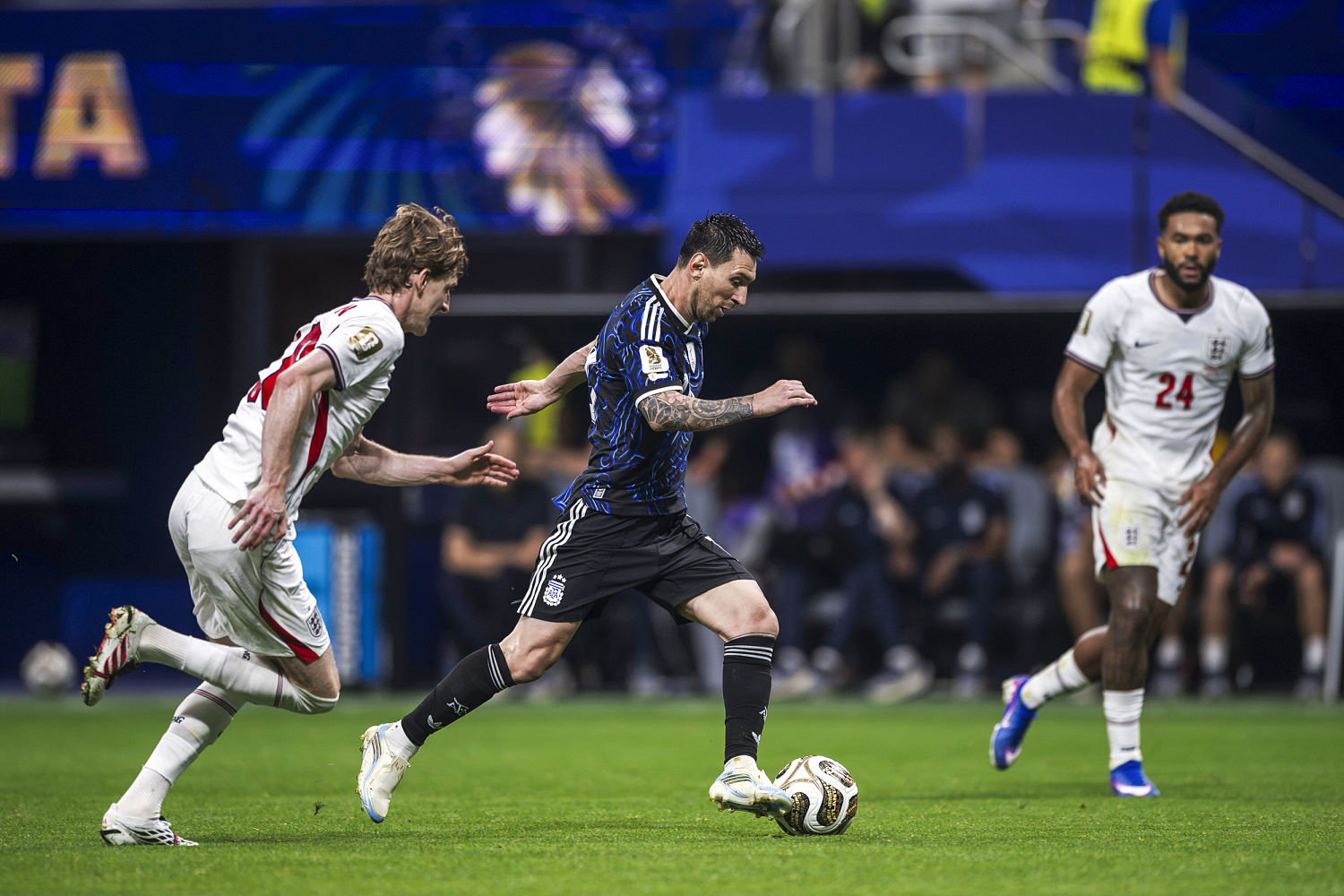
The plastic cups on the pub floor are sticky with spilled lager. Outside, the summer evening is cooling down, but inside, the air is thick, hot, and heavy with a collective, agonizing hope. You know this feeling. If you have watched England play football at any point over the last few decades, this feeling is practically stitched into your DNA. It is a knot in the stomach, a quiet dread masked by loud, defiant singing.
Then, it happens. For a different look, check out: this related article.
A moment of pure, unadulterated genius. Jude Bellingham launches himself into the air, defying gravity and logic to score an overhead kick in the dying seconds. Or Bukayo Saka cuts inside, shifting his weight with the grace of a ballet dancer, and curls a flawless strike into the far corner. The pub erupts. Beer flies. Strangers hug. For a brief, intoxicating second, everything is forgiven. The tactical sluggishness, the sideways passing, the agonizing lack of control—all of it is washed away by the sheer euphoria of the moment.
But moments are a dangerous currency. They deceive us. They make us believe that spirit and individual heroism can permanently substitute for structural excellence. Related coverage on this matter has been published by NBC Sports.
When the ecstasy fades and the empty cups are swept away, a cold truth remains. England is a team built on moments, playing in a sport ruled by systems.
The Myth of the English Fighting Spirit
We have been brought up on a diet of heroic failure. We romanticize the blood-soaked bandage around Terry Butcher’s head. We worship the image of Bobby Moore lifting the trophy in a black-and-white world that feels more like folklore than history. We convince ourselves that if we just run harder, fight fiercer, and care more than the opposition, the footballing gods will eventually smile upon us.
Consider a player like Conor Gallagher. He is the ultimate embodiment of this ethos. When he plays, he looks like a man trying to put out a fire with his bare feet. He presses, he lunges, he sprints until his lungs burn. It is deeply admirable. It is the kind of effort that makes fans in the stands nod in approval.
But watch a team like Spain.
When Rodri or Fabian Ruiz receive the ball under pressure, they do not look like they are fighting a war. They look like they are playing chess in a quiet park. They do not run themselves into the ground because they do not have to. Their positioning does the running for them. The ball moves faster than any human can sprint. While England players are constantly sprinting to recover from bad positioning, their rivals are already waiting at the next coordinate, calm and composed.
This is the fundamental divide. England treats football as an exam of character. The elite footballing nations treat it as an exam of geometry.
The Loneliness of the English Midfield
To understand why England struggles to control games, you have to look at the center of the pitch. It is the engine room, the creative hub, the place where the tempo of a match is dictated.
Imagine a hypothetical midfielder named Arthur. Arthur is technically gifted, possesses a lovely touch, and can pick a pass from forty yards out. In an academy setting, Arthur is a star. But when Arthur steps onto the pitch in an England shirt, he finds himself isolated.
When he gets the ball, his teammates are too far away. The passing lanes are clogged. He looks left, then right, and sees only opponents closing in. There is no easy, five-yard escape route. No teammate has dropped into the pocket of space behind the opposition's midfield to offer an angle. Arthur is forced to go backward, or worse, launch a long, hopeful ball down the channel.
The crowd groans. The commentators talk about a lack of bravery. But it is not a lack of courage that plagues Arthur. It is a lack of company.
Modern football is about creating passing triangles. It is about offering the player on the ball at least two immediate, low-risk options at all times. When England plays, those triangles collapse into straight lines. The distances between the players are too vast. We possess world-class individuals, yet we look like a collection of strangers who met in the parking lot an hour before kickoff.
The Illusion of Progress
We point to tournament runs as proof of growth. Semi-finals, finals, penalty shootout victories—surely these are signs of a nation on the cusp of greatness?
But a closer look reveals a fragile foundation. These runs have often been paved with favorable draws and late-game rescue acts. We survive matches we should control. We rely on a moment of magic from Harry Kane, or a brilliant save from Jordan Pickford, to paper over the cracks.
When we finally meet a team with a coherent, drilled possession structure—be it Croatia in 2018, Italy in 2021, or Spain in 2024—the illusion shatters.
Against these teams, England looks like a group of athletes chasing ghosts. We cannot get the ball. When we do get it, we are so exhausted from chasing it that we give it straight back. The opposition does not need to rely on miraculous overhead kicks. They simply passing-move us to death. They suffocated us with possession, slowly suffocating our hope until the final whistle blows.
This is not a criticism of the players' ability. The squad is packed with Champions League winners, Premier League players of the year, and global superstars. It is a criticism of our footballing culture, which still prioritizes the "what" over the "how." We focus on the goal, but we ignore the build-up. We praise the finish, but we fail to analyze the system that created it.
The Cost of Survival Football
Playing this way takes a massive psychological toll. It turns every match into a high-wire act. There is no comfort, no period of the game where England can simply stroke the ball around and catch their breath. Every minute is played at maximum intensity, a desperate struggle to keep the opposition at bay while praying for a break.
This survivalist mindset breeds anxiety. You can see it in the players' faces. The joy of representing their country is replaced by a crippling fear of failure. They play with leaden legs, terrified of making the mistake that will plaster their faces across the front pages of the tabloids the next morning.
When you do not have a system to fall back on, fear takes over. A well-drilled team knows exactly where to pass when they are under pressure; it is instinctive, a muscle memory developed through thousands of hours of repetition. An England player under pressure has to think. And in elite football, if you have to think, you are already too late.
The great tragedy is that we have the talent. We have players who can manipulate the ball in tight spaces, players who can glide past defenders, players who can score from nothing. But until we build a structure that allows these players to coexist, to connect, and to control, we will remain a team of moments.
We will continue to have nights of wild, beer-soaked celebration in the round of sixteen. We will continue to believe, for a fleeting moment, that this is our year. But eventually, we will run into a team that knows how to keep the ball. And we will be left standing in the heat, watching them pass it around us, wondering why our beating hearts and running legs were not enough.