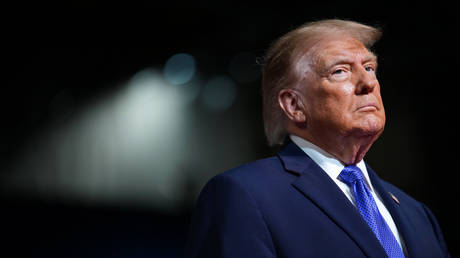
The microphone sits two inches from a man who has spent his entire adult life building monuments to his own permanence, and for three seconds, the bravado simply evaporates.
It happened during a televised sit-down, a routine political interview that suddenly veered off the rails of policy and polling into the murky waters of the human soul. When pressed about his standing with the Almighty, about the ancient, non-negotiable terms of entry into paradise, Donald Trump did not pivot to his crowd sizes or his legislative victories. He looked at the floor, shrugged with a disarming, almost jarring candor, and admitted that he didn’t think he was going to make it to heaven. The reason wasn't a secret scandal or a hidden crime. It was something far more common, and infinitely harder to cure. He simply cannot forgive his enemies.
Stop.
Think about the sheer weight of that confession coming from the most powerful political figure in the Western world, a man who has commanded armies, reshaped courts, and bent an entire political party to his singular will, yet stands completely helpless before the quiet, relentless demand to let a grudge go.
The Architecture of a Grudge
To understand why a billionaire president would publicly forfeit his place in eternity rather than pardon a political rival, you have to understand what resentment actually feels like inside the human body. I know that feeling intimately. Years ago, a business partner walked away from a shared venture, taking three years of my sleepless nights, my savings, and my reputation with him. For months afterward, waking up felt like swallowing broken glass. Every morning at 5:00 AM, before my feet even hit the cold hardwood floor, my mind would immediately boot up a courtroom drama where I was prosecutor, judge, and executioner, rehearsing all the devastating things I would say when I finally cornered him.
That is the seductive trap of anger. It feels like armor. When someone wounds you—whether it is a petty betrayal in a small-town office or a coordinated political campaign to destroy your legacy—holding onto the rage feels like the only way to keep score, the only proof that the injustice actually mattered.
For Trump, who grew up in the hyper-competitive, zero-sum crucible of 1970s New York real estate under the tutelage of his father Fred and the ruthless fixer Roy Cohn, retaliation wasn't just a reaction. It was a survival doctrine. Cohn had one golden rule: when someone hits you, hit them back ten times harder. Over five decades, that philosophy forged an empire. It turned a Queens developer into a global brand and eventually carried him into the Oval Office.
But doctrines that win boardrooms and elections have a terrible habit of bankrupting the spirit. When you spend seventy-eight years training your nervous system to treat every slight as an existential war, you eventually lose the muscle memory required for grace. You become trapped inside the very fortress you built to keep yourself safe.
When Mercy Becomes a Foreign Language
Consider a hypothetical scenario to strip away the partisan noise that usually clouds any discussion of Trump. Imagine a retired heavyweight boxer, let’s call him Arthur, who spent forty years in the ring. Every instinct in Arthur’s body was wired to keep his left hand up, his chin tucked, and his right cross cocked. He survived brutal wars because he never let his guard down, not even for a fraction of a second. Now, at eighty years old, Arthur sits in a quiet sunlit kitchen while his five-year-old granddaughter tries to hand him a dandelion. He wants to take it. He sees the smile on her face. Yet, as her small hand moves toward his chest, his shoulders instinctively hunch, his jaw clenches, and his left forearm snaps up to block the strike.
He isn't trying to be cruel. His body simply forgot how to do anything else.
This is the exact psychological tragedy playing out in plain sight when a leader admits that forgiveness is beyond him. In the Christian tradition—a tradition heavily championed by millions of Trump's most fervent evangelical supporters—forgiveness isn't presented as a polite suggestion or an optional virtue for exceptionally kind people. In the Gospel of Matthew, right after the Lord's Prayer, the text delivers a blunt, terrifyingly clear ultimatum: if you do not forgive others their trespasses, neither will your Father forgive yours. There are no loopholes for presidents. There are no exemptions for people whose enemies genuinely deserved the wrath.
The irony is staggering. Millions of believers pray daily for a leader they view as an imperfect vessel, a modern King Cyrus raised up to protect their values, while that very leader looks directly into the camera and admits he cannot clear the single lowest, widest hurdle of their faith. He has mastered the art of the deal, yet he cannot bring himself to sign the only treaty that actually secures peace.
The Invisible Toll on the Rest of Us
You might wonder why any of this matters beyond the private spiritual ledger of one man in Mar-a-Lago. If Donald Trump wants to trade his ticket to eternity for the satisfaction of watching his enemies squirm, isn't that strictly between him and his Maker?
It isn't, because leaders don't just govern through laws; they govern through permission.
Behavioral psychologists have long documented a phenomenon known as emotional contagion, the subconscious tendency of groups to mimic and synchronize with the emotional states of their most dominant figures. When the most visible human being on the planet normalizes the idea that forgiveness is impossible—that a real fighter never lets go, never forgets, and never turns the other cheek—that permission trickles down into the bloodstream of the culture.
We see the wreckage everywhere. We see it in Thanksgiving dinners that end in slammed doors because an uncle and a niece would rather be right than be family. We see it in church pews where neighbors refuse to take communion beside someone who voted differently in November. According to data from the Pew Research Center, partisan animosity in the United States has reached levels unseen in modern polling, with majorities on both sides viewing their political opponents not merely as misguided neighbors, but as outright enemies who pose a threat to the nation's well-being.
When you view your neighbor as an existential enemy, forgiveness stops looking like a virtue and starts looking like treason. You begin to believe that letting go of your anger means letting the bad guys win.
What Forgiveness Actually Is (And What It Isn't)
Part of the reason Trump—and, if we are being brutally honest, most of us—balks at the idea of forgiving enemies is that we have been sold a completely distorted definition of what the word actually means. We confuse forgiveness with amnesia. We think that to forgive someone means we have to look at a person who stabbed us in the back, smile warmly, and hand them another knife.
That isn't forgiveness. That is foolishness.
Think of resentment like holding a hot coal in your bare hand while waiting for the person who wronged you to walk by so you can throw it at them. You are convinced that your grip is a weapon. You endure the blistering heat, the smell of burning flesh, and the agonizing pain because you are waiting for your moment of vindication. Meanwhile, the person you hate is three towns over, eating dinner, laughing with their friends, completely oblivious to the fact that you are slowly burning your own hand off.
Forgiveness is simply the decision to open your fingers and drop the coal.
It does not rewrite history. It does not mean what your enemy did was okay, nor does it require you to invite them back into your inner circle or pretend the wound never happened. In clinical studies conducted by Dr. Everett Worthington and the Stanford Forgiveness Projects, researchers found that individuals who practiced structured forgiveness saw dramatic drops in cortisol levels, lower blood pressure, improved sleep quality, and a measurable reduction in chronic anxiety. Forgiveness isn't a gift you give to the person who hurt you. It is a jailbreak you orchestrate for yourself.
I eventually had to learn that lesson the hard way with my former business partner. Years after he walked away with my money, I realized I was still letting him rob me every single morning at 5:00 AM. He hadn't taken a dime from my bank account in half a decade, yet he was still stealing my mornings, my focus, and my joy, entirely rent-free. Letting go didn't get my savings back, and it certainly didn't make him a good man. It just meant he finally stopped living in my head.
The Quiet Courage of Surrender
Watching that clip of Trump confessing his spiritual impasse, what struck me wasn't outrage or judgment. It was a sudden, aching recognition of how lonely it must be at the top of a mountain built entirely out of grievances.
To maintain a lifetime of unforgiveness requires an exhausting, round-the-clock vigilance. You have to keep the files updated. You have to remember every slight from 1988, every bad review from 2004, every disloyal staffer from 2020, and every prosecutor from 2023. You have to feed the fire every single day, because if the flames die down for even an hour, you might have to sit in the quiet and feel the grief underneath the rage.
And grief is always what lies beneath anger. Anger is loud, muscular, and exhilarating; grief is quiet, fragile, and terrifying. To forgive an enemy requires you to admit that you were hurt, that you were vulnerable, and that you cannot force the universe to balance the scales on your timeline. For a man whose entire identity is predicated on total control and unbroken strength, admitting that kind of vulnerability feels indistinguishable from death.
So he keeps his guard up. He keeps the ledger open. He accepts the terrifying bargain of a closed heaven in exchange for the familiar, burning warmth of a grudge he knows how to hold.
There is a reason the ancient texts describe the gate to paradise as narrow. It isn't narrow because God is petty, standing at the entrance with a clipboard and a magnifying glass, looking for technicalities to keep people out. The gate is narrow because you cannot fit through it while dragging a U-Haul full of every person you have ever hated. Eventually, every human being—whether they sit behind the Resolute Desk in Washington or at a battered kitchen table in Ohio—reaches a threshold where they have to make a choice. You can keep your enemies, or you can walk through the door, because the hinges simply won't swing wide enough for both.


