Silence.
That is the first thing you notice when you stand three feet away from the Sovereign’s Sceptre inside the Jewel House at the Tower of London, shuffling along a moving walkway designed specifically so you cannot linger, cannot breathe too long on the reinforced glass, cannot ask the uncomfortable questions that rise in the back of your throat. The crowd around you whispers in a dozen languages, cameras strictly forbidden, eyes wide at the sheer, blinding defiance of a teardrop-shaped stone the size of a chicken egg. It sits cradled in gold at the top of a royal rod, throwing jagged spears of white and violet fire against the velvet dark. You might also find this similar article interesting: The Invisible Border Running Through Southern California.
Most people look at the 530.2-carat Cullinan I—known formally as the Great Star of Africa—and see a fairytale. They see monarchy, permanence, and the kind of dizzying wealth that feels almost abstract, like the distance between stars.
I looked at it on a rainy Tuesday in November, my shoes still damp from the cobblestones outside, and felt a strange, cold knot tighten in my stomach. Because if you know the real story of how that stone got from a dusty trench in southern Africa to a velvet cushion in London, you realize you aren't looking at a symbol of unbroken tradition. You are looking at the surviving fragment of a violent, nerve-shredding gamble—a physical artifact of empire, terror, and a single blow from a steel blade that nearly destroyed the greatest treasure ever pulled from the earth. As reported in recent articles by Associated Press, the implications are significant.
Eighteen Feet Down in the Red Dust
To understand the stone, you have to leave the chilly air-conditioning of London and step into the blistering heat of January 26, 1905, in Cullinan, a mining town roughly twenty-five miles east of Pretoria in what was then the British-ruled Transvaal Colony.
Frederick Wells was not looking for history that afternoon. He was the surface manager at the Premier No. 2 mine, making a routine late-day inspection eighteen feet below the rim of the open pit. Imagine the sensory reality of that trench: the metallic tang of sweat and crushed kimberlite rock, the relentless glare of the Highveld sun baking the red earth into brick, the rhythmic groan of hauling gear echoing off the pit walls.
Something caught the dying light embedded in the wall just above his eye level.
At first, Wells thought one of the miners was playing a practical joke on him—wedging a thick chunk of glass from a broken bottle into the clay to watch the boss make a fool of himself. You can picture the hesitation in his boots. In the brutal hierarchy of early twentieth-century mining, losing face was nearly as dangerous as a cave-in. He reached up with his pocketknife, expecting the cheap, hollow clink of discarded glass.
Instead, the blade scraped against the hardest natural substance known to humankind.
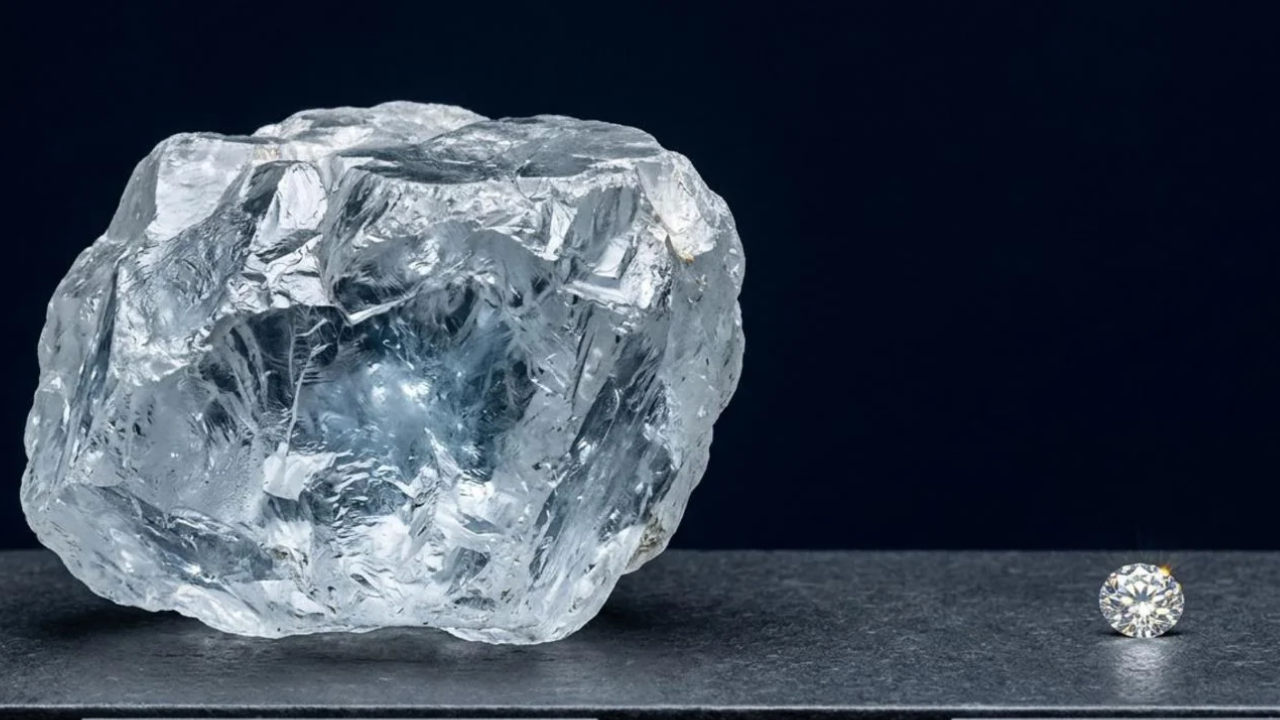
When Wells pried the stone loose from the blue-grey earth, he was holding 3,106.75 carats of pure, translucent carbon—roughly 1.37 pounds, the size of a grown man’s clenched fist. Named after Thomas Cullinan, the mine’s chairman, it was more than three times larger than any diamond ever found before or since. Even more astonishing to the geologists who examined it under trembling magnifying glasses: the stone had one remarkably flat, smooth face, leading experts to conclude that this colossal rock was merely a broken shard of an even larger, vanished parent crystal that had shattered deep within the earth's mantle millions of years earlier.
A Gift Wrapped in Guilt and Strategy
Finding a miracle is one thing; figuring out what to do with it is another entirely.
For two years, the Cullinan diamond sat unsold in a Johannesburg bank vault. Nobody could afford it. More than that, nobody knew how to insure it, how to move it, or how to cut it without turning millions of pounds into worthless gravel. Meanwhile, the political ground beneath South Africa was shifting violently. The Second Boer War had ended only a few years prior, leaving behind scorched farms, bitter resentments, and an uneasy British administration trying to stitch together a fractured colony.
Consider what happens next, because this is where the stone stops being a geological freak and becomes a geopolitical weapon.
In 1907, Louis Botha—a former Boer general who had fought against the British Empire and was now serving as the first Prime Minister of the self-governing Transvaal—proposed an extraordinary gesture. The Transvaal government would buy the diamond for £150,000 (an astronomical sum at the time, though arguably a fraction of its true worth) and present it to King Edward VII as a token of loyalty and reconciliation.
Think about the human weight of that transaction. Here was a defeated general offering the crown jewel of the earth to the monarch whose armies had occupied his homeland, hoping a lump of crystallized carbon might buy political goodwill and autonomy for his people. Inside the British Parliament, the proposal sparked fierce debate. Winston Churchill, then Under-Secretary of State for the Colonies, argued passionately in favor of accepting the gift, recognizing its symbolic power to cement British-Boer relations.
King Edward VII eventually agreed. Now came the terrifying part: getting the stone across six thousand miles of ocean without it vanishing into the bottom of the Atlantic or the pocket of an opportunistic thief.
The Decoy and the Parcel Post
If you were tasked with transporting the largest diamond in human history from Johannesburg to Sandringham House in Norfolk in 1907, how would you do it? You would probably hire an armored cruiser, surround the stone with armed guards, and lock it inside a bespoke steel safe bolted to the hull.
The British authorities did that—and it was entirely fake.
In one of the most audacious sleights of hand in criminal-prevention history, London detectives orchestrated a theatrical decoy operation. A heavily guarded steamer departed Cape Town with a sealed box placed inside the captain’s safe, tracked by breathless newspaper reporters and watched closely by every syndicate in Europe.
Meanwhile, the real 3,106-carat Cullinan diamond was wrapped in plain brown paper, tied with string, and dropped into an ordinary registered parcel post bag. It traveled across the ocean in a standard mail sack, indistinguishable from birthday letters and tax notices, costing a few shillings in postage. When it finally arrived at Sandringham in November 1907—just in time for King Edward’s sixty-sixth birthday—it looked so unassuming in the rough, almost like a cloudy block of alum or rock salt, that Queen Alexandra reportedly dismissed it at first glance, unimpressed by what looked like a large pebble.
She had no idea what was sleeping inside it.
Four Days of Terror in Amsterdam
You cannot simply polish a rough diamond into brilliance. To understand what Joseph Asscher faced in Amsterdam in early 1908, picture a master surgeon asked to perform open-heart surgery with a hammer and chisel—knowing that a single tremor of the wrist will kill the patient instantly and ruin his family’s name forever.
A diamond is paradoxical. It is the hardest material on earth, capable of scratching anything, yet it is brittle along specific atomic planes. Think of it like a stack of playing cards: incredibly strong if you push straight down on the deck, but easily separated if you slide a blade neatly between two cards. That atomic grain is called a cleavage plane. Find it, strike it at the exact right angle with the exact right force, and the stone splits cleanly in two. Miss by a fraction of a millimeter, and internal stresses inside the crystal—pressures locked inside the rock for over a billion years—will cause the diamond to shatter like a dropped wineglass.
King Edward entrusted the stone to the Royal Asscher Diamond Company in Amsterdam, the finest cutters in the world. Joseph Asscher spent months studying the Cullinan. He stared at it through polariscopes, mapping the microscopic black carbon inclusions trapped deep inside its core, plotting how to cleave around the flaws without sacrificing size.
On February 10, 1908, the workshop in Amsterdam fell dead silent.
A small group of witnesses, including representatives of the British Crown and a doctor standing by just in case, gathered around Asscher’s workbench. Asscher had spent days grinding a tiny V-shaped groove, barely a quarter-inch deep, along the critical cleavage plane of the rough stone. He picked up a specially forged steel cleaving blade, placed its edge inside the groove, and raised a heavy steel rod.
He struck the blade.
The steel blade snapped in two. The diamond did not budge.
I have always lingered on that exact second. Imagine the sound of breaking steel ringing through a silent room, the sudden intake of breath from the men watching, the cold sweat breaking out across Asscher’s neck. Every instinct tells you to stop, to step back from the table, to admit the stone is unconquerable.
Asscher did not step back. He picked up a second, stronger blade, seated it carefully into the exact same groove, and raised the rod again.
Crack.
The sound was sharp, clean, and absolute. The Cullinan split cleanly into two primary pieces—one weighing 1,977.5 carats, the other 1,040.5 carats—precisely along the line Asscher had calculated. Popular legend has long claimed that Joseph Asscher fainted dead away on the workshop floor the moment the stone parted; his descendants later clarified with dry Dutch pride that he did not faint, though he certainly cracked open a bottle of champagne and spent the next several days recovering in a hospital from sheer nervous exhaustion.
Over the next eight months, three master polishers worked fourteen hours a day to shape the fragments. When the dust finally settled, the original rough stone had yielded nine major gems—numbered Cullinan I through IX—along with ninety-six smaller brilliants and nine carats of unpolished fragments. More than half of the original weight had been ground away into diamond dust to release the fire trapped within.
The Weight of What Remains
Which brings us back to that moving walkway in London, and the question that refuses to go away once you know the whole story.
Today, the nine major stones remain part of the British Royal Family’s collection. Cullinan I—the 530.2-carat pear-shaped giant—sits at the head of the Sovereign’s Sceptre with Cross, removable so it can also be worn as a pendant. Cullinan II, weighing 317.4 carats, blazes from the front band of the Imperial State Crown, right beneath the Black Prince’s Ruby. Queen Mary, Queen Elizabeth II, and King Charles III have all worn pieces of that single South African crystal at coronations, state openings of Parliament, and solemn royal ceremonies.
Yet the silence inside the Jewel House feels different now than it did a century ago.
In recent years, calls from South African activists, historians, and lawmakers for the repatriation of the Cullinan diamonds have grown louder and harder to ignore. To many South Africans, the narrative of a "generous gift" from the Transvaal government in 1907 rings hollow—a transaction negotiated by a colonial administration under British imperial oversight, using wealth extracted from African soil by poorly paid Black miners working in perilous conditions. When King Charles III gripped the Sovereign’s Sceptre during his coronation in May 2023, millions watching around the world saw the majesty of ancient ritual, while millions of others saw a glaring reminder of an unhealed colonial ledger.
Is it a masterpiece of human courage and craftsmanship, or an artifact of imperial extraction? The truth, uncomfortable as it is, is that it is both at the exact same time. Every facet cut by those exhausted artisans in Amsterdam catches the light differently depending on where you are standing in the room.
When I finally stepped off the moving walkway at the Tower of London and walked back out into the damp November air, the heavy oak doors swung shut behind me, sealing the vault once more. Behind that thick glass, forged a billion years beneath the African crust and split by a trembling hand in Amsterdam, the Great Star of Africa continues to burn in the dark—brilliant, immovable, and forever divided over who truly owns its light.