The air in Beijing has a specific weight to it. On a Tuesday morning, just before the high-level motorcade arrives, that weight shifts. It isn't just the smog or the humidity of a changing season. It is the sudden, jarring absence of sound. The city’s rhythmic chaos—the electric hum of scooters, the distant shouting of street vendors, the endless chorus of horns—evaporates.
Then comes the vibration.
You feel it in your marrow before you see the source. It is a low-frequency thrum that belongs to something industrial, something predatory. This is not the sound of a standard internal combustion engine. It is the sound of eight tons of reinforced steel, Kevlar, and titanium moving with the grace of a mountain.
The Beast has arrived.
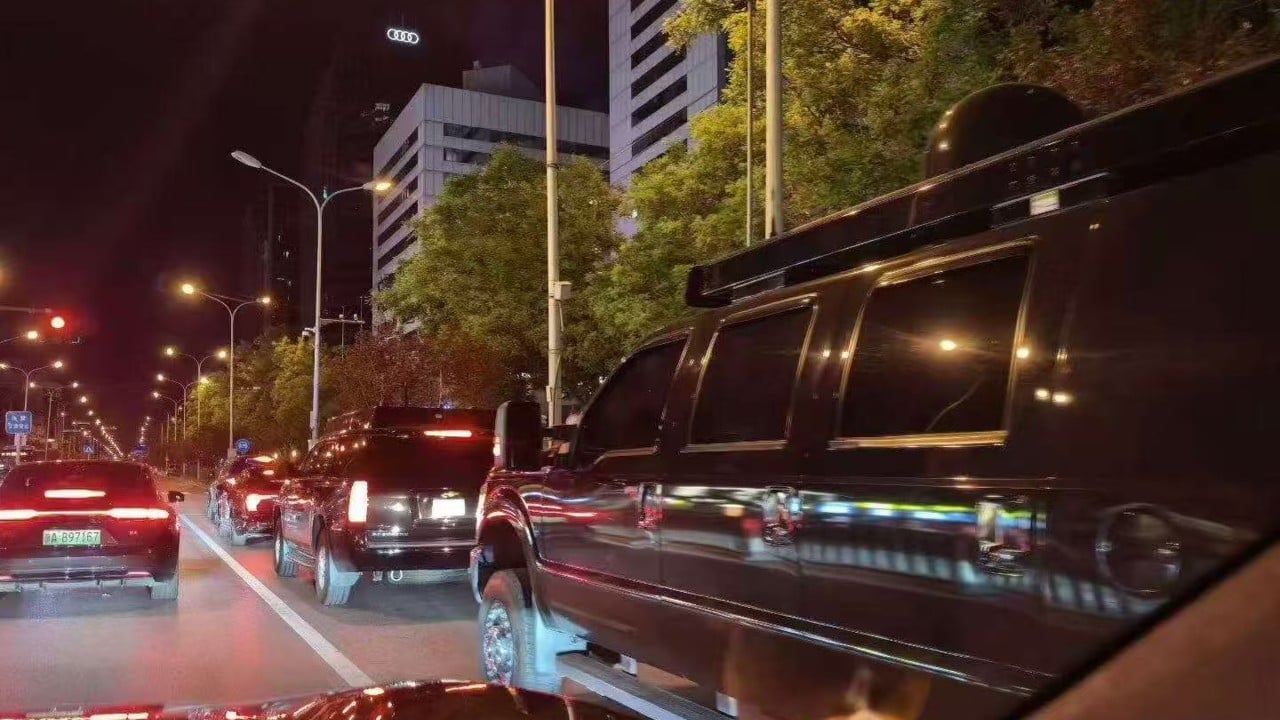
For the average observer standing on the sidewalk near the Forbidden City, the sighting of the United States Presidential motorcade is a surreal collision of worlds. We often view geopolitics as a series of digital headlines or grainy televised handshakes. But when the massive, obsidian-black SUVs and the distinctively hulking Cadillac limousine roll through ancient streets, the abstract becomes physical. The stakes of global diplomacy are no longer ideas. They are measured in inches of bulletproof glass.
The Anatomy of an Invisible Fortress
To understand the machine is to understand the paranoia and the precision of the modern era. We call it a car. That is a polite lie. Beneath the polished Cadillac exterior lies the chassis of a heavy-duty truck, modified to carry a weight that would crush a standard luxury sedan.
Consider the doors.
They are eight inches thick. They weigh as much as the cabin door of a Boeing 757. When they close, the seal is absolute, designed to protect the occupant from a chemical or biological attack by creating a 100% airtight environment. Imagine sitting inside that cabin. The world outside becomes a silent movie. You could be in the middle of a riot or a war zone, and the only thing you would hear is your own breathing and the soft whir of the independent oxygen supply.
The tires are reinforced with Kevlar, wrapped around steel rims that allow the vehicle to keep moving at highway speeds even if the rubber is shredded by gunfire. This is the engineering of survival. Every inch of the vehicle is a response to a historical tragedy, a lesson learned in blood and fire. It carries its own blood bank, matched to the President’s type. It carries a firefighting system, night-vision optics, and a communications suite that ensures the leader of the free world is never more than a second away from the nuclear codes.
But the machine is only half the story. The human cost of moving this fortress across the globe is where the true narrative begins.
The Ghosts in the Convoy
Long before the President ever touches down on Chinese soil, a different kind of army arrives. These are the advance teams—the logistics officers, the Secret Service technicians, and the specialized drivers who treat every turn of the steering wheel as a life-or-death calculation.
Think of a hypothetical driver, let’s call him Miller. Miller doesn't see the architecture of Beijing. He doesn't see the beauty of the Temple of Heaven. He sees "kill zones." He sees the structural integrity of overpasses. He sees the escape routes that lead to the nearest hardened medical facility. For Miller, the Beast is not a symbol of power; it is a responsibility that weighs several tons.
When the transport planes—massive C-17 Globemasters—belly-open at the airport, they vomit out these black behemoths into a foreign land. There is a profound irony in it. To facilitate a conversation between two world leaders, we must first transport a small, mobile fortress to ensure they can survive the meeting.
The appearance of the motorcade SUVs in Beijing, spotted by locals and journalists alike, acts as a drumroll. It is the physical manifestation of "The Visit." In the days leading up to the official arrival, these vehicles undergo "dry runs." They navigate the specific turns of the city, testing the clearance of gates and the timing of traffic lights.
The Language of the Machine
There is a psychological theater at play here. When the United States brings the Beast to China, it is not just for safety. It is a statement. In the world of high-stakes diplomacy, everything is a signal. The sheer scale of the American security apparatus—the sight of domestic SUVs with Washington D.C. plates prowling through Beijing—is a reminder of reach.
It says: We bring our own ground with us.
This isn't just about the President. It’s about the message of untouchability. The vehicle is a rolling piece of sovereign territory. Yet, for all its power, it is a deeply vulnerable thing. It is a target. The more armor you add, the heavier you become. The heavier you become, the slower you react. It is a constant arms race between protection and mobility.
We often mistake these motorcades for parades. They are the opposite. A parade is an invitation to look. A motorcade is a warning to stay back. The flashing lights are not festive; they are a visual perimeter. The sirens are not music; they are a command for the world to move aside.
The Silent Weight of the Glass
What does it feel like to be the person behind that eight-inch glass?
We imagine it must feel like being a god. But talk to anyone who has lived within that bubble, and they describe a different sensation: isolation. To be that protected is to be fundamentally removed from the very world you are trying to lead. You look out at the crowds in Beijing, and you see them through a filter that distorts the light. You are safe, yes. But you are also in a cage.
The Beast represents our collective modern anxiety. We live in an age where the distance between a handshake and a catastrophe is measured in the thickness of a steel plate. We have built these machines because we have to, because the alternative is unthinkable.
When the motorcade finally rolls past, leaving nothing but the smell of heavy diesel and the receding thrum of tires, the city rushes back in. The silence breaks. The horns return. The street vendors start shouting again. The "Beast" disappears into the secure underground of a state guesthouse, hidden away until it is needed to perform its next silent act of defiance against the unpredictable.
We watch it go, and we feel a strange mix of awe and exhaustion. It is a marvel of technology, a masterpiece of human ingenuity. But it is also a somber monument to our inability to simply walk among one another without fear.
The heavy black SUVs are gone, but the vibration stays in the pavement for a long time. It is the lingering pulse of a world that is always on guard, always watching, and always, perpetually, afraid of the quiet.