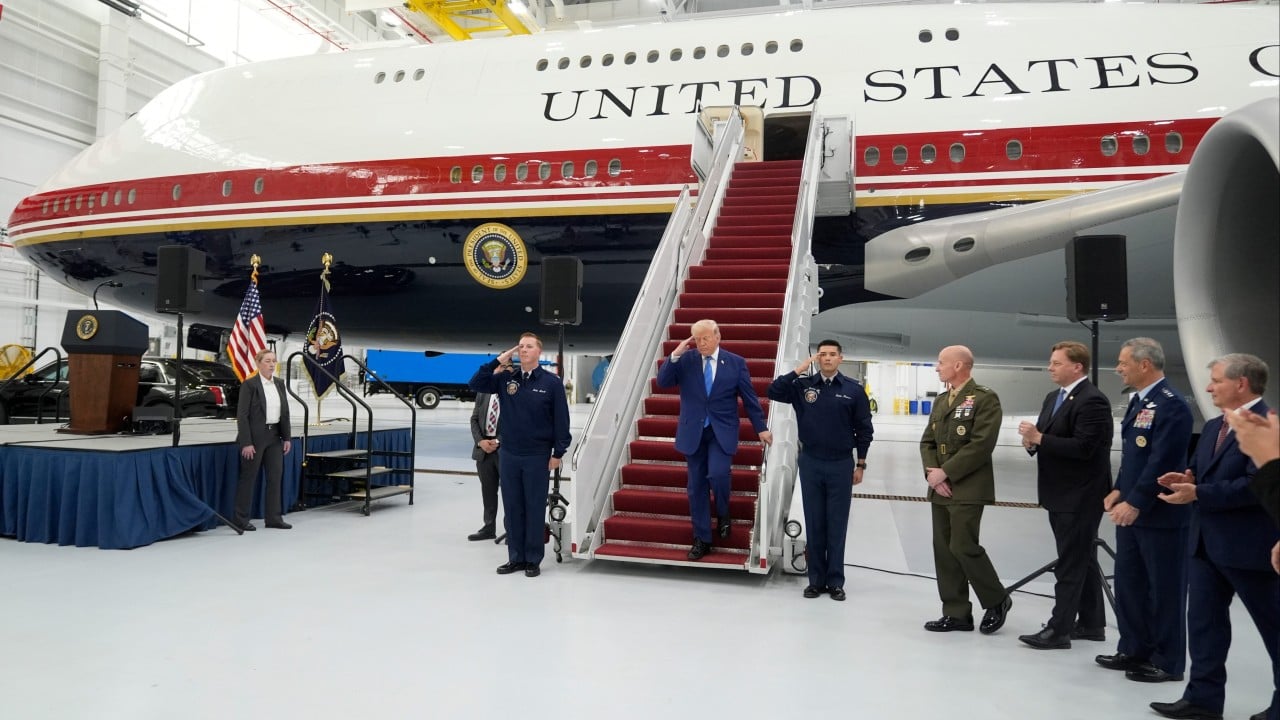
The spectacle inside the Joint Base Andrews hangar on June 19, 2026, was vintage Donald Trump. Standing before a crowd of uniformed service members, the president gestured broadly toward a massive Boeing 747-8 gleaming in a fresh coat of red, white, dark blue, and gold paint. He called it a flying White House with a level of luxury that nobody has ever seen before. The crowd cheered as the signature strains of his campaign rally music echoed through the newly constructed facility.
Then came the geopolitical pivot. Moments after praising the sheer quality of the woods and gold-toned interior accents, Trump announced that this newly christened presidential aircraft would soon carry him to the NATO summit in Ankara, Turkey, followed by a high-stakes diplomatic excursion to China.
It looks like an unalloyed victory for American taxpayers. The aircraft was handed over completely free of charge by the ruling House of Thani in Qatar, bypass-funding a multi-billion dollar procurement logjam with Boeing. Trump repeatedly blasted critics who questioned the optics of a American president accepting an ultra-luxury jumbo jet from a foreign monarchy, declaring that only a fool would turn down a free four-hundred-million-dollar plane.
But things are rarely free in global diplomacy. Beneath the polished exterior and the patriotic paint job lies a tangled web of constitutional friction, defense procurement shortcuts, and quiet Middle Eastern leverage that will accompany the commander-in-chief on his upcoming missions to Beijing and Ankara.
The Anatomy of a Presidential Gift
The story of this aircraft begins far from Washington. Originally manufactured in 2012 as a Boeing Business Jet for the Qatari royal flight, the airframe spent over a decade catering to the ultra-wealthy elite of Doha. It sat mostly idle in recent years as Qatar tried and failed to find a private buyer on the open market.
Money talks. When Trump returned to office in January 2025, he immediately tasked allies with finding a rapid solution to the stalled VC-25B acquisition program, which had seen its costs skyrocket toward five billion dollars under Boeing. Enter billionaire real estate investor and special envoy Steven Witkoff, who coordinated a quiet viewing of the Qatari jet at Palm Beach International Airport in February 2025.
What started as a speculative sales pitch quickly evolved into an outright donation. White House lawyers scrambled to find a legal mechanism to justify the acquisition. Attorney General Pam Bondi and White House Counsel David Warrington eventually issued a memorandum declaring the transaction legally permissible under one condition. The aircraft must be legally deeded to Trump’s presidential library foundation before he leaves office, allowing it to serve as a temporary bridge asset for the federal government in the interim.
Ethics watchdogs are furious. The Foreign Emoluments Clause of the United States Constitution explicitly prohibits federal officials from accepting gifts or titles from foreign states without the express consent of Congress. By routing the asset through a private library foundation while utilizing it for official state business, the administration has created a precedent that critics argue effectively neutralizes the constitutional barrier against foreign financial influence.
Qatar expects a return on its investment. The Gulf nation has spent years navigating a precarious security environment, sandwiched between regional rivals and deeply dependent on the American military footprint at Al Udeid Air Base. Gifting a crown jewel of their executive fleet directly to the American president guarantees an open line of communication with the West Wing that billions of dollars in traditional lobbying could never buy.
Fast Tracking and Cut Corners in Texas
A civilian airliner cannot simply switch on a radio and become Air Force One. The modification process usually requires years of structural rebuilding to install hardened electromagnetic pulse shielding, advanced missile defense countermeasures, and secure encrypted satellite communication arrays.
Time was short. The Pentagon bypassed Boeing entirely for the modification work, handing a rushed contract to defense firm L3Harris to perform the overhaul at a secure facility in Texas. The goal was simple. Get the plane operational by the summer of 2026, regardless of the usual bureaucratic milestones.
The timeline raised immediate red flags within the defense establishment. Documents submitted to the Federal Aviation Administration by AMAC, an aerospace contractor involved in the conversion pipeline, revealed urgent requests for expedited validations. The Air Force admits that it deliberately scaled back several of the highly customized survivability modifications originally slated for the next-generation presidential fleet.
Security experts are deeply unnerved. To meet the aggressive summer deadline, engineers left the interior layout of the Qatari jet minimally changed, focusing almost exclusively on installing essential military communications equipment. This means the structural auditing process, which normally involves stripping an aircraft down to its bare metal ribs to scan for foreign listening devices or latent cyber vulnerabilities, was compressed into a matter of months.
Money was shifted. Congressional defense subcommittees have already begun tracking how the funds for this accelerated conversion were scraped together, with several lawmakers alleging that the Pentagon quietly diverted capital away from long-term strategic priorities, including the critically delayed Sentinel intercontinental ballistic missile modernization program.
The result is a hybrid aircraft. The Air Force has officially designated the plane as the VC-25B Bridge, an interim solution designed to fly the president for the next two years until Boeing finally delivers its delayed, purpose-built replacements in late 2027 and 2028. It is a luxurious compromise that prioritizes immediate political optics over comprehensive military-grade hardening.
The Ankara and Beijing Agenda
The new plane will face its first major operational test next month when it touches down in Turkey for the NATO summit. The timing is delicate. Turkish President Recep Tayyip Erdogan has been aggressively positioning his country as a central mediator in regional conflicts, balancing his NATO obligations with lucrative economic ties to Moscow and Beijing.
Trump will arrive in a plane that signals personal luxury rather than traditional institutional power. That distinction matters in the transactional world of modern diplomacy. By flying an aircraft explicitly gifted by America’s closest Gulf ally, Trump enters regional talks with an overt reminder of his willingness to rewrite traditional diplomatic rules to secure a deal.
The stakes are even higher in September when Chinese President Xi Jinping travels to the United States, setting the stage for Trump’s subsequent return journey to China for a major international conference later in the year. Beijing has watched the acquisition of the Qatari jet with intense scrutiny, recognizing it as a symptom of a broader shift toward personalized, bilateral summitry.
Trade negotiations loom large. Trump’s economic team has been drafting a aggressive new slate of tariffs, while simultaneously signaling a willingness to negotiate grand bargains on technology transfers and market access. Flying into Beijing on a modified foreign luxury liner underlines the administration’s core philosophy that everything, including the very plane the president flies on, is open to negotiation.
The old fleet of VC-25A aircraft, which served American presidents with quiet reliability for over thirty-five years, has been retired to the broader executive airlift pool. Those planes carried the weight of institutional history, defined by the iconic blue-and-white aesthetic established during the Kennedy administration.
The new era looks different. The VC-25B Bridge represents a stark departure from that legacy, embodying a political doctrine where speed replaces patience, personal relationships supersede institutional norms, and the line between public governance and private assets is permanently blurred. As the new red, white, and blue jumbo jet prepares to take flight toward Ankara and Beijing, the world will be watching to see exactly what the donors of this free aircraft expect to receive in return.