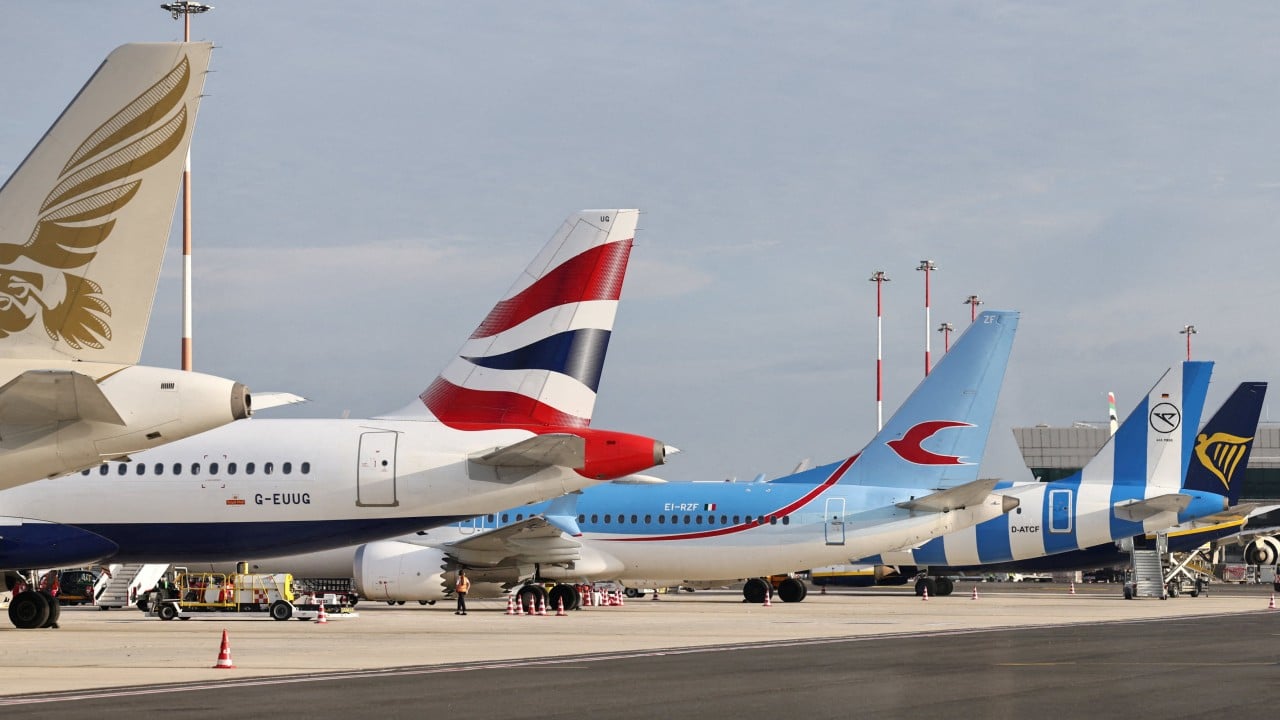
The metal tube weighs four hundred tons. It sits on the tarmac at Frankfurt, shivering against the predawn chill. Inside, three hundred people sleep fitfully against synthetic headrests, dreaming of destinations three thousand miles away. They trust the physics of lift. They trust the silence of the cabin walls. They do not think about what happens when the pumps stop.
Most passengers believe that aviation is an ecosystem of wings, engines, and titanium. They are wrong. Aviation is an ecosystem of chemistry. It is a fragile, continuous chain of boiling crude oil, fractional distillation, hydro-treating, and steel tankers moving across black oceans. Break one link in that chain, and the grand architecture of global mobility freezes in place.
A few years ago, that chain came closer to snapping than anyone in the terminal lounges realized.
Europe ran out of fuel. Not all at once, and not with the dramatic flair of empty highway gas stations during an oil shock. It happened in the quiet ledger books of refineries, in the silent recalculations of airline schedulers, and in the widening chasm between what the continent needed to burn and what it was capable of producing.
To understand how Europe found itself staring into an aviation fuel void, you have to look backward at the anatomy of an aging continent. For decades, European refineries were optimized for diesel. Refiners built their sprawling coastal complexes around the demands of cargo trucks, passenger cars, and industrial machinery. Jet fuel—technically known as Jet A-1—was always a byproduct, a secondary fraction skimmed off the distillation towers during the middle boiling ranges. It was important, certainly, but it was rarely the primary engine of refinery economics.
Then came the fractures.
Geopolitical tremors shook the energy corridors. Long-standing supply routes from the East, which had fed European storage tanks for generations, were severed by sanctions, embargoes, and the painful uncoupling of economies. Simultaneously, European climate policies accelerated the pressure on traditional fossil infrastructure. Refineries aged, margins tightened, and operators faced a bleak choice: spend billions upgrading facilities for a sunset industry or let production dwindle.
Dwindle it did.
By the time pandemic restrictions lifted and millions of travelers flooded back into airports with a collective hunger to see the world, European skies were writing checks their fuel tanks could not cash. Air travel rebounded with ferocious speed, but local refineries could not magically conjure more middle distillates out of thin air. You cannot squeeze a barrel of crude and force it to yield more jet fuel than physics allows without starving the diesel market.
Panic did not erupt in the headlines. Bureaucrats do not like to broadcast vulnerability. Instead, the deficit manifested as soaring crack spreads—the profit margin refiners make from turning crude oil into jet fuel. Prices spiked. Airlines faced existential cost pressures. Schedules were threatened. The invisible machinery of modern European travel was sputtering.
And then, half a world away, the giant stirred.
Picture the coast of South Korea. Specifically, picture Ulsan or Yeosu.
Here, the coastline does not belong to pristine beaches or quiet fishing villages. It belongs to industry on a scale that defies ordinary imagination. Colossal complexes of steel pipes, towering fractionators, storage spheres resembling giant silver marbles, and labyrinthine gantries rise directly from the water. Ships the size of city blocks dock at private piers, their pumping systems humming night and day with the deep, visceral vibration of heavy machinery.
South Korea is an energy anomaly. It possesses virtually no domestic oil reserves of its own. Not a single drop of crude bubbles up from Korean soil. Yet, through sheer engineering ambition and national strategy, South Korea built some of the largest, most sophisticated refining conglomerates on earth—companies like SK Innovation, GS Caltex, S-Oil, and HD Hyundai Oilbank.
These facilities were designed for export. They were engineered to buy raw crude from the Middle East, process it with ruthless efficiency, and ship high-value refined products across the globe. They are massive, complex chemical cathedrals operating with hyper-efficient conversion units that can crack heavy residue into high-purity jet fuel with precision.
When Europe’s deficit opened up like a wound, Korean refiners did not hesitate.
They saw an opening. They also saw an emergency.
The logistics of saving Europe’s summer vacations and cargo networks read like a masterclass in modern global trade. Massive Long Range tankers, capable of carrying hundreds of thousands of tons of refined fuel, began plotting courses away from traditional Asian distribution hubs and toward Northwest Europe.
Consider the journey of one such vessel, let us call it the Pacific Meridian.
She loaded up in Ulsan on a Tuesday, her deep hull settling low into the turquoise water as millions of gallons of crystal-clear Jet A-1 surged through steel loading arms. Her tanks were inerted with nitrogen, protecting the volatile, high-purity fuel from the slightest spark. The crew checked valves, sealed hatches, and cast off lines.
Ahead lay a voyage of over ten thousand nautical miles.
The ship steamed south through the turbulent waters of the South China Sea, navigated the narrow, congested bottleneck of the Strait of Malacca where container ships and fishing boats thread a watery needle, crossed the vast and unpredictable expanse of the Indian Ocean, rounded the Horn of Africa or threaded through the Red Sea depending on security conditions, and pushed up through the Mediterranean or around the stormy shoulder of Western Europe into the North Sea.
It is a journey of weeks. It is a journey burning bunker fuel to deliver fuel. Yet, economics and necessity conspired to make the math work.
When the Pacific Meridian finally docked at a terminal in Rotterdam or Antwerp, her arrival was not marked by cheering crowds or flashing cameras. A pipe was connected. Pumps engaged. The fuel flowed silently from the ship’s belly into the vast onshore storage tanks that feed pipeline networks connected to Amsterdam Airport Schiphol, London Heathrow, and Charles de Gaulle in Paris.
That single shipment was a drop in a very large ocean, but it was part of a relentless, coordinated armada. Month after month, tanker after tanker cleared Korean ports, carrying record volumes of jet fuel westward. South Korean refiners ramped up their operating rates, running their distillation units near maximum capacity to capture the arbitrage. They reconfigured yields, tweaked catalytic crackers, and turned their chemical focus toward the skies of Europe.
The effect was stabilizing.
Without those emergency maritime deliveries from East Asia, European aviation would have faced severe rationing. Grounded flights. Spiraling ticket prices that would have priced ordinary families out of the sky. Cargo delays that would have choked supply chains for electronics, pharmaceuticals, and perishables.
The invisible rescue went largely unnoticed by the public. Passengers sat in leather seats, sipped mediocre coffee, and argued over overhead bin space, entirely unaware that the kerosene burning in the wing turbines was refined beneath the neon lights of Ulsan and hauled halfway across the globe by anonymous mariners riding out swells in the middle of the Indian Ocean.
This is the hidden reality of our hyper-connected era. We live under the comforting illusion of local self-reliance. We imagine that our food, our energy, and our manufactured goods spring from local soil or nearby industrial parks. But when a shock hits—when a regional supply chain fractures under the weight of geopolitics and structural decline—we are instantly reminded that our world is held together by invisible bridges of steel and trade.
South Korea’s intervention in Europe’s jet fuel market was not an act of charity. It was business. It was capitalism operating at its most responsive and ruthless. When demand skyrocketed and local supply failed, market signals flashed across oceans, and economic actors answered the call.
Yet, reducing it purely to profit misses the deeper human truth. Behind every financial ledger entry is a network of human labor. There is the refinery technician in South Korea monitoring pressure gauges at three in the morning to ensure zero contamination in a batch of jet fuel. There is the chief engineer on a tanker calculating ballast water adjustments during a monsoon in the Indian Ocean. There is the fuel farm manager in Rotterdam verifying density specifications before clearing a pipeline for delivery to an airport hydrant system.
They are the unsung guardians of motion.
The crisis has eased, but the underlying vulnerability remains. European refining capacity continues to face structural headwinds as the energy transition accelerates. Refineries will continue to close or pivot toward biofuels and green hydrogen. Demand for aviation fuel, meanwhile, continues to climb as a rising global middle class takes to the skies in search of connection, business, and escape.
The gap between what Europe makes and what Europe burns has not vanished. It has simply been managed, deferred, and bridged by long-distance logistics.
The next time you sit by an airport window, watching the rain streak across the glass as a massive jetliner banks into the grey clouds, look past the gleaming aluminum and the corporate logos. Think about the molecule’s journey. Think of the crude oil pulled from the desert earth, shipped across tempestuous seas, transformed in the humming furnace of a Korean industrial city, loaded onto a floating fortress, and carried across ten thousand miles of open water just so a heavy machine could defy gravity for a few hours.
The world is smaller than we think. It is also much more fragile.
And somewhere out on the dark water, another tanker is already moving through the night, carrying the invisible current that keeps the world awake.


