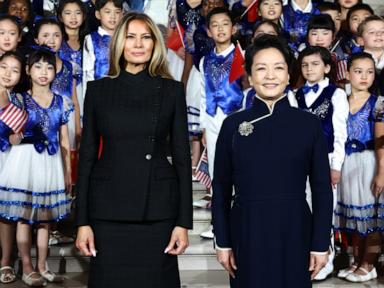
The television cameras rolled on a balmy Florida evening, capturing an impeccably manicured lawn and two couples exchanging polite, rehearsed pleasantries. To the casual observer watching the evening news, the scene at Mar-a-Lago resembled an upscale garden party rather than a pivotal geopolitical summit. Melania Trump stood alongside her husband, greeting Chinese President Xi Jinping and his wife, Peng Liyuan. Every camera angle was calculated. Every dress was selected with the precision of a military campaign.
Yet, beneath the veneer of high society and polite table manners, a quiet theater of statecraft was unfolding. Within hours of that initial handshake, twenty-two Tomahawk missiles would strike an airfield in Syria, turning a dinner of chocolate cake into an international crisis room. But for that initial afternoon, the primary currency traded across the Florida estate was not military strategy or trade deficits. It was optics. It was style. It was the deliberate weaponization of aesthetics.
Critics often dismiss these spousal outings as fluff—mere window dressing designed to fill lifestyle magazines and morning talk shows. That dismissal is a grave analytical error. In the upper echelons of international relations, style is substance. Wardrobes are communication channels. When two superpowers lock horns over currency manipulation, intellectual property theft, and territorial claims in the South China Sea, a well-placed hemline or a carefully coordinated silk jacket can signal warmth, defiance, or calculated deference without a single diplomat uttering a contentious word.
The Choreography of the Spousal Itinerary
State visits do not happen by accident. Every minute detail of a visiting delegation's schedule is negotiated months in advance by teams of protocol officers, intelligence analysts, and press handlers. When a foreign leader brings a spouse, the host nation must construct a parallel diplomatic track. While the heads of state retreat behind closed doors to wrangle over tariffs and security protocols, the spouses are dispatched into the public eye to humanize the proceedings.
This parallel track is designed to project cultural compatibility. Consider the locations chosen for these outings. Botanical gardens, children's classrooms, private museums, and historic estates are selected to evoke shared human values while subtly asserting national identity. When Melania Trump hosted Peng Liyuan, the choice of venue mattered just as much as the guest list. Mar-a-Lago offered an atmosphere of exclusive American wealth and tropical leisure, projecting an image of power wrapped in hospitality.
Yet, this hospitality is entirely transactional. Every photograph published by state media or picked up by global wire services is scrutinized by foreign ministries in Beijing, Washington, and beyond. If a host appears distracted, or if a guest wears a garment originating from a rival nation, pundits dissect the perceived slight for days. The machinery running these events leaves nothing to chance, treating public perception as a critical theater of operations.
The Heavyweight Soft Power of Peng Liyuan
To understand the dynamics of this particular diplomatic outing, one must look closely at the background of China's first lady. Peng Liyuan is not a traditional political spouse in the Western mold. Long before her husband ascended to the presidency, she was a household name across China—a celebrated folk singer, a major general in the People's Liberation Army cultural troupe, and a towering cultural icon in her own right.
This background gives her a unique standing on the world stage. When Peng steps off an aircraft, she does not merely represent her husband; she embodies a state-backed projection of modern Chinese prestige. Her wardrobe choices consistently reflect a deliberate strategy known as state tailoring. Rather than wearing Western luxury brands—a trap that many rising economies fell into during the late twentieth century—Peng exclusively wears Chinese couture, specifically brands designed by domestic houses like Exception.
This approach sends a clear, unyielding message. It broadcasts national self-reliance, cultural pride, and economic maturity. By championing domestic fashion designers on foreign soil, Peng turns her wardrobe into a billboard for the domestic manufacturing economy. When she stood next to Melania Trump in Florida, the visual contrast was stark. Melania represented the glamorous, high-end European aesthetic traditionally favored by American elites, while Peng represented a rising, sovereign nationalism that proudly looked inward for its cultural validation.
The Cynical Utility of Haute Couture
In the arena of foreign policy, emotions are tools to be managed. Public opinion polls in both democratic and authoritarian regimes can sway legislative support or constrain executive action. Consequently, governments spend vast sums on image consultants and public relations firms to ensure their leaders appear relatable, strong, and culturally attuned.
Fashion provides a convenient shortcut through complex policy debates. Explaining bilateral trade imbalances or currency exchange rates to the general public is notoriously difficult. Viewers tune out numbers and economic projections. However, human beings are hardwired to process visual information instantly. A striking dress, a graceful gesture, or an awkward handshake registers immediately in the human brain, bypassing intellectual scrutiny and lodging directly in the emotional memory.
Political operators know this. They understand that a warm photograph of two first ladies sharing a moment of levity can temporarily soften public hostility toward an otherwise adversarial government. When trade negotiations stall and tensions mount, state-controlled media in China or partisan networks in the United States can deploy these images to reset the emotional baseline of the audience. The style becomes a tactical distraction, a shimmering smokescreen behind which contentious hardball negotiations continue unabated.
The Press Pool as Theater Director
No analysis of fashion diplomacy is complete without examining the media apparatus that consumes and amplifies it. The modern press corps functions as an unwitting co-conspirator in this theatrical enterprise. Reporters assigned to cover state visits are often sequestered away from actual policy talks, left with little to report on other than the visual choreography provided to them.
As a result, front pages are frequently dominated by style columns disguised as hard news. Journalists debate whether a coat was too expensive for the political climate, whether a designer snubbed a political figure, or what message a specific color choice might convey. This hyper-focus on aesthetics creates a bizarre distortion in the historical record. Future historians reviewing the primary sources of these summits will find thousands of words dedicated to hemlines and luxury handbags, while the actual geopolitical shifts agreed upon in the subterranean rooms of the estate remain heavily redacted or entirely unwritten.
This media obsession plays directly into the hands of state propagandists. By turning diplomacy into a high-stakes fashion show, governments successfully divert public scrutiny away from uncomfortable realities. Human rights abuses, environmental degradation, and aggressive territorial expansion are easily overshadowed by the shimmering spectacle of two wealthy women walking through a sunlit garden.
Historical Roots of Aesthetic Statecraft
The weaponization of personal appearance in international relations is far from a modern invention. Monarchs and emperors understood long before the advent of television that luxury and style are direct extensions of sovereign power. Louis XIV built the Palace of Versailles not merely as a comfortable home, but as an architectural weapon designed to intimidate foreign ambassadors through sheer aesthetic dominance.
When Jacqueline Kennedy traveled to Paris in 1961 wearing Givenchy, she was engaging in the exact same diplomatic calculus that drives modern state visits. She used French fashion as a bridge of cultural affinity, disarming a skeptical European press and charming the French public with a nod to their own heritage. Similarly, Richard Nixon's historic trip to China in 1972 was carefully stage-managed down to every public appearance, recognizing that the visual imagery of an American president walking the Great Wall would permanently alter the global balance of power in the minds of television viewers worldwide.
What has changed in the contemporary era is merely the speed and scale of transmission. A sartorial choice made in Florida is instantly beamed onto millions of smartphones in Shanghai, New York, and London within milliseconds. The feedback loop is instantaneous, and the pressure on political spouses to perform their roles flawlessly has intensified exponentially.
The Lingering Aftermath of the Spectacle
When the cameras finally stopped rolling at Mar-a-Lago and the motorcades departed for the airport, the illusion of effortless harmony dissolved back into the gritty reality of international competition. The trade deficits remained. The cybersecurity accusations persisted. The geopolitical friction points in the South China Sea continued to simmer without resolution.
Yet, the images endured. They filled the history books of public relations departments and served as case studies in university political science courses. They proved once again that while armies and treasuries decide the ultimate fate of nations, the human imagination is captured by much simpler things. A smile. A handshake. A carefully chosen dress worn under the bright Florida sun, hiding the hard edges of global power beneath a flawless seam.