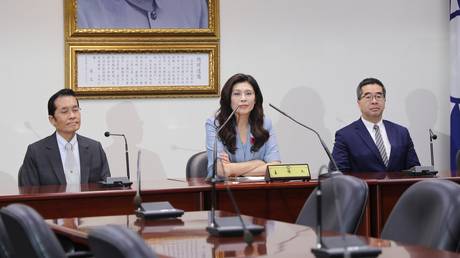
The recent departure of Taiwan’s opposition leadership for mainland China is not a simple diplomatic courtesy call. It is a high-stakes play for political survival. While official statements focus on "reducing tensions" and "protecting trade," the underlying reality is far more transactional. The Kuomintang (KMT) is attempting to position itself as the sole adult in the room, capable of talking to a neighbor that refuses to acknowledge the current administration in Taipei. This move seeks to bypass the ruling Democratic Progressive Party (DPP) entirely, creating a secondary channel of communication that effectively undermines the official government’s foreign policy.
By engaging directly with the Communist Party of China (CPC), the opposition is betting that the Taiwanese electorate prioritizes economic stability and the absence of conflict over ideological purity. It is a gamble. If the trip yields tangible benefits—such as the lifting of trade bans on Taiwanese agricultural products or a visible reduction in military posturing—the KMT wins a powerful narrative for the next election cycle. If it results in nothing but empty photo ops and a perceived "sell-out" to Beijing, it may have handed the DPP a permanent mandate to rule.
The Backdoor Diplomacy Strategy
Mainstream reporting often frames these trips as "peace missions." That is a superficial reading. In reality, we are seeing the institutionalization of a "backdoor" diplomatic track. Since Beijing has frozen all official communications with the DPP leadership, the KMT has stepped into the vacuum. This is a deliberate power move. By being the only party Beijing is willing to pick up the phone for, the KMT attempts to make itself indispensable to Taiwan’s security.
This creates a dangerous friction within Taiwan’s domestic politics. When an opposition party negotiates with a foreign power that is openly hostile to the sitting government, it blurs the line between domestic competition and national security. The DPP views this as a breach of sovereignty. The KMT views it as a necessary pragmatism to prevent a total communication breakdown that could lead to accidental kinetic conflict.
Money over Mandates
The timing of this visit is no coincidence. Taiwan’s economy, while dominated by high-end semiconductors, still relies heavily on traditional sectors like agriculture, fishing, and tourism. These sectors are vulnerable. Beijing has frequently used "technical" bans on items like pineapples or group tours to exert pressure.
When the opposition leader meets with Chinese officials, the subtext is clear: We can make the pain stop. This isn't just about trade; it’s about micro-targeting voters in rural districts who have felt the brunt of Beijing’s economic coercion. If the KMT returns with a "gift" in the form of reopened markets, they aren't just bringing home trade deals—they are bringing home votes. It is a classic example of using external relations to solve internal electoral deficits.
The Invisible Guest at the Table
Washington is watching these developments with a mixture of professional detachment and private anxiety. While the United States officially supports cross-strait dialogue, they prefer it to happen through established, official channels. A rogue diplomatic track led by an opposition party complicates the U.S. strategy of integrated deterrence.
If the KMT promises a "de-escalation" that conflicts with Taiwan’s current defense buildup or its security cooperation with the U.S., it creates a rift that Beijing is more than happy to exploit. The goal for China isn't necessarily to reach a final settlement; it is to keep the Taiwanese polity divided. A house divided against itself cannot effectively negotiate a unified defense posture.
The Problem of the 1992 Consensus
At the heart of this visit is the "1992 Consensus"—a murky, unwritten agreement where both sides acknowledge there is "one China" but have different interpretations of what that means. To the KMT, this is the magic key that opens the door to the Great Hall of the People. To the DPP, it is a poison pill that eventually leads to the erosion of Taiwan’s autonomy.
The opposition leader’s trip is a public reaffirmation of this consensus. It serves as a signal to the Chinese leadership that a segment of Taiwan’s political elite is still willing to play by the old rules. However, the younger generation of Taiwanese voters increasingly views the 1992 Consensus as a relic of a bygone era. They don't see "one China" with different interpretations; they see one Taiwan and one China. This generational shift makes the KMT’s reliance on old-school diplomacy look increasingly out of touch, even if it provides short-term relief from military drills.
The Mechanics of the Meeting
What actually happens in these closed-door sessions? The public sees the handshakes and the banquet tables. The real work is done in the "working groups" that follow. These groups discuss the nitty-gritty of regional stability, the safety of Taiwanese businessmen working on the mainland, and the potential for direct flights.
- Safety of Nationals: Thousands of Taiwanese citizens live and work in China. Their legal status is often precarious during times of high tension.
- Supply Chain Integrity: Despite the talk of "decoupling," the electronics supply chain is still deeply integrated across the strait.
- Military Communication: While not "hotline" level, these meetings allow for a "vibe check" on how far Beijing is willing to push its gray-zone tactics.
By addressing these issues, the KMT tries to prove they are the more competent managers of the status quo. They are positioning themselves as the "safety valve" in a pressure cooker.
A Legacy of Skepticism
The ghost of 2014 still haunts these proceedings. Back then, a proposed trade pact with China sparked the Sunflower Movement, where students occupied the legislature to protest what they saw as over-reliance on Beijing. The KMT has never fully recovered from that PR disaster. Every time a leader goes to Beijing, the specter of the Sunflower Movement rises again.
The opposition knows this. They are treading carefully, avoiding any language that could be interpreted as a step toward unification. But Beijing is a master of the "salami-slicing" technique. They push for small concessions, bit by bit, until the cumulative effect is a significant shift in the status quo. The opposition leader might go in looking for a trade deal and walk out having inadvertently validated a narrative that Taiwan is a "province" waiting to return to the fold.
The Risks of Personal Diplomacy
Politics in Taiwan is intensely personal. This trip is as much about the opposition leader’s standing within his own party as it is about cross-strait relations. There are internal rivals watching for any stumble. If he appears too subservient, he will be eaten alive by the Taiwanese press. If he is too combative, he returns empty-handed, proving the DPP’s point that talking to Beijing is a waste of time.
This creates a performative aspect to the visit. The leader must look "stately" but not "traitorous." It is a tightrope walk over a pit of political fire. The risk is that in trying to please everyone—the Chinese hosts, the domestic voters, and the party elders—he ends up satisfying no one.
The Beijing Perspective
For the CPC, this visit is a propaganda victory. It allows them to tell their domestic audience that "reasonable" people in Taiwan still exist and that the "separatists" in the DPP are an isolated minority. It is a way of showing strength without firing a single shot. By hosting the opposition, Beijing dictates the terms of the engagement. They choose who is "worthy" of a seat at the table, thereby exercising a form of veto power over who can represent Taiwanese interests.
The Strategy of Tension
We must understand that Beijing uses tension as a tool, not just a result of policy. They can turn the heat up or down at will. By welcoming the KMT, they are momentarily turning the heat down to show what "peace" looks like under their terms. This is a classic carrot-and-stick approach. The KMT is the carrot; the aircraft carriers circling the island are the stick.
If the Taiwanese public begins to believe that the stick only goes away when the KMT is in power, then Beijing’s strategy has succeeded. This is the definition of political warfare. It is an attempt to influence the democratic processes of another entity by using a mixture of economic incentives and psychological pressure.
The opposition leader’s presence in China is the physical manifestation of this strategy. He is, whether he likes it or not, a piece on a much larger chessboard. The moves he makes in Beijing will resonate far beyond the immediate news cycle. They will shape the narrative of the next several years of East Asian security.
Success for this mission isn't measured in a signed treaty. It is measured in the degree to which the Taiwanese public starts to fear the alternative. If the trip creates a sense of "inevitable alignment," then the foundations of Taiwan’s current resistance have been weakened. The real investigative question isn't what they discussed in the meeting, but what the KMT had to promise in the hallway to get the meeting in the first place.
Diplomacy is rarely about what is said in the room. It is about what is understood before the doors even open. The KMT is betting that they can manage a tiger that has every intention of eventually devouring them. It is a bold, perhaps desperate, attempt to regain relevance in a world that is increasingly moving toward binary choices. In the end, the voters in Taipei, not the officials in Beijing, will decide if this trip was a masterclass in pragmatism or a historical mistake.
There are no neutral observers in this conflict. Every handshake is a statement of intent, and every silence is a concession. The opposition leader has stepped into the arena; now he has to find a way out that doesn't involve giving up the very island he hopes to lead.


