Most holiday gift guides are little more than affiliate-link farms masquerading as shopping advice. When you search for the best Lego sets to gift this holiday season, you are usually handed a bloated list of thirty-plus boxes sorted vaguely by price, designed to make you click blindly rather than buy wisely. If you want the actual best Lego sets right now, skip the generic lists and target sets with high piece-to-price ratios, retiring status, or genuine mechanical ingenuity—like the Lego Icons Concorde (10318) for adults, the Lego Creator 3-in-1 Medieval Castle (31120) for builders who want replayability, and the Lego Technic NASA Mars Rover Perseverance (42158) for older kids who want real engineering.
To buy the right box this winter, you have to understand how the Danish toy giant actually operates behind the curtain.
The Economics of the Plastic Brick
Lego is no longer just a children's toy company. Over the last decade, the brand executed one of the most aggressive demographic pivots in retail history, aggressively courting the "AFOL"—Adult Fan of Lego—market. Today, sets stamped with an "18+" black box dominate the top shelf of every toy store and department display.
This shift changed how sets are priced, marketed, and ultimately discounted. Historically, veteran collectors used the ten-cent-per-piece rule as a baseline for value. If a set had 1,000 pieces and cost $100, you were getting a fair deal. That metric is largely broken now. Licensing fees for intellectual properties like Star Wars, Marvel, Disney, and Lord of the Rings routinely inflate prices to twelve, fifteen, or even twenty cents per piece. When you buy a licensed set, a massive percentage of your money goes straight to Burbank or San Francisco, not into the weight of the ABS plastic in the box.
Consider a hypothetical example of two different $100 sets sitting side by side on a shelf. Box A is an unlicensed Lego City or Creator set containing 1,200 bricks, two motorized functions, and three distinct build instructions. Box B is a licensed sci-fi starfighter containing 650 bricks, four exclusive minifigures, and a sticker sheet the size of a paperback novel. Box B will almost certainly be featured on every mainstream holiday list because the brand name sells itself. Box A is the superior gift for someone who actually enjoys the act of building.
The Sticker Problem and Mold Costs
If you want to judge the true quality of a Lego set before opening it, look at the decoration method. High-end display sets increasingly rely on vinyl stickers rather than pad-printed bricks. For a $50 playset, stickers are fine. For a $400 collector piece, applying forty crooked decals with tweezers feels cheap.
Lego limits printed pieces because every unique print requires a dedicated production line slot and storage bin in their factories in Billund, Nyíregyháza, or Jiaxing. Similarly, introducing a brand-new plastic mold costs tens of thousands of dollars in precision steel tooling. When a set features newly molded elements—like specific botanical leaves or custom minifigure helmets—the retail price climbs to amortize that factory cost. Savvy buyers look for sets that use existing bricks in clever, unexpected geometry rather than relying on giant, single-use molded shells.
What to Buy for Young Builders Without Wasting Money
Buying for kids between the ages of six and twelve is where most gift-givers make critical mistakes. They buy a massive, complex licensed set because it looks impressive under the tree, only to watch the child abandon it halfway through bag four because the build process is too repetitive or fragile.
Playability beats display value every single time for younger builders. A great kids' set needs structural integrity. It needs to survive being swooshed across a living room and dropped onto hardwood floors.
- Lego Creator 3-in-1 Line: This is the undisputed king of value in the entire Lego catalog. Nearly every box in this theme offers three distinct builds using the exact same pool of bricks. Sets like the Medieval Castle (31120) or the Space Astronaut (31152) teach kids the core philosophy of the toy—that bricks are meant to be taken apart and reimagined, not glued together and placed on a shelf.
- Lego City Space Subtheme: Over the last couple of years, Lego revitalized its internal Space lineup without relying on movie licenses. Sets like the Modular Space Station (60433) or the Space Explorer Rover and Alien Life (60431) feature standardized airlock connection systems. This means a child can physically snap different sets together to build a massive, unified base. You get maximum creative return without paying the Star Wars tax.
- Lego Speed Champions: If you need a stocking stuffer or a gift under $30, stop looking at basic polybags and buy a Speed Champions car. Designed at an eight-stud-wide scale, these sets utilize some of the most advanced, mind-bending building techniques Lego designers have ever devised. Building a Ferrari 812 Competizione (76914) or a Ford Mustang Dark Horse (76920) feels like solving a miniature mechanical puzzle. They are sturdy enough to race across the kitchen floor and detailed enough to sit on an office desk.
The Adult Collector Market and the Art of the Display Piece
Adults buy Lego for entirely different reasons than children. For an adult, the build process is a form of tactile meditation—a way to shut off a screen for four hours and work with your hands. Once finished, the set becomes home decor. If it looks like a bright primary-colored toy, it ends up in a closet. If it looks like a museum piece, it stays on the bookshelf.
Architectural and Engineering Marvels
The Lego Icons and Architecture lines understand this assignment better than anything else. Take the Concorde (10318). Measuring over forty inches long, it contains zero stickers—every single livery marking and window line is printed directly onto the bricks. Better yet, the internal engineering allows you to twist the tail cone to deploy and retract the landing gear simultaneously, while the famous droop-snoot nose tilts down just like the real supersonic jet.
For buyers working with a smaller footprint and a tighter budget, the Architecture Himeji Castle (21060) captures the sweeping rooflines and defensive walls of the Japanese landmark at a micro-scale that looks sophisticated in any living room. It proves you do not need five thousand pieces to create visual impact.
The Botanical Collection Phenomenon
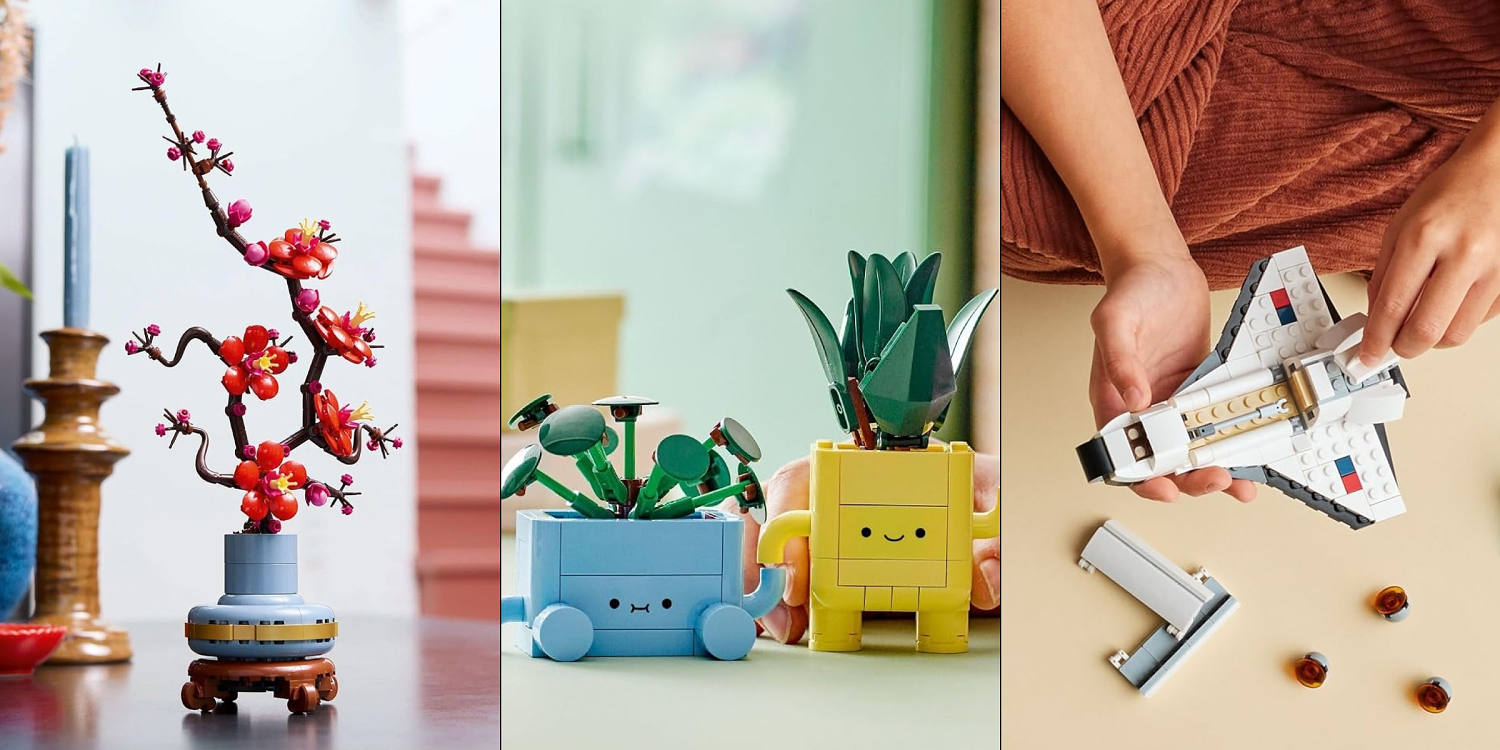
Few product lines have brought more newcomers into the hobby than the Lego Botanical Collection. Sets like the Orchid (10311), Bonsai Tree (10281), and Wildflower Bouquet (10313) solve a genuine gifting problem. They are affordable, generally sitting between $50 and $60, require zero watering, and showcase incredible parts usage. In the Bonsai Tree, dozens of tiny pink frogs are used as cherry blossoms. In the Orchid, pink Demogorgon heads from Stranger Things and minifigure shields form the petals. It is clever, restrained, and universally appealing to people who would never otherwise buy a toy.
Pop Culture Icons Done Right
If you are going to pay the licensing premium, make sure the set earns it. Too many licensed sets are just gray triangles—a notorious complaint among Star Wars collectors tired of endless variations of Star Destroyers and Millennium Falcons.
When a licensed set works, it captures the soul of the source material. The Lego Ideas Jaws (21350) diorama gives you the Orca fishing boat, the three main characters, and the shark bursting out of a brick-built ocean wave. Similarly, the Lego Icons The Lord of the Rings Rivendell (10316) is widely considered one of the greatest sets ever designed, utilizing roof tiles made of hundreds of individual 1x1 plates that you align using a flat brick separator. At $500, it is an investment, not an impulse buy, but the sheer density of architectural detail justifies the price tag in a way few giant sets ever manage.
The Technic Divide Mechanics Over Aesthetics
Before buying a Lego Technic set, know your recipient. Technic swaps traditional studded bricks for beams, pins, axles, and gears. The build process is entirely different. It requires spatial reasoning, careful attention to gear friction, and the finger strength to push dozens of friction pins into place. If a builder puts a single differential gear in backward during step forty, the entire model will lock up at step three hundred, requiring hours of painful disassembly.
For people who love mechanical engineering, nothing else comes close. The NASA Mars Rover Perseverance (42158) features a fully articulated six-wheel rocker-bogie suspension system that actually keeps all six wheels on the ground when rolling over uneven obstacles, plus 360-degree steering and a movable robotic arm. It is a genuine education in planetary rover mechanics disguised as a $100 gift.
On the massive end of the spectrum, sets like the Liebherr Crawler Crane LR 13000 (42146) or the flagship 1:8 scale supercars—such as the Ferrari Daytona SP3 (42143)—offer working eight-speed sequential gearboxes and moving pistons. However, avoid buying these mega-sets for casual builders. Without a deep appreciation for mechanical linkages, a 3,500-piece Technic build quickly turns from a fun holiday project into an exhausting chore.
Navigating the Secondary Market and Retirement Windows
Every Lego set has a finite lifespan. Most stay on retail shelves for eighteen to twenty-four months before Lego permanently retires the production run to make room for new waves. Once a set retires, supply freezes overnight, and secondary market prices on platforms like BrickLink and eBay climb rapidly.
November and December represent the absolute final window to buy sets slated for end-of-year retirement at retail price. If a recipient has their eye on an older modular building, a specific Star Wars diorama, or a popular Ideas set that came out two years ago, do not wait until January. By the new year, that $200 set will likely cost $320 from a third-party reseller.
How to Spot a Fake Discount
Holiday sales create a minefield of deceptive pricing. Major retailers routinely inflate the "original" price of a Lego set during November just to slap a bright red "25% Off" banner over it, bringing it right back down to the standard Manufacturer's Suggested Retail Price (MSRP).
Never trust a percentage-off badge without checking the actual MSRP on the official Lego website first. A genuine deal in the Lego world is 20% off true retail price. You will see this discount frequently at big-box stores like Target, Walmart, and Amazon on mainstream themes like City, Friends, Star Wars, and Technic. Conversely, massive Lego-exclusive sets—often marked as "Hard to Find" on the official store—almost never go on sale at third-party retailers. For those boxes, your best financial move is buying directly through the Lego Insiders loyalty program during a Double Points event, which effectively gives you 10% back in store credit toward a future purchase, often stacked with a free Gift With Purchase (GWP) mini-set.
The Counter-Argument Against Massive Sets
The biggest trap in holiday shopping is assuming bigger equals better. Modern flagship Lego sets routinely cross the 4,000, 5,000, and even 9,000-piece thresholds. Sets like the Titanic (10294) or the Eiffel Tower (10307) are astonishing feats of industrial design, standing nearly five feet tall when completed.
They are also logistical nightmares for normal human beings.
Before you buy someone a gargantuan set, ask yourself where they are going to put it. A model with a three-foot footprint requires dedicated furniture, heavy-duty shelving, and constant dusting. Taking it apart means sorting five thousand tiny pieces into zip-top bags, because rebuilding a massive set from a single giant pile of unsorted plastic is a special kind of misery. Often, buying two or three mid-sized sets in the $80 to $150 range provides a vastly better building experience, greater variety, and far less spatial regret than dropping $600 on a single monolithic box.
The Pre-Purchase Checklist
Stop scrolling through endless top-thirty lists and apply a strict filter before entering your credit card details.
- Check the retirement status: Search the set number plus the word "retiring" to see if this holiday season is your last chance to get it at retail price.
- Verify the true MSRP: Cross-reference the price on Lego.com so you do not fall for fake Black Friday or Cyber Monday markups.
- Match the build style to the person: Buy Creator 3-in-1 or City for imaginative kids, Technic for gearheads, and Icons or Botanicals for adults who care about how their living room looks.
- Measure the shelf: Check the exact finished dimensions printed on the side of the box before committing to anything over 2,500 pieces.
Buy the set that respects the builder's time, intelligence, and shelf space, and leave the overpriced licensed filler sitting on the store shelf.