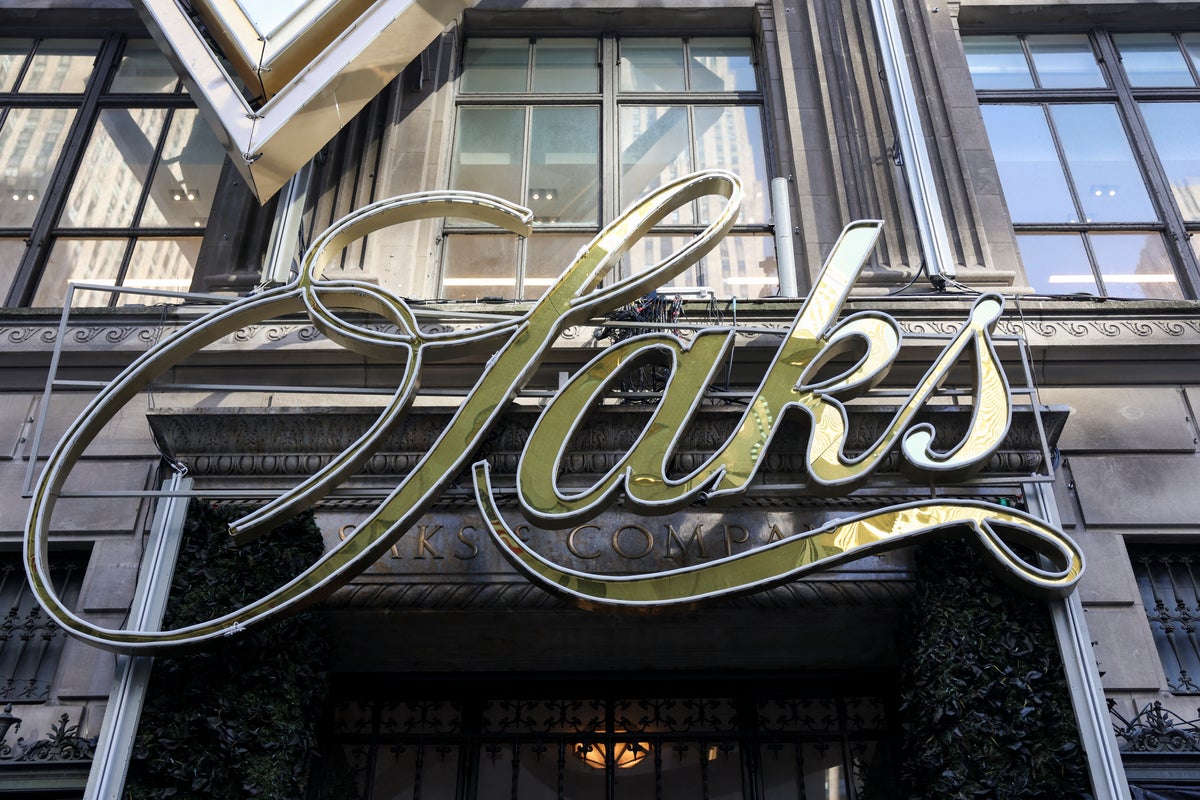
The coffee was still hot when the calendars began to clear. It’s a specific kind of silence that descends upon a corporate office when the "Update on Organizational Structure" email hits the inbox. At Saks Global—the newly minted titan formed from the union of Saks Fifth Avenue and Neiman Marcus—that silence didn't just feel heavy. It felt like the end of an era.
The glass-and-steel cathedrals of high fashion are built on the premise of excess, but the reality inside the boardroom has become one of surgical extraction. While the storefronts still boast velvet ropes and $2,000 handbags, the back offices are being gutted. This isn't just a "culling" of the workforce, as the dry financial headlines suggest. It is a fundamental rewriting of what luxury looks like when the math no longer adds up.
Consider a person we’ll call Sarah. She isn’t a statistic. She is a Director of Brand Heritage who spent fifteen years ensuring that the specific shade of cream on a shopping bag remained consistent across three continents. She survived the pandemic. She survived the shift to e-commerce. But she couldn't survive the merger. When the notification arrived, she wasn't looking at a severance package; she was looking at the sudden evaporation of a legacy.
Saks Global is currently shedding a massive portion of its corporate staff—some estimates suggest several hundred positions—as it attempts to find "synergies" between two former rivals. In the language of private equity, a synergy is a beautiful thing. In the language of the people sitting in those cubicles, it is a polite word for a pink slip.
The Weight of the Crown
The merger between Saks and Neiman Marcus was supposed to be the definitive answer to the Amazon-ification of retail. By joining forces, they created a behemoth with the scale to negotiate, the data to predict, and the prestige to survive. But behemoths are heavy. They require a lot of fuel.
To understand why these cuts are happening now, you have to look past the mahogany desks and into the brutal mechanics of luxury debt. Luxury is a game of margins. When the economy stutters, the first thing to go isn't the billionaire's appetite for art; it's the aspirational shopper’s ability to justify a new pair of Louboutins.
The middle class, once the secret engine of the luxury boom, has retreated. Inflation didn't just make eggs more expensive; it made the "treat yourself" culture feel like a reckless gamble. Saks Global is reacting to a world where the top 1% cannot carry the weight of the entire infrastructure alone.
The cuts hit the corporate heart. Marketing, human resources, logistics, and middle management—the connective tissue that keeps a multi-billion-dollar machine running—are being thinned out. The logic is simple: if you have two companies doing the same thing, you only need one person to steer the ship. But ships aren't just steered. They are maintained. They are scrubbed. They are loved.
The Invisible Stakes of a Brand
When a company like Saks Global reduces its headcount so drastically, the immediate impact is a line item on a balance sheet. The stock price might tick upward. The investors might breathe a sigh of relief. But the long-term cost is often invisible until it’s too late to fix.
Luxury is a feeling. It is the belief that you are being taken care of by an institution that values excellence above efficiency. When you hollow out the corporate staff, you lose the institutional memory. You lose the person who remembers why a certain designer was banned in 1998, or why a specific flagship store’s lighting must be calibrated to the sunset.
We are witnessing the "Procter & Gamble-ization" of high fashion.
The goal is no longer to be a house of dreams, but a high-efficiency delivery mechanism for status symbols. The people being let go are the keepers of the dream. Without them, Saks Global risks becoming just another website with a very expensive warehouse.
The pressure is immense. Consider the math of the merger. Amazon and Salesforce are lurking in the background as investors and partners, bringing with them a culture of "Day 1" thinking and ruthless optimization. In Silicon Valley, a layoff is a pivot. In the world of Fifth Avenue, a layoff is a crack in the porcelain.
The Human Cost of Optimization
Imagine the Monday morning after the cuts.
The survivors walk into the office. The desks next to them are empty. There is no celebratory champagne for the "newly streamlined" organization. Instead, there is the crushing weight of "doing more with less."
One person is now doing the work of three. The social media manager is now also the copywriter and the junior analyst. The buyer for European shoes is now also looking at handbags and accessories. The result is a thinning of the soul.
We often talk about layoffs in terms of percentages. "Ten percent of the workforce." "Five hundred heads." But a "head" is a person with a mortgage, a child in daycare, and a deep sense of identity tied to their profession. To work at Saks was once a badge of honor. It meant you were the best in the business. Today, it means you are a variable in an equation that is trying to solve for "profitability at any cost."
The cruelty of the modern corporate cycle is that these cuts are rarely the last ones. They are a signal. They tell the market that the company is in a defensive crouch. And when a luxury brand stops leaning forward, it starts to look old.
A World Without the Middle
The Saks Global restructuring is a microcosm of a much larger shift in our global economy. We are moving toward a "barbell" reality. On one end, you have the ultra-premium, ultra-expensive, and ultra-exclusive. On the other, you have the mass-market, high-volume, and low-cost.
The middle is dying.
The corporate staff being cut are the people who managed that middle ground. They were the ones who figured out how to make a $500 wallet feel like a $5,000 experience. As those roles disappear, the bridge between the average consumer and the world of high fashion begins to crumble.
Is this the future we want? A world where luxury is just an algorithm-driven transaction, stripped of the human touch that made it storied in the first place?
The executives at Saks Global would argue that they are saving the company. They would say that by cutting now, they ensure the brand survives for another hundred years. Perhaps they are right. Survival is a messy, unglamorous business. But as the lights go out in offices across New York and Dallas, it’t hard not to feel that something precious is being tossed into the bin along with the old letterhead.
The bags are still beautiful. The windows are still polished. But if you listen closely to the halls of the corporate headquarters, you can hear it.
The echo.
It’s the sound of a legacy being trimmed for the sake of a spreadsheet. It’s the sound of the humans being moved out of the way to make room for the "Global" in the name. And for those left behind, the view from the top of the mountain has never felt more precarious.
The red lipstick stays on. The smile remains fixed. But the heart of the house is beating a little slower today.