The headlines are screaming about a "blockade" of the Strait of Hormuz. They’re painting a picture of a desperate Tehran crawling to the negotiating table because the U.S. Navy finally turned off the world’s oil faucet. It’s a clean narrative. It’s easy to digest.
It is also fundamentally wrong. Meanwhile, you can explore similar developments here: The Dark Silence at Buchenwald and the Breaking of Germany’s Cultural Consensus.
If you think Iran is calling Washington because they’re "beaten," you haven’t been paying attention to the last forty years of shadow theater in the Persian Gulf. This isn't a surrender. It’s a price hike. The consensus view—that raw military pressure equals immediate diplomatic submission—is a relic of 20th-century thinking that ignores the brutal mathematics of modern energy logistics and the specific psychology of the Islamic Revolutionary Guard Corps (IRGC).
The Blockade Myth
Let’s talk about the physical reality of "blocking" the Strait of Hormuz. Pundits talk about it like it’s a garden hose you can just kink. It’s not. We’re talking about a waterway where the shipping lanes are two miles wide, separated by a two-mile buffer. To understand the full picture, we recommend the detailed analysis by Al Jazeera.
The U.S. isn't "blocking" the strait in a way that stops Iranian movement; they are creating a friction tax. Every time a carrier strike group sits in those waters, the cost of insurance for a VLCC (Very Large Crude Carrier) spikes. But guess who is best at navigating "gray zone" logistics? It isn’t the law-abiding shipping conglomerates in London or Singapore. It’s the Iranian ghost fleet.
By "choking" the strait, the U.S. has inadvertently handed Iran a premium on every barrel they manage to sneak out through the Jask terminal—which, conveniently, sits outside the strait. Iran has spent a decade building infrastructure to bypass the very chokepoint the West thinks it’s holding hostage.
The Phone Call Strategy
Trump says they "want to make a deal very badly." Maybe they do. But not for the reasons the State Department wants to believe.
In Persian diplomacy, the "phone call" is a tactical weapon, not an admission of defeat. When Tehran reaches out during a period of high tension, they aren't looking for a white flag. They are looking for a "pause" button. They know the American political cycle is shorter than a season of prestige television. They play for time.
I’ve watched analysts misread this play since the 1980s. They see a sagging Rial and bread protests in Mashhad and assume the regime is weeks away from collapse. They forget that the IRGC thrives in a black-market economy. Sanctions and blockades don't starve the elite; they eliminate the competition. When you formalize a blockade, you kill the "legitimate" Iranian private sector and hand 100% of the remaining economy to the guys with the guns.
Why wouldn't they call? If a five-minute conversation can get a carrier moved or a sanction waived for "humanitarian" reasons, it’s the cheapest intelligence-gathering mission they’ve ever run.
The Oil Market’s Dirty Secret
The biggest lie in this entire "blockade" narrative is that the world can't live without that oil.
The market has already priced in a conflict. If the Strait of Hormuz actually closed—not just "monitored" but hard-closed—oil wouldn't just go to $150. It would break the global financial system. The U.S. knows this. China knows this. Iran knows this.
Because of this "Mutual Assured Economic Destruction," a total blockade is a bluff. It’s a theatrical performance where both sides know the lines.
- The U.S. Bluff: "We will stop every drop of oil." (They can't, without sinking Chinese tankers and starting World War III).
- The Iranian Bluff: "We will mine the strait." (They won't, because they’d starve their own people faster than the West could).
What we are seeing is Aggressive Signaling. It’s a dance designed to see who blinks first during an election year or a budget cycle.
The "Art of the Deal" Meets the "Science of the Souk"
The competitor's piece suggests that the "deal" Iran wants is a return to the status quo. That’s a fundamental misunderstanding of the leverage at play.
Iran wants a deal that codifies their status as a regional hegemon. They aren't looking to "behave." They are looking for a deal that pays them to stop doing the things they were only doing to get the deal in the first place. It’s a protection racket at a geopolitical scale.
If you’re an investor or a policy hawk, don't look at the headlines about "desperation." Look at the shipping data in the Gulf of Oman. Look at the volume of crude moving into Ningbo. If the blockade were working, the Chinese economy would be screaming. It’s not. They’re getting discounted Iranian crude, rebranded as Malaysian or Emirati, and laughing at the "blockade" on their way to the bank.
Stop Asking if the Sanctions Work
The question isn't "Are the sanctions working?" The question is "Who are they working for?"
- For the U.S. Administration: They provide a "strongman" narrative for domestic consumption.
- For the IRGC: They provide a monopoly on all remaining trade and a convenient "Great Satan" to blame for their own economic mismanagement.
- For the Hardliners in Tehran: They provide the perfect excuse to accelerate the nuclear program under the guise of "national survival."
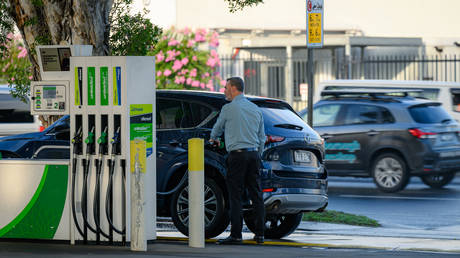
The only people the sanctions and the blockade don't work for are the Iranian middle class and the global consumer paying a "risk premium" at the pump for a conflict that is largely choreographed.
The Counter-Intuitive Truth
If the U.S. actually wanted to break the Iranian regime, they wouldn't block the strait. They would flood the region with so much cheap energy and open trade that the IRGC’s black-market monopolies would become irrelevant.
A blockade is a gift to a command economy. It justifies the existence of the secret police. It makes the smuggler a national hero.
Iran isn't calling because they are out of options. They are calling because they’ve identified a window where the U.S. is desperate for a "foreign policy win." They are going to sell us a "peace" that they’ve already broken a dozen times, and we’re going to buy it because the alternative—actually admitting that the blockade is a porous, expensive failure—is too politically bruising to face.
The Brutal Reality of "Maximum Pressure"
We’ve seen this movie.
In 2019, the pressure was "maximum." The result? Attacks on the Abqaiq–Khurais processing facility in Saudi Arabia. In 2020, it was "maximum." The result? Missiles at Al-Asad airbase.
The "blockade" isn't a solution; it’s a catalyst for the next escalation. Tehran’s "desire for a deal" is a desire for a reset. They want to clear the board because they’ve reached the limit of what they can extract from this current cycle of chaos.
They aren't "badly" wanting a deal because they’re starving. They want a deal because they’ve won this round of chicken and they’re ready to collect their winnings before the next hand is dealt.
Stop reading the tea leaves of "official" statements. Watch the tankers. Follow the insurance premiums. And for heaven's sake, stop believing that a phone call from a professional survivor like the Iranian foreign ministry is anything other than a feint.
The "blockade" is a paper tiger, and the "deal" is just a way to buy more paper.