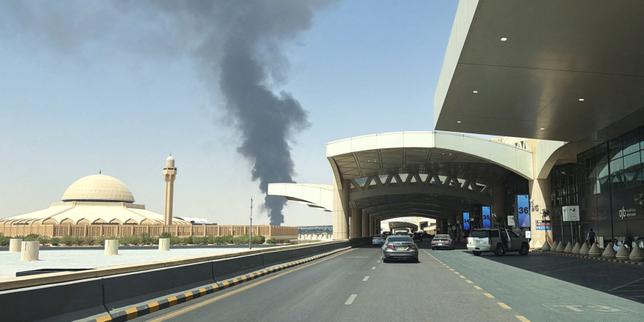
When a ballistic missile targets a capital city, the stakes instantly shift from regional tension to international crisis. That is precisely what happened when the Saudi-led military coalition intercepted a ballistic missile launched toward Riyadh by Houthi forces. It wasn't just another night of intercepted projectiles near the border. It was a direct strike aimed at the heart of Saudi Arabia's political and financial power.
You need to understand the geography and the physics here to grasp why this specific incident rattled diplomats worldwide. Riyadh sits deep inside Saudi territory, hundreds of kilometers away from the Yemeni border. Hitting the capital requires advanced rocketry, precise guidance systems, and a blatant escalation in capability.
The Escalation No One Wanted to Ignore
For years, the conflict in Yemen played out as a brutal proxy war largely contained to border regions and strategic port cities like Hodeidah. Missiles occasionally crossed into southern Saudi provinces, triggering Patriot battery launches that rarely made global front pages. But aiming directly at Riyadh changes the calculus entirely.
When air defense systems light up the night sky over a major metropolis, civilian panic follows immediately. Even when interceptions succeed, falling debris poses severe risks to populated neighborhoods.
International observers immediately condemned the launch, pointing out that such actions torpedo peace talks and prolong humanitarian suffering in Yemen. But condemnation rarely stops a determined faction equipped with external military backing and increasingly sophisticated hardware.
Behind the Technology of Interception
People often ask how these missile defense systems actually work in practice. It comes down to split-second radar tracking and kinetic kill vehicles. When a ballistic missile reaches the apex of its trajectory, Saudi Patriot batteries calculate its arc and fire interceptors designed to collide with the incoming threat at supersonic speeds.
It is high-stakes physics playing out in seconds.
However, defense systems are never one hundred percent foolproof. Relying purely on interception is a defensive trap. It drains financial resources and leaves cities perpetually on edge. Experts argue that military shields must be paired with aggressive diplomatic pressure to cut off the supply chains feeding these weapons into Yemen in the first place.
What This Means for Regional Stability
The fallout from these attacks extends far beyond Riyadh's city limits. Global energy markets react instantly to any security threat in Saudi Arabia. Oil infrastructure, shipping lanes in the Red Sea, and foreign investment confidence all hang in the balance whenever air raid sirens sound in the kingdom.
If you are following Middle Eastern geopolitics, you know that de-escalation is fragile. Every time a ballistic missile crosses the threshold toward a civilian center, trust evaporates.
The path forward requires more than temporary ceasefires that crumble at the first sign of friction. Regional actors must decide whether continuous escalation serves any practical purpose, or if economic development and stability should finally take priority. Until that realization hits all sides, the night skies over the Arabian Peninsula will remain tense, guarded, and unpredictable.