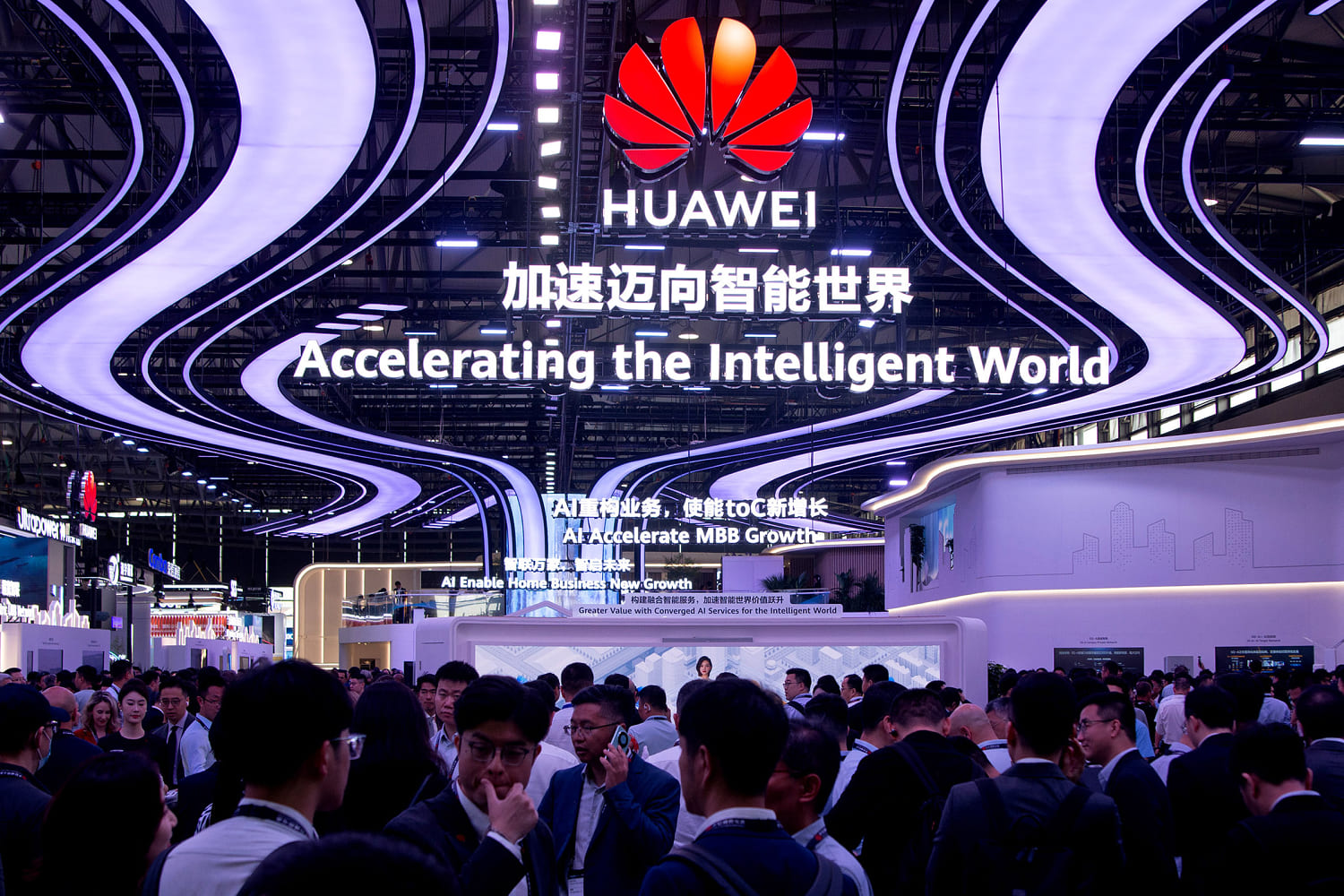
Huawei’s semiconductor division, HiSilicon, isn’t interested in playing a game it’s rigged to lose. For decades, the tech world has worshipped at the altar of Moore’s Law—the idea that you just shrink transistors to get faster gadgets. But when the U.S. government cut off your access to the machines that do the shrinking, that path becomes a dead end.
On May 25, 2026, at a technical symposium in Shanghai, Huawei’s chip boss He Tingbo didn't just announce a new product. She announced a new philosophy called the Tau (τ) Scaling Law. It’s a shift from making things smaller to making them smarter. Instead of obsessing over nanometers, Huawei is pivoting to system-level efficiency.
They’re basically telling the world that if they can’t have the smallest transistors, they’ll build the fastest highways between the ones they have.
The Math Behind the Magic
The core of this breakthrough is something Huawei calls LogicFolding. Most modern chips are essentially flat cities. Data has to travel long distances across the silicon to get from point A to point B. This creates heat and slows everything down.
LogicFolding changes the layout. Think of it like replacing a sprawling suburban neighborhood with a high-rise apartment complex. By "folding" the logic circuits, Huawei claims they can shorten the wiring inside a chip significantly.
According to leaked data from the symposium, the results are startling. We’re looking at:
- A 53.5% increase in transistor density.
- A 41% jump in energy efficiency for performance cores.
- Peak clock speeds hitting 3.1 GHz.
That last number is the kicker. For context, the heavy hitters from Apple and Qualcomm are pushing past 4.0 GHz. Huawei is still behind in raw speed, but they’re closing the "user experience gap" without needing the multi-billion dollar EUV lithography machines that the U.S. won't let them buy.
Survival is the Mother of Invention
I’ve watched Huawei’s "extreme survival mode" since the 2019 blacklist. Honestly, most experts thought they’d be out of the high-end smartphone business by now. Instead, they’ve mass-produced 381 different chip designs over the last six years.
That’s not just a statistic. It’s an engineering marathon.
The move to Tau Scaling is a pragmatic admission. Huawei knows that SMIC (their manufacturing partner) is struggling with 5nm yields using older DUV equipment. Those chips are reportedly 50% more expensive to make than TSMC's version because they require "multi-patterning"—basically etching the same wafer over and over to get the detail right. It’s slow, it’s expensive, and the failure rate is high.
By focusing on interconnect latency and LogicFolding, Huawei is extracting 3nm-level performance out of older 7nm or 5nm production lines. It’s like tuning a 2010 Honda Civic to outrun a 2024 Ferrari on a narrow, twisty road. The Ferrari has more horsepower, but the Civic is better built for the specific track.
The First Real Test
The theory sounds great on a PowerPoint slide, but we’ll see the truth in September 2026. That’s when the Mate 90 series is expected to drop. This phone will likely debut the next-generation Kirin chip featuring the full LogicFolding architecture.
If that phone doesn't overheat and can trade blows with the latest iPhone in daily tasks, the U.S. sanctions strategy might need a total rewrite. The goal of the sanctions was to freeze China’s tech at the 7nm level. Huawei is proving that the "nanometer" label is becoming a marketing gimmick rather than a hard limit on performance.
Beyond Smartphones
This isn't just about phones. It’s about AI.
The Ascend 950 series is also part of this roadmap. With NVIDIA’s most powerful chips banned in China, Huawei has a captive market. Firms like ByteDance and Alibaba are already buying up Ascend chips because they have no other choice. If Huawei can apply Tau Scaling to these AI clusters, they might solve the massive power-drain issues that currently plague Chinese data centers.
Current Chinese AI clusters often use four times the power of an NVIDIA setup to get the same results. Lowering that "power penalty" is the only way China stays in the AI race.
What You Should Watch For
Don't get distracted by the 1.4nm target Huawei mentioned for 2031. Five years is an eternity in tech. Focus on the immediate.
If you’re a developer or a tech buyer, keep an eye on CANN (Compute Architecture for Neural Networks). That’s Huawei’s answer to NVIDIA’s CUDA. As Huawei open-sources this software, the friction for moving away from American hardware drops.
The era of "smaller is always better" is ending because it had to. Huawei was forced to find a second path, and it turns out that path might be more efficient than the original.
If you're tracking this space, look for the Mate 90 teardowns this autumn. The microscope won't lie about whether LogicFolding is a revolution or just a very clever way to hide a manufacturing handicap. Check the thermal benchmarks first—that’s where a "folded" chip usually fails if the engineering isn't perfect.