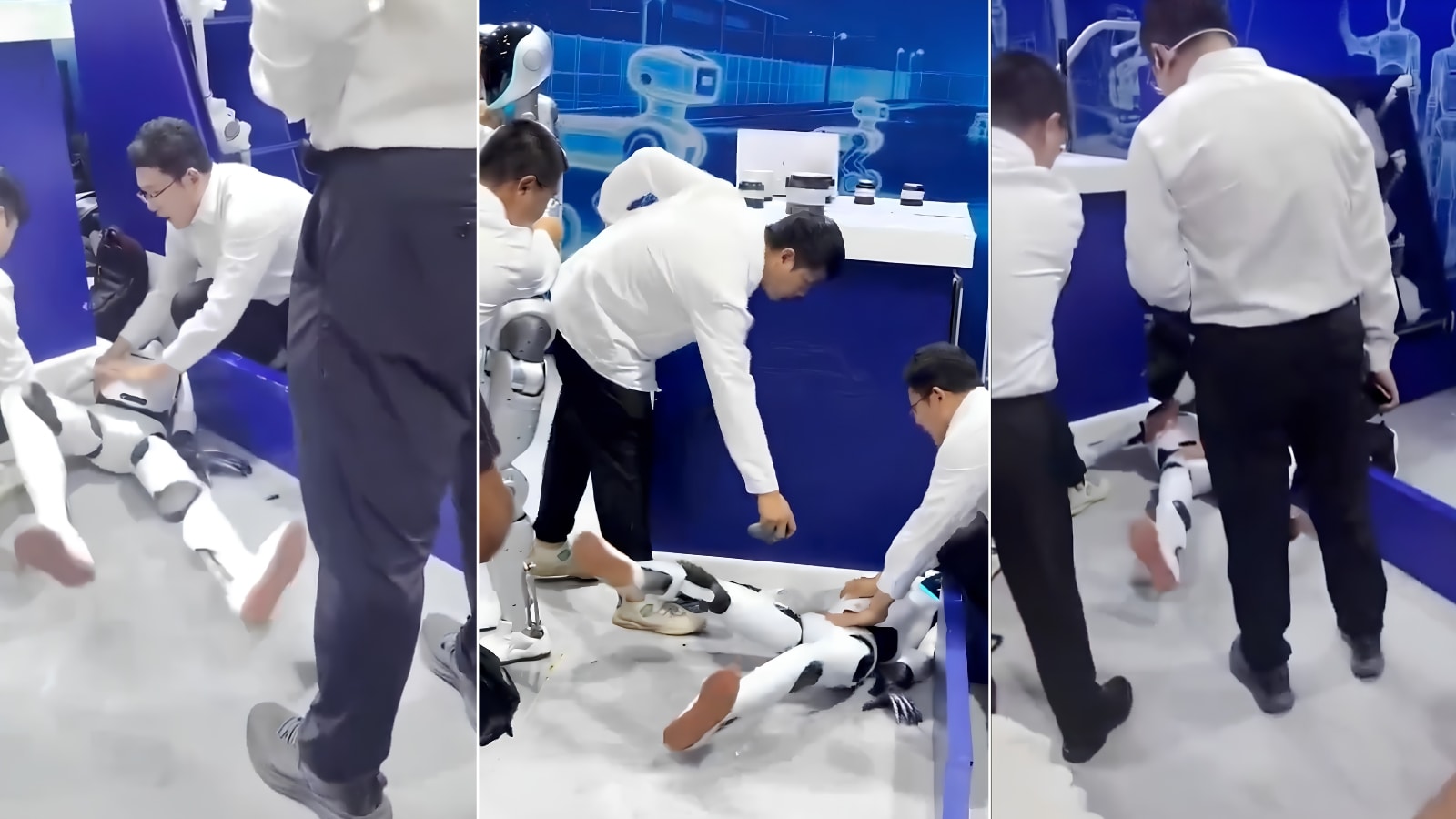
The footage spread across global feeds within hours. A humanoid robot standing on a polished stage in Beijing suddenly flailed its arms, twisted its torso into an unnatural angle, and jerked backward as if overcome by sudden fury. Commentators chuckled, internet users generated thousands of memes about mechanical teenage angst, and casual observers wrote it off as a harmless glitch. The prevailing narrative branded the event as a robot throwing a tantrum due to a failed remote control link.
That explanation is comforting. It is also entirely wrong.
Machines do not experience emotional outbursts, and they certainly do not suffer from psychological breakdowns. What happened under the harsh lights of that convention center was something far more mundane and much more concerning for the future of commercial automation. The machine experienced a severe state estimation failure coupled with a safety watchdog trip, exposing the brittle reality underlying modern robotics marketing.
For years, industrial labs have poured billions of dollars into bipedal locomotion, hydraulic actuators, and neural network controllers. They want the public to see effortless grace. They want investors to envision humanoid assistants walking seamlessly through crowded offices and busy factory floors. But public demonstrations remain tightly scripted theatrical productions. When the script breaks, the underlying mechanics reveal just how far away true autonomy actually is.
The Anatomy of a Control Loss Event
To understand why the Beijing robot appeared to lose its temper, you have to look past the theatrical framing and examine the hardware. Humanoid robots are not self-contained intelligence engines walking around under their own power. They are massive bundles of sensors, feedback loops, and servo motors tethered directly to external computing clusters or remote operators via wireless signals.
When a wireless connection drops or experiences catastrophic latency, the robot enters a terrifying limbo state. The central processing unit stops receiving valid state updates from the motor controllers, while the physical body continues to fight against the laws of gravity.
In this specific incident, the remote control link did not merely fail; it stuttered. This is the worst-case scenario for a real-time control system. A complete drop often triggers an immediate, hard-coded emergency shutdown that locks actuators or guides the machine into a controlled slump. A stutter, however, sends conflicting packets to the limbs. One frame tells the knee to extend, while the next delayed frame tries to compensate for a perceived tilt that no longer exists.
The result is violent oscillation. The robot's control algorithm desperately attempts to find balance using stale data, overcorrecting with massive torque spikes. To the human eye, it looks like rage. To an engineer, it looks like a textbook feedback loop going unstable.
[Wireless Signal Drop] ➔ [Stale Data Packet Reception] ➔ [Algorithm Overcorrection] ➔ [Torque Spike Oscillation]
This phenomenon is not unique to Chinese robotics firms. American and European labs face the exact same physical constraints. Bipedal balance is an ongoing mathematical emergency. Humans take our vestibular system and musculoskeletal feedback for granted, but replicating that bio-mechanical efficiency in steel and carbon fiber requires thousands of calculations per second. Remove stable communication for even fifty milliseconds, and the machine turns into a flailing hazard.
The Marketing Mirage Versus the Factory Floor
We have entered a peculiar era of technological theater. Venture capital funding flows heavily toward companies that can produce flashy promotional videos of robots dancing, folding laundry, or jogging through parks. These demonstrations create an expectation of readiness that engineering teams cannot possibly satisfy in the real world.
The industry relies on a carefully maintained illusion. Behind every autonomous humanoid walking across a convention stage, there is usually a team of safety engineers hovering off-camera with emergency kill switches, hidden cables, or invisible geofences. When the system works, the media hails a breakthrough. When it fails, public relations teams blame a glitch and move on to the next press cycle.
This dynamic creates a dangerous disconnect between the boardroom and the workbench. Investors demand commercial timelines that ignore basic physics. Executives promise enterprise deployment years before the software can reliably handle unexpected obstacles like a stray cable on the floor or a sudden Wi-Fi interference spike from a nearby microwave oven.
Industrial arms and wheeled automated guided vehicles succeeded because they operate in constrained, predictable environments. They do not need to solve the complex balance equations required to keep a two-legged torso upright against gravity. Humanoid robots are being forced into commercial markets prematurely because investors love the anthropomorphic aesthetic, not because the utility justifies the cost.
The Unspoken Safety Crisis
Beyond the viral humor of a shaking machine lies a much harder operational truth. If a robot cannot maintain stability during a minor wireless drop in a controlled convention hall, how will it behave in a crowded hospital or a logistics warehouse filled with human workers?
Safety standards for collaborative robots, known as cobots, are exceptionally strict. Traditional industrial cobots operate at limited speeds and use force-limiting sensors to stop the moment they make contact with a human obstruction. A humanoid robot, however, weighs anywhere from fifty to over one hundred kilograms. To walk dynamically, it must generate significant kinetic energy.
When a heavy biped loses control, it does not gently stop. It falls with devastating momentum.
+------------------------+---------------------------------------+
| Operational Environment| Primary Failure Risk                  |
+------------------------+---------------------------------------+
| Controlled Stage       | Wireless packet loss, erratic torque  |
| Logistics Warehouse    | Sensor blinding, dynamic collisions   |
| Public Healthcare      | Unpredictable human movement, latency |
+------------------------+---------------------------------------+
The industry rarely discusses the hardware fatigue caused by these sudden control failures. High-torque actuators slamming against their physical limits experience micro-fractures in the gearboxes and internal strain on the wiring harnesses. A robot that throws a tantrum on stage is a robot that likely needs a complete teardown and gearbox replacement before its next demonstration.
Moving Past the Hype Cycle
Fixing this trajectory requires an uncomfortable reckoning across the robotics sector. The obsession with untethered, fully autonomous humanoid form factors must take a backseat to core reliability engineering.
Edge computing must improve drastically. If a robot relies on an off-board computer or a cloud connection to maintain basic balance, it is fundamentally unsafe for deployment. Every humanoid machine must possess enough localized computing power to execute emergency stabilization routines entirely on board, completely isolated from external network conditions.
Furthermore, transparency from manufacturers would go a long way toward building genuine trust. Admitting that a demonstration failed due to local RF interference or server latency does not weaken a company's standing; it proves they understand the engineering hurdles ahead. Pretending that the machine simply had a bad day insults the intelligence of the engineers who spend their lives trying to tame these chaotic physical systems.
The viral video from Beijing will eventually fade from public memory, replaced by the next shiny product launch. But the underlying physics will remain unchanged. Until the robotics industry stops prioritizing theatrical marketing over foundational stability, machines will continue to betray their creators the moment the signal drops.