Large language models and generative artificial intelligence frameworks operate on an architectural paradox: the digital economy relies fundamentally on a physical foundation of intense thermal dissipation and heavy resource consumption. Every inference cycle, fine-tuning pass, and training run executes via billions of transistors switching states simultaneously. This electronic activity generates thermal energy that must be removed from the silicon package to prevent thermal throttling or catastrophic structural failure. In high-density data centers, the historical mechanism for this heat removal has been evaporative cooling—a process that consumes millions of gallons of fresh water daily.
As cluster sizes scale from tens of thousands of Graphics Processing Units (GPUs) to clusters exceeding 100,000 accelerators, the infrastructure sector faces a structural bottleneck. The traditional method of air-cooling enterprise data centers is reaching its thermodynamic limits. The industry must now transition to liquid-to-air and liquid-to-liquid closed-loop cooling architectures, a shift driven not just by corporate environmental targets, but by the raw physics of modern silicon.
The Thermodynamic Mechanics of AI Compute
To quantify the environmental debt of an AI prompt, one must evaluate the data center energy chain. A single query initiates an instruction pipeline across a distributed cluster. This workload increases the dynamic power consumption of the processor, converting electrical energy into thermal energy.
[Electrical Grid Input]
       │
       ▼
[Silicon Package (GPU/CPU Accelerator)] ──(Heat Generation via Transistor Switching)
       │
       ▼
[Primary Cooling Loop (Conduction via Cold Plate)]
       │
       ▼
[Secondary Cooling Loop (Facility Water/Chiller System)]
       │
       ▼
[Atmospheric Dissipation (Evaporative Cooling Tower / Water Loss)]
Data center thermal management is governed by Water Utilization Effectiveness (WUE), defined mathematically as:
$$\text{WUE} = \frac{\text{Annual Water Consumption (Liters)}}{\text{IT Equipment Energy (Kilowating-hours)}}$$
The baseline metric varies heavily by geography, ambient humidity, and facility design. An average enterprise data center operating with traditional evaporative cooling towers exhibits a WUE of approximately 1.8 liters per kilowatt-hour. When applied to the training of a foundational model requiring dozens of megawatts of continuous power for months, or to inference workloads processing billions of queries daily, the cumulative water extraction impacts local municipal infrastructure.
Evaporative cooling functions by exposing hot facility water to the ambient air stream within a cooling tower. As a portion of the water evaporates, it absorbs the latent heat of vaporization from the remaining volume, cooling the liquid before it circulates back to the heat exchangers inside the server room. This evaporated water is permanently lost from the local watershed. Furthermore, as water evaporates, minerals concentrate in the basin, requiring a process known as "blowdown"—draining a fraction of the highly mineralized water and replacing it with fresh water to prevent scaling and corrosion on internal surfaces. This dual mechanism of evaporation and blowdown creates a highly extractive resource profile.
The Microprocessor Thermal Wall
The core catalyst forcing the adoption of liquid cooling is the escalating Thermal Design Power (TDP) of next-generation accelerators. For multiple hardware generations, air cooling sufficed. High-velocity fans pushed conditioned air through massive copper heatsinks mounted directly onto processors with a TDP between 200 and 400 watts.
This operational paradigm breaks down at higher power densities. Modern AI accelerators feature a footprint where the TDP exceeds 700 watts, and architectures now cross the 1,000-to-1,200-watt threshold per package.
Air possesses a low specific heat capacity ($1.005 \text{ kJ/kg}\cdot\text{K}$) compared to water ($4.184 \text{ kJ/kg}\cdot\text{K}$). Air cooling an array of 1,200-watt chips requires an unsustainable volume of airflow, demanding massive fan arrays that consume significant parasitic power, generate extreme acoustic pressure, and require deeper server chassis that reduce overall rack density.
Beyond 30 to 40 kilowatts per rack, traditional raised-floor air distribution cannot deliver sufficient mass flow to prevent hot spots. Modern AI compute deployments routinely target 100 to 145 kilowatts per rack. At this density, liquid cooling transitions from an optional optimization strategy to an absolute engineering requirement.
Deconstructing Closed-Loop Architecture
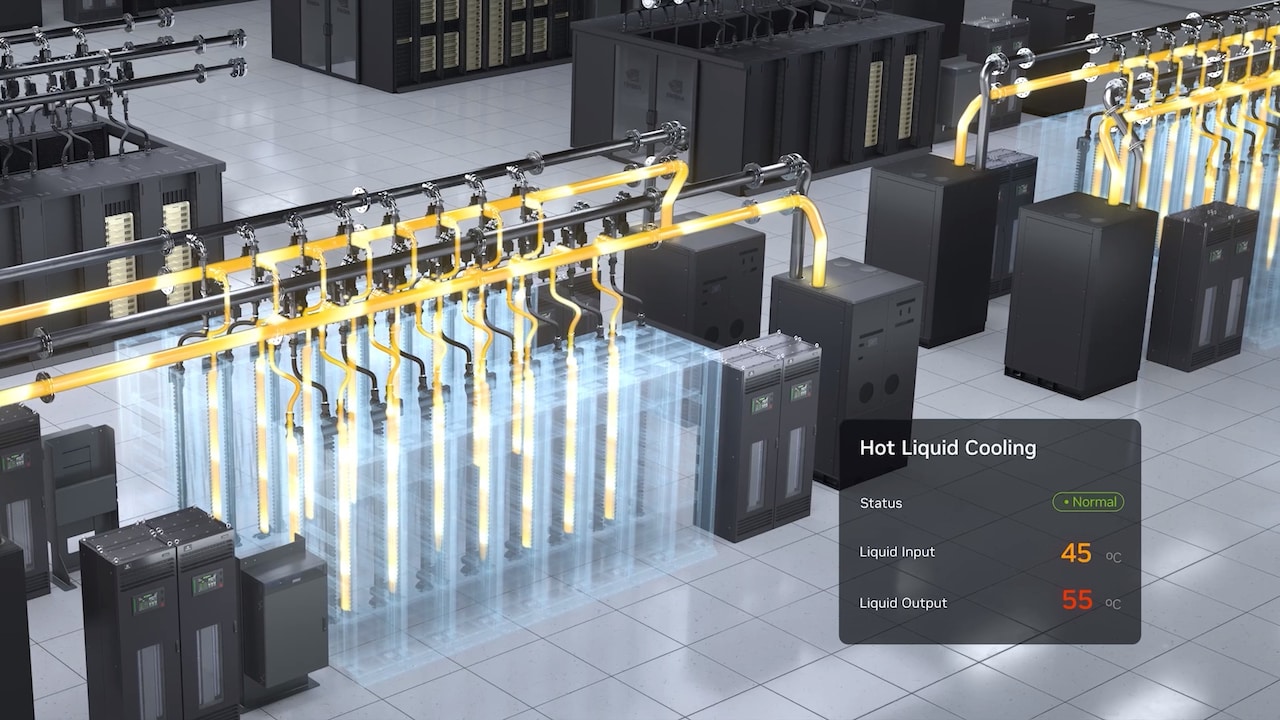
The architectural pivot popularized by next-generation chip designs focuses on direct-to-chip (DLC) liquid cooling implemented via a closed loop. This structure completely alters the water consumption dynamic by isolating the primary cooling medium from the external environment.
The Primary Loop: Direct-to-Chip Conduction
In a direct-to-chip configuration, micro-channel copper cold plates are mounted directly to the integrated heat spreader of the GPU and CPU packages. A specialized fluid—typically treated demineralized water or a dielectric fluid—pumps through these micro-channels. Because the fluid comes into immediate thermal proximity with the silicon, heat transfer occurs via conduction far more efficiently than through air.
The Secondary Loop: Coolant Distribution Units
The warmed fluid leaves the server chassis and enters a Coolant Distribution Unit (CDU). The CDU contains pumps, filtration systems, and a highly efficient liquid-to-liquid or liquid-to-air heat exchanger.
- In a liquid-to-air system (closed-loop dry coolers), the internal fluid passes through large outdoor radiator coils cooled by ambient air fans. The liquid never evaporates; it is continuously recirculated within a sealed system. Water consumption in this primary and secondary loop dropped to zero after the initial fill.
- In a liquid-to-liquid system, the CDU transfers the heat from the clean, internal server loop to a separate facility water loop. This facility loop then rejects the heat to the outside environment, which can still utilize evaporative cooling towers, though at a significantly higher optimization level due to elevated operating temperatures.
The Thermodynamics of Higher Facility Water Temperatures
Closed-loop liquid cooling allows data centers to operate with much higher Facility Water Temperatures (FWT). While air-cooled facilities must chill air down to 18–22°C, liquid-cooled cold plates can reliably accept water at 32°C or even 45°C while keeping junction temperatures below the silicon thermal limit.
Operating at higher temperatures enables the use of economizers or dry coolers year-round in most climates. Eliminating the need for continuous mechanical refrigeration (chillers) reduces the facility's Power Usage Effectiveness (PUE) and allows the elimination of evaporative cooling towers entirely in geographies with favorable ambient profiles.
Operational and Economic Realities of the Transition
Retrofitting existing data centers or building greenfield facilities optimized for liquid-cooled clusters introduces structural trade-offs that enterprise strategists must balance.
                    ┌──────────────────────────────┐
                    │ Direct-to-Chip Liquid Cooling│
                    └──────────────┬───────────────┘
                                   │
         ┌─────────────────────────┴─────────────────────────┐
         ▼                                                   ▼
┌─────────────────────────────────┐                 ┌─────────────────────────────────┐
│        CapEx Incentives         │                 │       OpEx & Risk Factors       │
├─────────────────────────────────┤                 ├─────────────────────────────────┤
│ • 3x - 5x Rack Density Increase │                 │ • Complex Plumbing Architecture │
│ • Elimination of Chiller Plants │                 │ • Risk of Dielectric Leaks      │
│ • Higher Compute per Sq. Foot   │                 │ • Specialized Technician Training│
└─────────────────────────────────┘                 └─────────────────────────────────┘
The primary barrier to immediate adoption is the steep upfront capital expenditure. Liquid cooling requires a complex plumbing architecture inside the data center, including manifolds, flexible hoses, dripless quick-connect couplings, and dedicated CDUs. The cost of these specialized components exceeds that of traditional ductwork and air-handling units.
Furthermore, the risk of fluid leakage introduces operational hazards. A leak in an air-cooled server blows dust; a leak in a water-cooled server can cause short circuits and destroy hundreds of thousands of dollars of compute hardware. To mitigate this risk, operators deploy redundant leak detection cables along the chassis floors and increasingly opt for specialized engineered fluids or dual-phase dielectric liquids that do not conduct electricity.
The capital expenditure is offset by immediate operational savings and structural scaling advantages. By packing more compute into a smaller footprint, operators compress the physical size of the data center. A cluster that previously required an entire warehouse can now fit within a fraction of the square footage, reducing real estate acquisition costs and shortening the length of high-speed optical cabling required to interconnect the nodes.
This cable shortening minimizes signal latency and reduces the power needed for optical transceivers. Additionally, eliminating large server fans and refrigeration chillers drops the parasitic power load of the facility, allowing more grid power to be routed directly to the accelerators.
The Regulatory and Scarcity Bottleneck
The geopolitical and corporate drive toward computing efficiency is accelerated by tightening municipal restrictions. Data centers do not operate in a vacuum; they draw from the same aquiferous networks and utility grids that sustain residential populations and agricultural sectors.
In arid regions, local governments are restricting permits for data centers utilizing open-loop evaporative cooling. Regulators increasingly demand that operators demonstrate low or near-zero WUE metrics before granting grid connectivity access.
This regulatory framework alters the total cost of ownership calculations. An operator using a cheap, water-heavy cooling system may face sudden regulatory halts or increased water tariffs during drought cycles. A closed-loop liquid-to-air infrastructure represents a predictable, resilient asset that insulates the operator from local resource volatility.
Systemic Integration Requirements
Implementing a closed-loop infrastructure requires a fundamental redesign of the server chassis and rack infrastructure. The traditional 19-inch server rack is giving way to wider, deeper custom architectures designed to handle the heavy weight of fluid-filled manifolds and the structural routing of plumbing lines alongside power busbars.
Operators must establish rigorous testing protocols to manage fluid chemistry. Over time, even closed systems can suffer from biological growth, corrosion, or material degradation if the coolant chemistry is unmonitored. This introduces a new operational layer to data center management: data center technicians must possess competencies in fluid dynamics, metallurgy, and chemistry alongside traditional network engineering skills.
The Strategic Infrastructure Playbook
Enterprise infrastructure planners and hyperscale cloud providers cannot treat thermal management as an afterthought. To avoid stranded assets and operational bottlenecks over a ten-year horizon, deployments must follow a clear structural path:
- Mandate that all greenfield data center builds incorporate facility-level plumbing capable of supporting liquid-to-liquid or liquid-to-air CDUs. Building a facility with dry-cooler capability from inception prevents costly structural overhauls later.
- Standardize on direct-to-chip cooling plates for any deployment involving accelerators with a TDP exceeding 700 watts. Relying on air cooling at this density induces immediate thermal throttling, degrading the return on hardware investment.
- Phase out evaporative cooling towers in favor of closed-loop dry coolers equipped with adiabatic assistance loops. These systems use minimal water misters only during extreme ambient temperature peaks, keeping water consumption low while protecting performance.
The transition from air to liquid cooling is not an environmental altruism play; it is a structural mandate forced by the density of modern silicon. Organizations that master the deployment of closed-loop liquid infrastructure will scale their compute capabilities unhindered by local resource constraints, while those relying on legacy air-and-water dissipation will find themselves limited by physical thermal boundaries and regulatory ceilings.