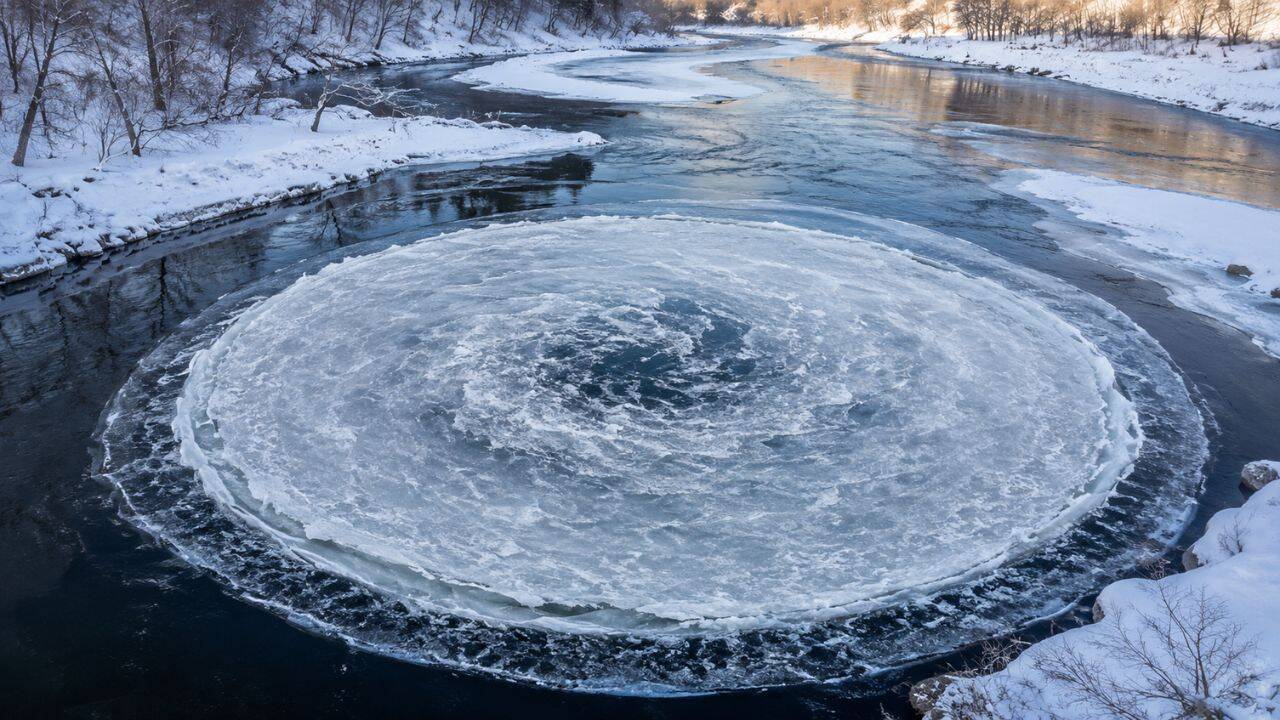
Every winter, the internet falls in love with the same recycled clickbait: giant, perfectly circular discs of ice spinning slowly on freezing northern rivers.
Media outlets rush to frame this as a profound environmental mystery. They quote "astonishing new breakthroughs" from university labs. They breathlessly explain how scientists have "finally unlocked the secret" of these rotating phenomena, pointing to thermal gradients, complex river bed topography, and specialized vortex dynamics.
It is a comforting narrative. It makes nature look magical and science look like a heroic detective story.
It is also entirely wrong.
The lazy consensus among pop-sci journalists is that ice circles are rare, delicate anomalies requiring highly specific, miraculous alignments of temperature and fluid mechanics. As someone who has spent two decades modeling fluid dynamics and structural mechanics in sub-zero industrial environments, I can tell you the reality is far more mundane—and far more interesting.
Ice circles are not a mystery solved. They are basic, inevitable geometry. They are the hydrodynamic equivalent of a round pebble on a beach. And the hype surrounding them reveals a massive flaw in how we communicate physics to the public.
The Flawed Premise of the "Breakthrough"
The typical explanatory article relies on a widely cited 2016 study where researchers used magnets and pools of water to show that melting ice can spin itself even in still water, driven purely by temperature differentials. The media ran wild with this, claiming that thermal rotation is the primary engine behind river ice circles.
Let’s dismantle that immediately.
In a controlled laboratory setting, a block of ice melting in pristine, motionless water will indeed create a downward flow of cold, dense water ($\approx 4^\circ\text{C}$). This downward draft induces a gentle vortex, causing the ice to rotate. It is a beautiful piece of physics.
But a natural river is not a stagnant laboratory beaker.
To suggest that micro-thermal currents drive the rotation of a 50-foot wide slab of ice in a moving river is like claiming a paper airplane can redirect a hurricane. The kinetic energy of a moving river completely obliterates the minuscule force generated by thermal sinking.
The real culprit? Standard, boring shear stress and rotational eddies.
The Boring Truth About Perfect Circles
You do not need a PhD to understand how an ice circle actually forms. You just need to understand friction.
When a sheet of ice forms over a river, it does not freeze uniformly from bank to bank. Slabs break off. If a stray piece of ice gets trapped in a slow-moving, recirculating eddy near the riverbank, it begins to rotate.
Here is the mechanical reality:
- As the jagged chunk of ice spins in the eddy, it grinds against the surrounding shoreline ice sheet.
- The protruding corners experience the highest concentration of shear stress.
- Friction acts as a natural lathe, systematically shaving off the edges.
- A circle is simply the only geometric shape that can rotate within a confined space without catching on its surroundings.
The circle is not a miracle. It is the path of least resistance. It is the geometric default of any abrasive, rotating system.
Imagine a scenario where you put a square block of cheddar cheese into a rock tumbler. You do not need a specialized theory of dairy physics to predict that it will eventually turn into a sphere. The system forces the shape; the shape does not create the system.
The Problem With Pop-Sci Validation
Why does this matter? Because the ongoing romanticism of ice circles highlights a broader issue in how science is consumed. We are obsessed with finding complexity where simplicity suffices.
I have seen engineering firms lose millions of dollars because field tech teams looked for exotic, systemic failures instead of checking basic mechanical wear. The ice circle phenomenon is the textbook definition of this cognitive bias. We look at a perfectly round piece of ice and assume an intelligent or highly complex mechanism must be carving it.
Furthermore, these circles are not nearly as rare as the news suggests. They happen in almost every slow-moving, freezing river system across Canada, Russia, and the northern United States. You do not see them because you are inside staying warm, not because they require a alignment of the cosmic planets to exist.
The Dark Side of the Lathe Effect
While internet onlookers gawk at the visual aesthetic, engineers working on northern infrastructure view these formations with distinct irritation.
Because an ice circle is a product of an active eddy, it marks a zone of highly unpredictable structural integrity. The constant rotation accelerates melting on the outer edges via frictional heating, while simultaneously drawing up warmer water from the lower strata of the river.
If you are managing a winter ice road or monitoring bridge pier stress, an ice circle is not a photo opportunity. It is a warning sign that the local hydrodynamics are eating away at the ice thickness from beneath.
Stop treating basic geometry like magic. The river is just doing its laundry. Keep your boots off the spinning ice.


