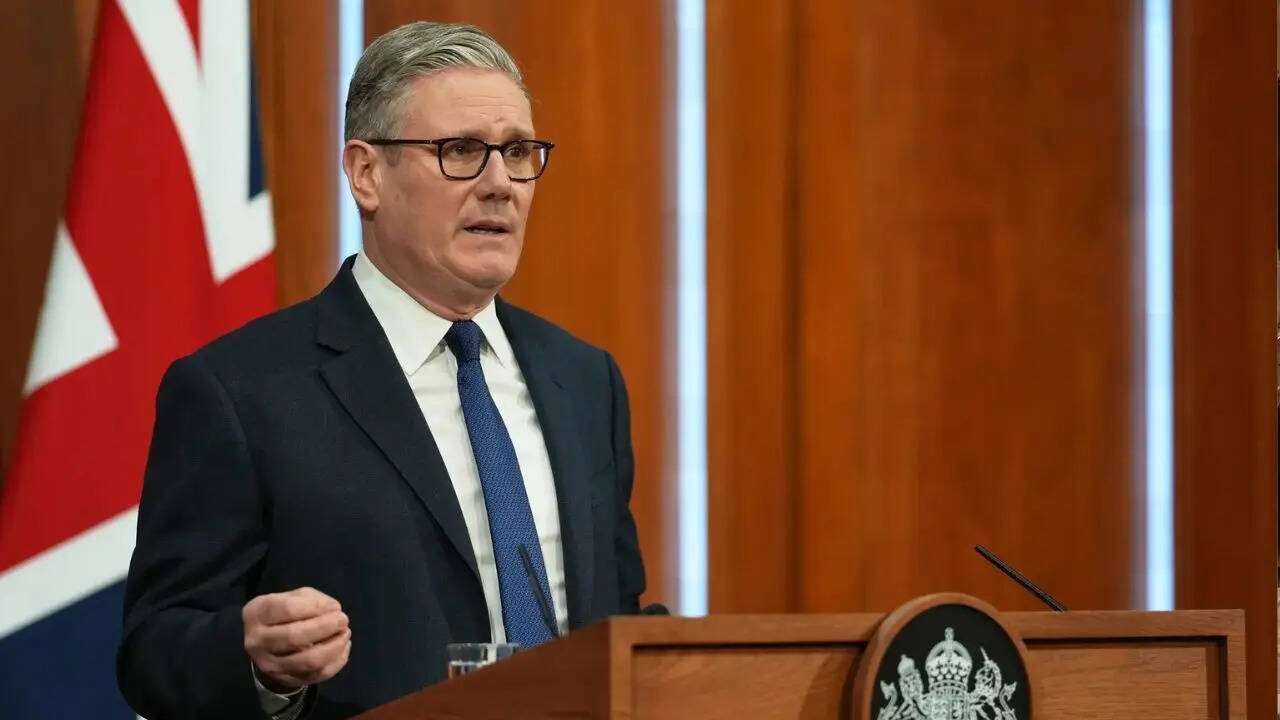
The headlines want you to believe that a new era of energy warfare has begun. Keir Starmer stands at the podium, announces that the UK will supply uranium to Ukraine, promises a fresh wave of sanctions to choke off the Russian war machine, and the press nods along in synchronized approval. It sounds decisive. It sounds strategic.
It is entirely performative.
The Western media is trapped in a lazy consensus that treats nuclear fuel like a chess piece you can simply move across a board to checkmate an adversary. In reality, the global nuclear fuel supply chain is not a game of checkers; it is a hyper-concentrated, deeply entrenched web of chemical dependencies that cannot be broken by press releases or political posturing. The UK-Ukraine uranium announcement ignores the brutal physics and economics of how nuclear reactors actually work. Sending raw or even enriched uranium to Ukraine does not liberate their grid from Moscow. It merely highlights the West's fundamental misunderstanding of the atom.
The Fuel Fabrication Fallacy What the Prime Minister Left Out
To understand why this announcement is hollow, you have to look at the anatomy of a nuclear power plant. Ukraine relies heavily on VVER-1000 and VVER-440 reactors—Soviet-designed pressurized water reactors. You cannot just shovel uranium into these facilities like coal into a furnace.
The nuclear fuel cycle requires four distinct, highly specialized steps:
- Mining: Extracting raw uranium oxide ($U_3O_8$) from the ground.
- Conversion: Turning that solid oxide into a gas, uranium hexafluoride ($UF_6$).
- Enrichment: Spinning that gas in centrifuges to increase the concentration of the fissile isotope $U-235$ from its natural state of 0.7% up to roughly 3% to 5%.
- Fabrication: Shaping that enriched uranium into precise ceramic pellets and loading them into highly engineered, geometric fuel assemblies tailored to the exact physical dimensions and thermal-hydraulic profile of a specific reactor design.
When the UK promises to "supply uranium," they are usually talking about the early stages of this chain. But Ukraine doesn't just need uranium atoms; it needs highly specific VVER fuel assemblies. For decades, Russia’s state-owned nuclear monopoly, Rosatom, was the sole architect and manufacturer of these assemblies.
While companies like Westinghouse have spent years—and millions of dollars—painstakingly reverse-engineering VVER fuel rods to break the Russian monopoly, the bottleneck has never been a raw shortage of uranium dirt. The bottleneck is precision engineering and manufacturing capacity. The UK supplying raw material to the front end of the pipe does nothing to accelerate the complex metallurgy and mechanical assembly required at the back end.
Rosatom Is Untouchable and Everyone Knows It
The second half of the political theater involves ramping up sanctions on Russia. It is a comforting narrative: we will starve their economy until they comply. Except the West cannot sanction Russia's nuclear sector without triggering an immediate, catastrophic energy crisis at home.
Let's look at the actual data, stripped of geopolitical spin. Russia controls roughly 44% of the global uranium enrichment capacity. For context, the United States possesses only a fraction of the domestic enrichment capacity required to feed its own commercial reactor fleet, relying on Russian imports for about 20% of its enriched uranium. In Europe, the dependency is even more acute for nations running Soviet-era fleets.
Imagine a scenario where the West imposes absolute, sweeping sanctions on Rosatom tomorrow.
- Enriched uranium prices skyrocket overnight.
- Utilities across Europe and the US face a structural deficit of fuel that cannot be replaced by domestic Western suppliers like Urenco for at least five to seven years.
- Reactors face forced shutdowns, pulling gigawatts of baseload, carbon-free power off Western grids at a time when electricity demand is surging from data centers and industrial electrification.
This is why, despite years of escalating sanctions on Russian oil, banking, and oligarchs, Rosatom has remained largely insulated from meaningful, structural embargoes. Western politicians know that a total blockade on Russian nuclear services would harm Western economies far more than it would hurt the Kremlin's treasury. Starmer’s rhetoric about "ramping up sanctions" deliberately obscures this leverage dynamic. You cannot effectively sanction an entity that holds the keys to your own electrical grid's stability.
The Cost of the Contrarian Reality
There is a genuine downside to admitting this truth. Acknowledging that Western nuclear independence is currently a myth damages public morale and exposes a decades-long failure of industrial policy. For forty years, Western nations outsourced their heavy industrial chemistry and enrichment capabilities because it was cheaper to buy subsidized, downblended weapons-grade uranium from Russia under programs like Megatons to Megawatts.
We saved billions of dollars on paper while completely dismantling our domestic fuel cycle infrastructure. Now, fixing that mistake requires massive capital expenditure, state-backed low-interest loans, and at least a decade of regulatory streamlining to build new conversion and enrichment facilities.
Buying raw uranium from allied nations and shipping it toward Eastern Europe is a band-aid on a severed artery. It creates the illusion of momentum while avoiding the hard, multi-decade capital allocations needed to rebuild Western industrial sovereignty.
Redefining the Nuclear Question
The public consistently asks the wrong questions about energy security. The question isn't, "How do we send more fuel to Ukraine?" The real question is, "How do we rebuild the forgotten machine that processes that fuel?"
If we want to actually disrupt Russia's stranglehold on the nuclear sector, the actionable advice is counter-intuitive to everything you hear in modern political discourse:
- Stop focusing on uranium mining. There is plenty of uranium in stable jurisdictions like Australia, Canada, and Kazakhstan. Mining is not the bottleneck.
- Nationalize or heavily subsidize the enrichment infrastructure. Private capital will not build multi-billion-dollar centrifuge facilities when they risk being undercut if geopolitical tensions ease and cheap fuel floods the market again. The state must guarantee long-term floor prices for domestic enrichment.
- Accept the hypocrisy in the short term. Western utilities must continue to quietly buy Russian nuclear services while the new infrastructure is built. Cutting off the supply prematurely out of moral righteousness will only collapse the very economies trying to fund the defense of Ukraine.
The UK's announcement makes for an excellent press release, but it does zero damage to Russia's geopolitical leverage. Until the West stops treating energy policy as a branding exercise and starts treating it as a game of industrial capacity, Rosatom will continue to run the global nuclear market. Everything else is just noise.