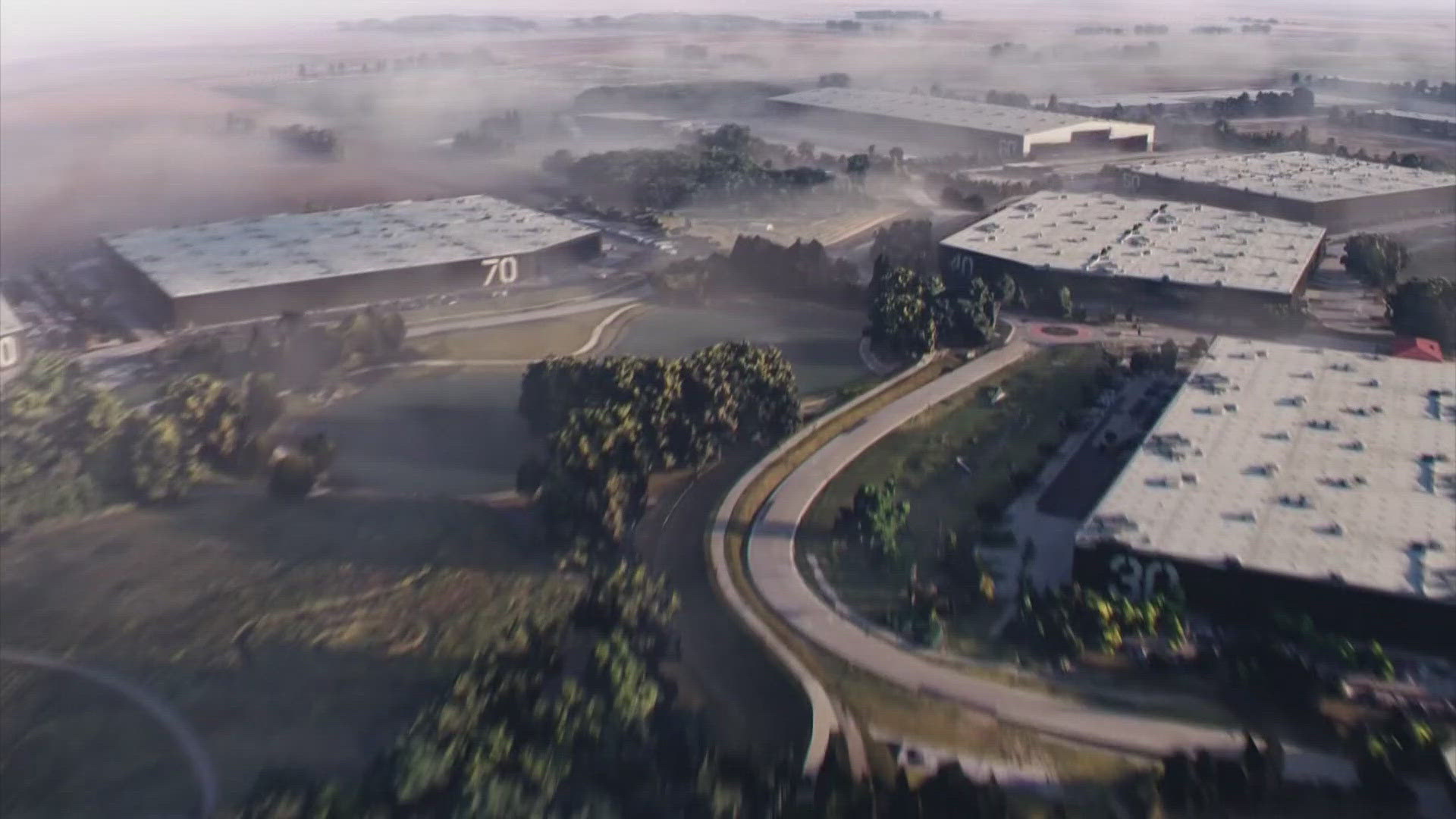
Anduril Industries’ $1 billion commitment to a new 5-million-square-foot campus in Long Beach, California, is not merely a real estate transaction; it is a fundamental restructuring of the defense industrial base’s production function. This move signals a departure from the "boutique" prototyping model that has characterized defense startups for the last decade, transitioning instead toward a high-rate, software-defined manufacturing capability designed to compete with the traditional "Big Five" primes. The investment serves as a physical manifestation of a shift from labor-intensive assembly to capital-intensive, automated production of autonomous systems.
The Structural Shift from Prototyping to Attritable Scale
The legacy defense procurement cycle favors low-volume, high-complexity platforms—exquisite hardware like the F-35—where unit costs are astronomical and production timelines span decades. Anduril’s strategy rests on the inverse: high-volume, "attritable" systems. These are platforms cheap enough to be lost in combat but capable enough to provide a tactical advantage.
To achieve this, the firm requires a specific type of industrial footprint that traditional Silicon Valley office parks cannot provide. The Long Beach expansion addresses three critical bottlenecks in the current defense-tech ecosystem:
- Vertical Integration of the Supply Chain: By consolidating design, testing, and mass production within a single 5-million-square-foot ecosystem, Anduril minimizes the "hand-off" friction between engineering and manufacturing. This mirrors the vertical integration strategies of SpaceX and Tesla, where software updates can be pushed to hardware on the assembly line in near real-time.
- The "Software-First" Hardware Constraint: Autonomous systems like the Lattice OS require hardware that is designed for rapid iteration. A decentralized supply chain often lags behind software development by 18 to 24 months. Concentrating the manufacturing in California—despite the higher cost of business—allows for a tighter feedback loop between the software engineers in Costa Mesa and the production technicians in Long Beach.
- Volume as a Strategic Deterrent: The Department of Defense (DoD) has signaled through initiatives like "Replicator" that it intends to field thousands of autonomous systems. Winning these contracts requires proof of capacity. The $1 billion investment is a capital expenditure (CapEx) signal to the Pentagon that the infrastructure for "mass" already exists.
The Economic Geography of the Long Beach Selection
The choice of Long Beach is mathematically driven by the region’s existing labor density and logistical infrastructure. While many tech firms are fleeing California for lower-tax jurisdictions, Anduril’s $1 billion bet suggests that the specialized talent pool in the "Aerospace Walk" (the historical corridor of Douglas, Boeing, and McDonnell Douglas) outweighs the tax burden.
The Long Beach labor market provides a unique intersection of two distinct skill sets:
- Aerospace Structures Expertise: A legacy workforce capable of handling composite materials, propulsion systems, and flight controls.
- Systems Integration Talent: A newer generation of engineers from nearby institutions (Caltech, USC, UCLA) who specialize in computer vision and robotics.
Logistically, the proximity to the Port of Long Beach and Los Angeles International Airport (LAX) creates a "just-in-time" advantage for global component sourcing. However, this geographic concentration introduces a specific risk profile. The high cost of living in Southern California forces a higher wage floor, meaning Anduril must achieve significantly higher levels of automation per square foot than a competitor based in the Midwest or the Southeast to maintain the same margin on attritable hardware.
Quantifying the Manufacturing Alpha
The $1 billion investment is distributed across facility acquisition, specialized tooling, and the "Software-Defined Manufacturing" (SDM) stack. Unlike traditional manufacturing, where a factory is hard-coded for one specific vehicle (e.g., a specific tank or jet), Anduril’s Long Beach campus is designed around the concept of "flexible manufacturing cells."
This architecture allows the facility to pivot production between different product lines—such as the Roadrunner interceptor, the Altius loitering munition, and Dive-LD underwater vehicles—without a multi-year retooling phase. The competitive advantage here is the reduction of the "Unit Cost of Adaptability."
In traditional defense manufacturing:
$$C_{total} = C_{fixed} + (C_{variable} \times V)$$
Where $C_{fixed}$ is the massive cost of a dedicated assembly line.
In Anduril’s SDM model:
$$C_{total} = C_{platform} + \sum (C_{software_integration})$$
The fixed costs are high initially, but the marginal cost of switching between different types of autonomous hardware is drastically lower because the underlying "Lattice" software architecture remains the core component across all platforms.
The Replicator Initiative and the Scaling Hurdle
The Pentagon’s Replicator program aims to deploy thousands of "small, smart, cheap" autonomous systems within 18 to 24 months. This timeline is incompatible with the traditional defense acquisition process. Anduril’s Long Beach campus is essentially a bet on the permanency of this new procurement philosophy.
However, three primary risks could undermine this $1 billion investment:
- The "Valley of Death" in Procurement: Even with a 5-million-square-foot factory, Anduril is dependent on the DoD moving from "Other Transaction Authority" (OTA) prototypes to Programs of Record. If the DoD’s budget remains tied to legacy platforms, Anduril will be left with massive overcapacity and high overhead.
- Regulatory Friction in Autonomous Testing: California’s regulatory environment for testing unmanned aerial systems (UAS) and maritime drones is significantly more restrictive than in states like Nevada or Texas. The friction between high-rate production in Long Beach and the need for high-rate testing could create a geographic bottleneck.
- Talent Scarcity in Specialized Robotics: While the aerospace legacy exists, the specific intersection of "AI-first" robotics and mass production is a thin talent market. Anduril is competing directly with SpaceX, Blue Origin, and Tesla for the same 500 to 1,000 elite systems engineers.
Reconfiguring the Defense Value Chain
Traditionally, defense contractors act as "integrators" of a vast web of subcontractors. This model is designed to distribute political support across as many congressional districts as possible, but it is inherently inefficient for rapid technology cycles. Anduril’s expansion signals a move toward "horizontal modularity."
By owning the entire stack from the silicon to the airframe, Anduril captures the "innovation rent" that is usually lost to middle-tier suppliers. This allows them to price their systems based on the value of the mission (e.g., "cost per successful intercept") rather than the "cost-plus" model that guarantees a 10-15% profit margin regardless of performance.
This model forces a transition in the industry’s "Cost Function":
- Traditional Defense: High Precision + High Cost + Low Volume = Strategic Fragility.
- Anduril’s Model: Moderate Precision + Low Cost + High Volume = Strategic Resilience.
The Strategic Play for 2026 and Beyond
The Long Beach campus is designed to be the first "Gigafactory" of defense. Success will be measured not by the number of employees hired, but by the "output per square foot" and the "velocity of iteration." If Anduril can prove that a software-defined factory can produce a new class of weapon systems faster and cheaper than the legacy primes, they will have successfully broken the 50-year-old oligopoly of the defense industry.
The immediate strategic requirement is the synchronization of this production capacity with the "Lattice" ecosystem. Hardware is the delivery vehicle; software is the moat. The $1 billion investment is the price of admission to prove that Silicon Valley can build as well as it can code.
The move into Long Beach forces a response from the "Big Five." They must either:
- Acquire: Purchase mid-tier autonomous firms to bolt onto their existing legacy structures (historically difficult due to cultural and software integration issues).
- Retool: Invest billions in their own flexible manufacturing facilities, potentially cannibalizing their high-margin legacy programs.
- Specialize: Relinquish the "attritable" market to Anduril and focus exclusively on the "exquisite" platforms.
The Long Beach facility ensures that for the first time in three decades, the incumbent defense primes are no longer the only entities capable of delivering scale to the warfighter. The strategic recommendation for the Department of Defense is to utilize this new capacity to force a "competitive manufacturing" environment, breaking the dependency on single-source contracts for critical autonomous technologies.
Anduril must now execute on the "Production-to-Software" ratio. The goal is to reach a point where the hardware cost is so low that the primary value—and the primary margin—is entirely contained within the AI pilot and the sensor-fusion software. Once the Long Beach facility reaches 80% capacity utilization, the unit economics of autonomous defense will fundamentally decouple from the inflation-heavy trends of traditional aerospace, creating a permanent shift in how national security is funded and fielded.