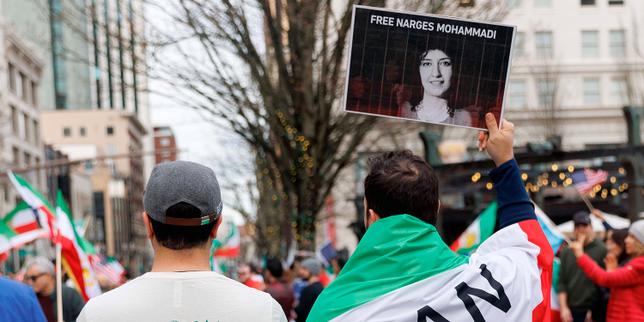
A book does not usually weigh anything. You pick it up, flip the pages, and feel only the faint friction of wood pulp against your fingertips. But some pages carry an invisible density. They are heavy with the smell of damp concrete, solitary confinement, and the quiet defiance of a woman who refused to unlearn her own voice.
Consider how words travel. From the grey, suffocating depths of Evin Prison in Tehran to the clean, brightly lit oak shelves of independent bookstores in Paris. It sounds like a metaphor, but it is a logistical miracle born of sheer stubbornness. Narges Mohammadi writes because silence is an accomplice to tyranny. And tyrants, for all their barbed wire and concrete blocks, have never quite figured out what to do with a sentence that refuses to die.
The Nobel Peace Prize sits on a mantelpiece in the imagination of the world, but its holder has often lived behind steel doors. While international bodies drafted resolutions and diplomats adjusted their ties, Mohammadi mapped the geometry of isolation. Her earlier smuggled testimonies on "white torture"—the calculated psychological destruction of solitary confinement—were never written for literary prizes. They were written as a distress flare fired from the bottom of an ocean. Each line passed through visiting rooms, whispered across courtrooms, or carried out in fragments by released cellmates.
When these texts cross borders and land in French translation, something shifts. The physical journey is perilous, requiring couriers who risk their livelihoods and safety to move manuscripts past checkpoints. Yet the deeper crossing is metaphysical. Words written by an inmate under constant surveillance suddenly rest next to novels and philosophy essays in the heart of Europe. They transform from illicit contraband into shared human history.
Picture a reader in a quiet Parisian cafe opening Une femme ne renonce jamais. Outside, traffic hums along the boulevard under a pale autumn sky. Inside, the contrast is absolute. The reader encounters a voice that has survived heart trouble, political show trials, and deliberate medical neglect without ever surrendering its core. You realize immediately that you are not holding a standard political memoir. You are holding an act of defiance printed in ink.
We often talk about human rights as abstract statistics. We quote numbers of political prisoners, lengths of sentences, and dates of detention decrees. But numbers do not bleed. Numbers do not lie awake on a prison mat wondering if their children remember the sound of their laughter. Mohammadi’s writing drags us out of the realm of safe abstraction and forces us to look squarely at the individual cost of conscience.
The stakes are invisible until they knock on your door. For Mohammadi, the cost of speaking out has been brutal: years stolen from her life, forced separation from her twins now growing up in exile, and the unyielding pressure of a regime determined to render her invisible. Yet her writings prove an ancient truth. You can lock the body in a cell, but if the mind retains its sovereignty, the walls eventually begin to crumble.
Every copy sold in a European bookstore is a tiny, persistent pulse against censorship. It says that distance does not dilute courage. It says that a regime's borders stop where human solidarity begins.
The paper is crisp. The ink is permanent. And somewhere in the dark, a voice continues to speak, refusing to be quieted by the night.