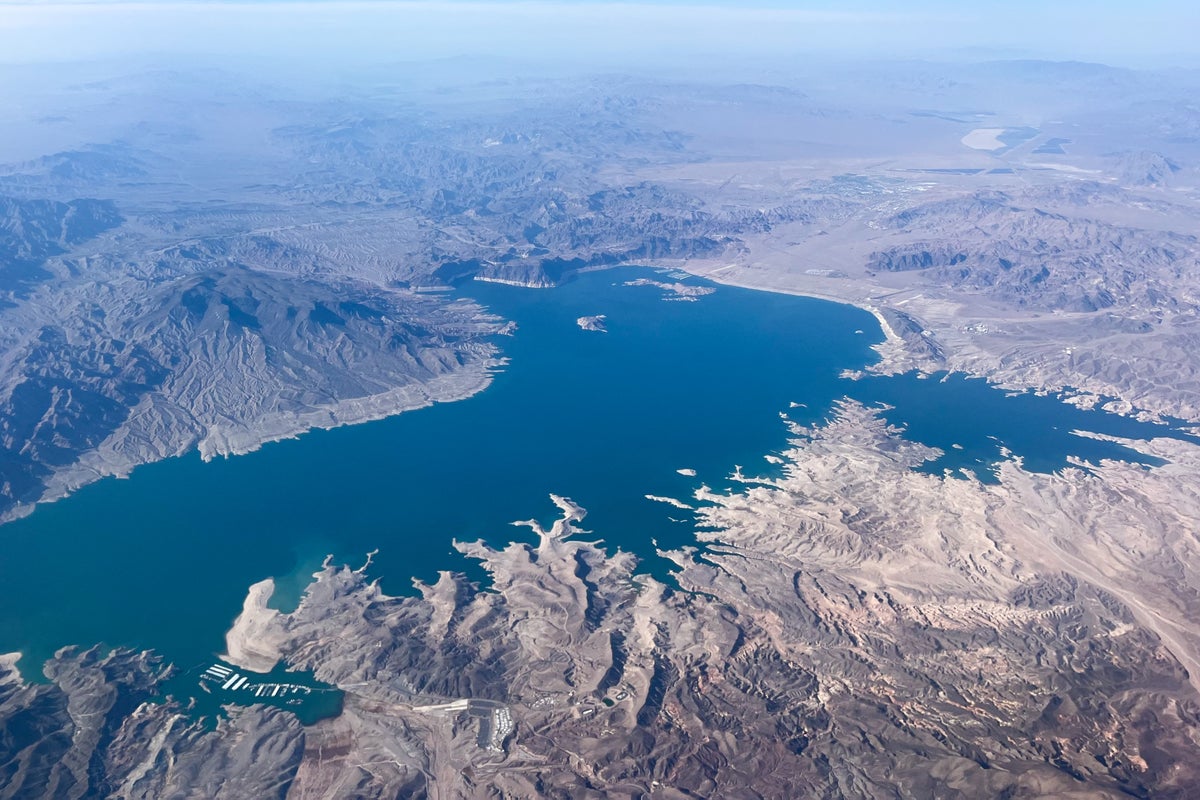
The arithmetic of the American Southwest has finally broken. For decades, politicians in Phoenix and Tucson built an empire of master-planned communities and lush golf courses on the back of an accounting fiction, pretending that a river system choked by a multi-decade drought could endlessly support modern desert urbanization. That fiction is evaporating. Under federal directives managing the shrinking Colorado River, Arizona faces disproportionate reductions, losing hundreds of thousands of acre-feet of vital supply as Lake Mead and Lake Powell hover near dead pool status.
Yet focusing solely on the looming shut-off threats misses the structural mechanics of how water actually disappears in the desert. The emergency is not just about dry taps or cracked earth. It is about a legal framework written a century ago that treats a vanishing resource as an eternal guarantee.
The Structural Flaw in Prior Appropriation
To understand why Arizona absorbs the brunt of these cutbacks while upper-basin states watch from a distance, you have to look at the 1922 Colorado River Compact. Drafted during an abnormally wet historical period, the compact divided millions of acre-feet of water that simply did not exist in reality. When shortages hit, the legal doctrine of prior appropriation dictates that junior water rights holders take the cuts first.
As a lower-basin state whose major infrastructure project—the Central Arizona Project (CAP)—was built later than California's older diversion canals, Arizona sits lower on the legal totem pole. This means municipal growth, tribal agricultural lands, and central desert irrigation districts absorb immediate pain while legacy agreements protect older claimants downstream and upstream.
Consider a hypothetical subdivision outside Phoenix built in the early 2000s. Under original planning assumptions, developers secured long-term slipstream water assurances through municipal banking credits. As those credits face strict federal auditing and state accounting corrections, communities discover that paper water does not translate to physical moisture when the canal gates drop.
The Groundwater Illusion
When surface water allocations shrink, municipalities typically pivot to groundwater pumping to bridge the deficit. This substitution creates a false sense of security. Beneath the Sonoran Desert lies an ancient aquifer system that took millennia to accumulate. Pumping it out to offset Colorado River losses is the equivalent of burning the furniture to heat the house.
For years, rural areas outside active management zones operated with almost zero oversight, leading to massive agricultural operations draining the water table to grow export crops like alfalfa. Subsidence—where the ground literally collapses underfoot due to depleted subterranean space—has cracked concrete canals, warped roads, and permanently destroyed storage capacity.
State regulations have slowly tightened around new subdivision approvals, requiring proof of a 100-year assured water supply. However, grandfathered agricultural exemptions remain wide enough to drive a tractor through. When a deep agricultural well drops another twenty feet in a single season, it draws down the same hydrological budget that nearby suburban municipalities rely upon for backup.
The Technology Trap and Conservation Limits
Efficiency is the preferred buzzword of modern water managers. Drip irrigation, turf removal rebates, and advanced wastewater recycling plants are real achievements that have kept metropolitan water use relatively flat even as population numbers climbed. Phoenix and Tucson are undeniably smarter about conservation than they were thirty years ago.
Conservation alone, however, operates under diminishing returns. You can only rip out so many lawns before you reach the baseline requirements of urban survival. Furthermore, advanced water purification facilities require immense amounts of electrical power to operate. When declining reservoir levels threaten the hydroelectric turbines at Glen Canyon Dam and Hoover Dam, the energy required to clean and move recycled water becomes more expensive and harder to generate.
The system relies on a closed loop of declining returns. Less water means less hydropower. Less hydropower means more expensive energy. More expensive energy strains municipal budgets just as utilities need to invest billions into deep-well infrastructure, desalination partnerships, and interstate pipeline projects.
The Real Price of Desert Survival
The narrative of an imminent, Hollywood-style apocalypse where entire cities run dry overnight is misleading. Urban centers will not simply turn off the taps tomorrow. Wealth buys priority, and municipalities will aggressively buy out agricultural water rights to keep suburban faucets running.
The true casualty is flexibility. Every acre-foot transferred from rural farming to urban cooling is a rural community wiped off the economic map. It is a generational shift in how the American West functions, transitioning from an era of abundance engineering to an era of permanent triage. The adjustments required over the coming years demand brutal honesty about desert limits, moving past political spin to confront the hard reality of a river that can no longer feed the civilization built along its banks.