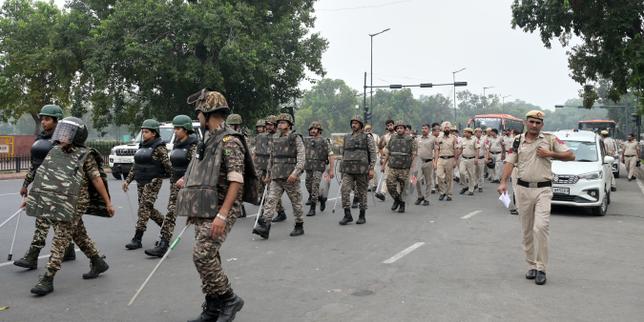
On October 10, 2026, police at New Delhi’s international airport intercepted a 31-year-old political communication strategist the moment he stepped off a plane. Within days, officers detained him a second time on live television outside his residence in the Indian capital. His name is Abhijeet Dipke, and he leads an insurgent youth movement called the Cockroach Janta Party (CJP)—or Parti du peuple cafard. Dipke was arrested preemptively to stop him from leading a massive demonstration against the Election Commission of India (ECI) over a controversial voter-roll audit that has stripped more than 130 million citizens of their voting rights.
Surface-level wire reports framed the arrests as another routine skirmish between Delhi police and street protesters. That misses the real story. The preventive detention of Dipke and his co-organizers, Saurav Das and Ashutosh Ranka, marks a volatile collision between a meme-driven generation of unemployed graduates and the institutional machinery of the world's largest democracy.
How a Judicial Insult Spawned a Mass Movement
To understand why the Indian state deployed roughly 20,000 police officers to lock down central New Delhi ahead of a student-led march, you have to look back five months to May 2026.
At the time, Dipke was a recent postgraduate student living in Boston. Back home in India, young people were protesting systemic failures, including widespread leaks of national entrance exams. During a hearing, Chief Justice of India Surya Kant made a remark comparing certain protesting youths to cockroaches.
Dipke turned the slur into a weapon. He launched an Instagram account under the banner of the Cockroach Janta Party, adopting the resilient insect as a mascot for a generation that refuses to be crushed. The account gained twenty million followers in a single day. Satire rapidly hardened into street power.
By July 2026, Dipke had returned to India and teamed up with Das and Ranka to organize a sustained sit-in at Jantar Mantar, Delhi’s historic protest square. Their target was the leaked NEET medical entrance exam. Five days of continuous mobilization accomplished something few veteran opposition politicians had managed since Narendra Modi took office in 2014. The government blinked. Union Education Minister Dharmendra Pradhan resigned.
For the ruling Bharatiya Janata Party (BJP), the lesson was clear. This decentralized network of law graduates, IT workers, and students was no longer a joke on social media. It could force cabinet-level concessions.
The 130 Million Voter Purge Behind the October Crackdown
After toppling the education minister, the Cockroach Janta Party pivoted from exam fraud to the architecture of Indian elections.
In June 2025, the Election Commission of India initiated an unprecedented nationwide audit known as the Special Intensive Revision (SIR). Election officials set out to re-verify nearly one billion registered voters, stating the goal was to eliminate duplicate entries, deceased individuals, people who had relocated, and what its directive termed "foreign illegal immigrants".
By autumn 2026, the scale of the deletions triggered an institutional crisis.
| Metric | Reported Figure |
|---|---|
| Total Voters Purged Nationwide | Over 130 million |
| Voters Removed in New Delhi Alone | 4.76 million (nearly one-third of the city's electorate) |
| Security Personnel Deployed in Delhi (Oct 2026) | Approximately 20,000 |
| Total Protesters Detained Across Anti-CEC Demonstrations | More than 7,000 |
Matters escalated in late September 2026 when media reports revealed internal friction inside the three-member Election Commission itself. Two election commissioners had reportedly raised formal objections regarding how the revision process was being executed. Opposition figures, including Congress party leader Rahul Gandhi and former Delhi Chief Minister Arvind Kejriwal, accused Chief Election Commissioner Gyanesh Kumar of presiding over a partisan purge designed to disenfranchise marginalized communities and urban migrants ahead of key state elections.
The ECI denied any wrongdoing, insisting that all major policy decisions on the voter roll cleanup were unanimous and mathematically necessary to maintain clean rolls.
Into this powder keg stepped the CJP. Dipke and his allies announced a mobilization in New Delhi demanding two specific outcomes:
- The immediate suspension and independent audit of the Special Intensive Revision process.
- The resignation and prosecution of Chief Election Commissioner Gyanesh Kumar.
Preventive Detention as Crowd Control
The state did not wait for the crowds to gather.
Under Indian law, police frequently invoke preventive detention statutes—provisions inherited from colonial-era policing and retained in modern criminal codes—to hold organizers before a suspected breach of the peace occurs. Critics call it a pre-crime dragnet that neutralizes dissent without requiring proof of an actual offense.
When Dipke landed in New Delhi on October 10, officers took him into custody at the terminal alongside Das and Ranka. Meanwhile, police sealed off the avenues surrounding Jantar Mantar. Protesters who managed to reach the perimeter were loaded onto waiting police buses. A local court ordered the three CJP leaders released the following day, prompting Dipke to take to social media and brand Prime Minister Modi a coward and a bully.
The freedom was brief. On October 16, as Dipke walked out of his Delhi residence flanked by television crews, police officers surrounded him and announced on camera that he was back under preventive arrest.
Das and Ranka were also re-arrested, with a court extending their custody before releasing them on October 21. Their release came with strict strings attached. Both men were forced to sign legal undertakings promising not to organize demonstrations at Jantar Mantar while the site remains denotified for protests, and pledging to maintain peaceful conduct.
Gray Areas and The Fragility of Leaderless Protest
Watching these events unfold over decades of covering South Asian politics, a familiar pattern emerges—along with a few genuine anomalies that complicate easy narratives.
First, there is the problem of the voter rolls themselves. India’s electoral database has long suffered from genuine bloat. Rapid urbanization means millions of internal migrant workers are registered in their home villages while living and working in megacities like Delhi and Mumbai. Deceased voters frequently remain on rolls for years. Cleaning that data is a legitimate administrative necessity. However, when a cleanup removes nearly one-third of a capital city's electorate in a single sweep without transparent, door-to-door verification, the cure looks indistinguishable from mass disenfranchisement. The ECI's refusal to publish granular, booth-level justifications for the 130 million deletions only fueled public suspicion.
Second, the Cockroach Janta Party is facing the classic growing pains of every digital-first protest movement.
In August 2026, the group formalized its structure during a meeting in Chhatrapati Sambhajinagar, Maharashtra, naming Dipke as National Convenor and drafting a five-point manifesto covering voter rights, parliamentary conduct, women's representation, and media ownership. By mid-November, the CJP began appointing zonal and state committees ahead of the high-stakes 2027 Uttar Pradesh assembly elections.
That transition from viral hashtag to formal political organization carries heavy risks:
- Co-optation by established parties. Mainstream opposition leaders like Rahul Gandhi have marched alongside anti-ECI demonstrators, while Hindu nationalist groups such as the Rashtriya Swayamsevak Sangh (RSS) have accused the CJP of being a front for organized left-wing outfits. Every time a legacy politician shares a stage with CJP activists, the movement loses a slice of its non-partisan appeal.
- Legal attrition. Courts and police have discovered they do not need long prison sentences to bleed a youth movement dry. Repeated preventive arrests, bail conditions, and forced undertakings restrict key organizers from physically appearing at rally points.
- Momentum fatigue. The CJP paused major street actions during the October Dussehra and Diwali festival season, promising to return to the streets afterward. History shows that once a street movement yields the pavement for religious holidays or administrative cooling-off periods, rebuilding the initial combustion is notoriously difficult.
Why This Matters Beyond New Delhi
The confrontation in New Delhi is not an isolated domestic dispute. Across South Asia—from student uprisings in Bangladesh to youth-led anti-corruption marches in Nepal—a demographic cohort raised on smartphones and battered by structural unemployment is bypassing traditional political parties entirely.
In India, youth joblessness and recurring leaks of civil service and university exams created the tinder. A careless remark from a high-ranking judge provided the spark. Now, the dispute over 130 million missing names on the voter rolls has given that anger a constitutional target.
By arresting Abhijeet Dipke at airport terminals and residential gates, Indian authorities successfully cleared the streets around Jantar Mantar for a few weeks. What they have not solved is the underlying arithmetic of a nation where millions of young people believe the exams are rigged, the jobs are nonexistent, and their names have been quietly erased from the ballot box before they even get a chance to vote.