The Weight of Geography and Iron
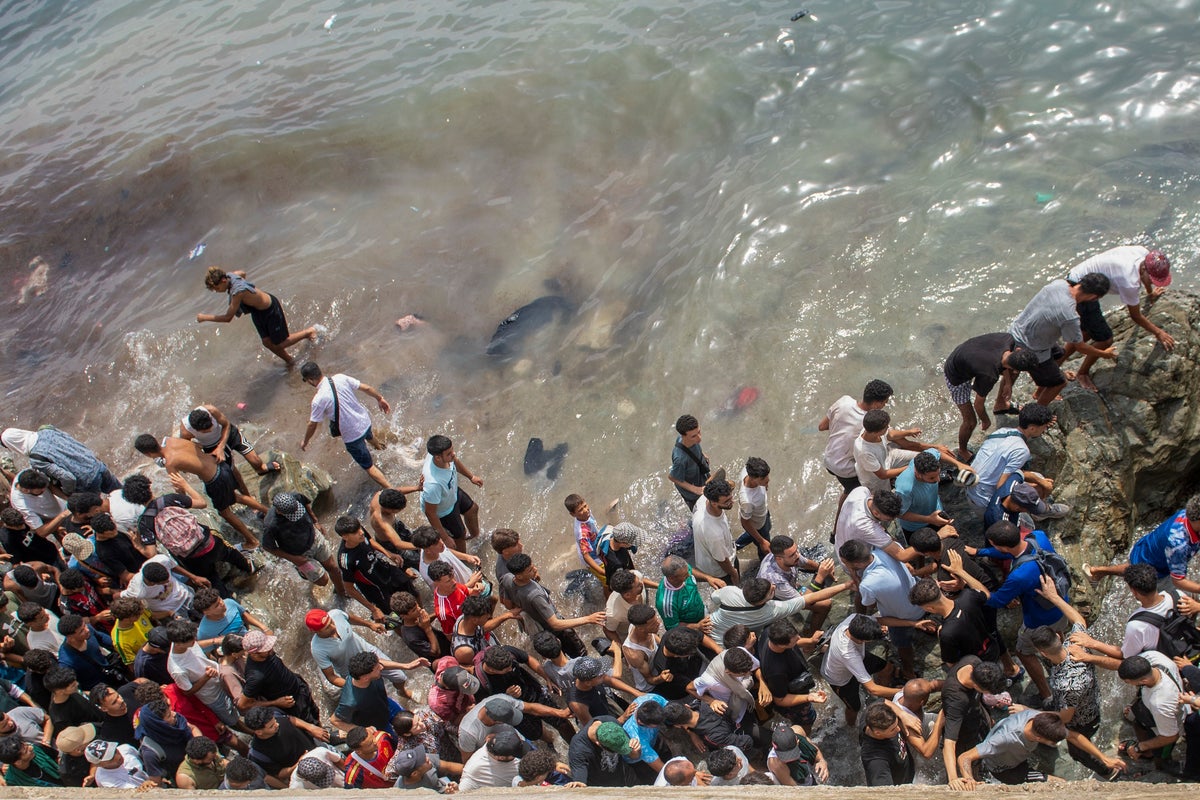
Concreting a frontier does not erase its gravity. When thousands sprint toward a heavily fortified European perimeter on African soil, the immediate reflex of television networks is to reach for the language of sudden catastrophes. A surprise surge. An unexpected wave. Officials in capitals far removed from the dirt and the tear gas express shock at the coordination of the crowds.
They should not be. Ceuta is not a random destination chosen by chance or spontaneous desperation. It is a pressure cooker built by centuries of imperial design, fenced in by high-tensile steel, and supercharged by modern economic decay. To understand why desperate young men and women hurl themselves against the double-barrier fences of this Spanish enclave, one must look past the breaking news banners and examine the anatomy of a frontier engineered to fracture. For another perspective, check out: this related article.
Borders are rarely static lines on a map. In places like Ceuta and its sister enclave Melilla, the border is a living organism of exclusion. It separates the European Union from Morocco, wealth from acute scarcity, and a guarded European standard of living from the grinding stagnation of North African peripheries. When the barrier was originally reinforced with razor wire, electronic sensors, and watchtowers, policymakers promised stability. Instead, they manufactured a permanent standoff.
The Imperial Blueprint
Ceuta is an anomaly. Claimed by Portugal in the fifteenth century and later passing to the Spanish Crown, this narrow Mediterranean peninsula has spent over five hundred years functioning as a military outpost, a penal colony, and a contested trophy. Unlike the rest of mainland Spain, it is geographically bound to the African continent. This geographic reality creates a profound psychological and geopolitical friction. For Morocco, the enclaves are colonial stigmata, remaining pockets of European sovereignty on North African land that mock national territorial integrity. For Spain, they are historic territories defended with the full legal and military weight of the state. Related insight regarding this has been shared by NPR.
This dual identity shapes every interaction between security forces and migrants. The people gathering in the hills overlooking the fence are not merely crossing an international boundary; they are stepping across a fault line of global inequality that has been hardening for generations.
We spent decades watching European funds flow into North African border control operations. Billions of euros have been funneled into Morocco to act as Europe's southern gendarme. Patrol boats, thermal cameras, and crowd-control training programs were deployed with bureaucratic precision. Yet every time the external security apparatus tightens, the human response simply mutates.
Fluidity defines desperate migration. Block one route, and another forms, deadlier and more chaotic. The rush across the frontier is not a failure of intelligence. It is the predictable outcome of compressing a massive population gradient against a wall that cannot possibly absorb the pressure.
The Economics of Desperation
Behind the fence lies a stark socio-economic divide. The immediate hinterland of northern Morocco has long suffered from economic neglect. Traditional smuggling economies, which sustained families in cities like Fnideq and Tetouan for decades, were systematically dismantled by Moroccan authorities under intense pressure from Madrid and Brussels.
When the petty trade economy died, thousands of small-scale traders, porters, and laborers lost their livelihoods overnight. Young people in the region faced a bleak binary choice: resign themselves to chronic joblessness or look toward the concrete barriers shimmering in the distance.
Europe represents an abstraction of survival. Stories filter back through social media and word of mouth, romanticizing the informal labor markets of southern Spain or the agricultural hubs of Andalusia. The reality awaiting those who scale the razor wire is often undocumented precarity, underground economies, and constant fear of deportation. But abstract danger competes poorly against concrete starvation. When local economies are choked off, the risk of a broken limb or a police baton strike during a border rush becomes a rational calculation.
Security analysts often speak of migration waves as weather events. Rainstorms that arrive unannounced. Hurricanes that defy forecasting. This is a comforting fiction. Weather cannot negotiate, and weather does not respond to policy incentives. Human movement reacts directly to the tools deployed to stop it.
Consider the physical barrier itself. The border fence around Ceuta is a masterclass in hostile architecture. It features parallel fences meters high, angled razor wire designed to shred flesh rather than simply impede progress, and non-lethal deterrents operated by Guardia Civil officers. Yet, every physical reinforcement triggers a tactical evolution among the desperate. Groups become larger, relying on sheer mass to overwhelm static defensive positions. Coordination shifts from small, hidden crossings to synchronized mass rushes where hundreds of individuals target multiple points simultaneously.
The strategy relies on overwhelming response capacity. If security forces can only respond to a finite number of breaches at once, a sufficiently large crowd guarantees that a fraction will make it across the line. It is a grim numbers game played with human lives.
The Political Weaponization of People
Borders do not exist in a vacuum of law and order. They are deeply political instruments. The frontier between Spain and Morocco regularly transforms into a diplomatic chessboard where human bodies serve as pawns.
When diplomatic tensions flare between Rabat and Madrid over issues ranging from Western Sahara policy to fishing rights, the enforcement mechanisms at the border subtly loosen. Checkpoints experience administrative slowdowns. Surveillance assets are quietly redirected. The message conveyed without a single word spoken in public is unmistakable: cooperation has a price, and stability depends entirely on the goodwill of foreign capitals.
This dynamic leaves the migrants caught in a geopolitical crossfire. They are tolerated when diplomatic ties are warm, and cracked down upon with brutal efficiency when relations sour. The border rush is rarely an organic, isolated phenomenon. It is often the visible symptom of invisible diplomatic friction.
Human rights organizations document the aftermath with monotonous regularity. Beatings, summary pushbacks that violate international asylum law, and medical neglect. Yet the cycle persists. Each violent confrontation leaves behind a trail of trauma, yet the hills above Ceuta refill within weeks.
The Reality of Fortress Europe
We are witnessing the slow exhaustion of a containment model. The prevailing political consensus across much of the West holds that borders can be defended through sheer engineering, surveillance technology, and externalized policing. Outsourcing border management to authoritarian regimes or volatile transit countries is treated as a masterstroke of geopolitical pragmatism.
It is a fragile illusion.
No amount of steel, concrete, or electronic surveillance can permanently suppress human mobility driven by massive demographic and economic disparities. As long as the gap between the Global North and South widards, as long as climate pressures degrade arable land in the Sahel, and as long as local economies in North Africa remain stifled, people will run toward the fence.
The tragedy of Ceuta is not that a border was rushed. The tragedy is that we have built a world where the only viable lottery ticket for a desperate human being is a suicidal sprint across razor wire. Until policymakers stop treating human movement exclusively as a law enforcement crisis and confront the structural engine driving the desperation, the fences will keep growing taller, the rushes will keep turning bloodier, and the illusion of security will continue to fracture from within.