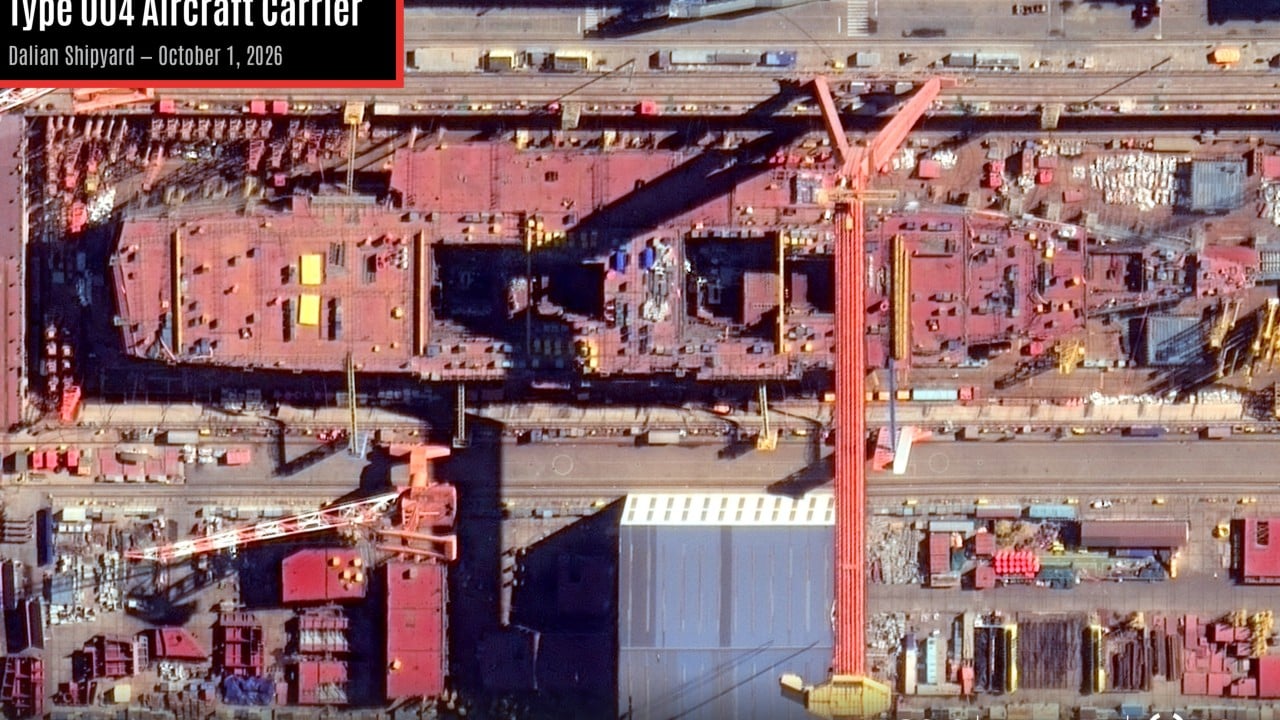
Commercial satellite imagery from northeastern China confirms that China’s fourth aircraft carrier, designated the Type 004, is assembling at a pace that puts a 2027 hull launch squarely on the table. Defense analysts tracking the dry docks at Dalian Shipbuilding Industry Company point to newly installed hull modules, widening beam dimensions, and heavy reactor-containment structures that mark a permanent break from Beijing's conventionally powered fleet. While the Type 003 Fujian introduced electromagnetic catapults to the People’s Liberation Army Navy, the vessel taking shape in Dalian represents the endgame of Chinese naval aviation—a nuclear-powered supercarrier engineered to match the displacement, sortie rate, and blue-water endurance of the United States Navy’s Gerald R. Ford class.
Most coverage of Chinese naval expansion stops at counting hulls. That misses the real story. Building a 110,000-ton warship is an industrial feat, certainly, yet the true disruption lies in the supply chain and propulsion architecture hidden beneath the flight deck.
What Satellite Imagery Reveals at Dalian
The dry dock at Dalian is not just holding steel; it is revealing a structural blueprint. Over the past several months, commercial overhead photography has captured massive keel blocks and lower hull sections taking shape in the same basin that refitted China’s first carrier, the Liaoning, and built its second, the Shandong.
Look closely at the beam—the widest part of the hull. Measurements derived from synthetic aperture radar and optical passes show a hull profile noticeably broader than the Fujian, which displaces roughly 80,000 to 85,000 tons. A wider beam is never an accident in naval architecture. It buys deck space for larger aircraft elevators, wider taxi lanes, and simultaneous launch-and-recovery cycles. More importantly, the internal compartmentalization visible before the upper hangar decks seal the hull reveals square, heavily reinforced void spaces amidships.
In naval engineering, those dimensions correspond to pressurized water reactor containment.
China has spent decades refining naval nuclear propulsion for its Type 093 and Type 095 attack submarines, as well as its Type 094 ballistic missile boats. Scaling a submarine reactor up to power a 100,000-ton surface combatant running three or four electromagnetic catapults is a different animal entirely. Submarine reactors prioritize acoustic quietness over raw thermal output. Supercarrier reactors must generate massive, continuous megawatts to drive four propellers at 30-plus knots while simultaneously charging capacitor banks for electromagnetic aircraft launch systems, high-powered phased-array radars, and future directed-energy weapons.
To solve this, Chinese nuclear engineers leaned heavily on land-based prototypes. Open-source intelligence and satellite monitoring of Site 909 in Sichuan province—the historical cradle of China’s naval nuclear program—have documented extensive facility expansions and cooling-tower infrastructure consistent with testing a high-output surface warship reactor. The modules appearing in Dalian suggest those land-based trials crossed the threshold from experimental to operational faster than Western intelligence estimates predicted five years ago.
The Strategic Shift From Coastal Defense to Blue Water Power
Why spend tens of billions of dollars on nuclear supercarriers when land-based anti-ship ballistic missiles like the DF-21D and DF-26 already threaten adversary fleets across the Western Pacific?
Because missiles cannot hold territory, police sea lanes, or project sustained air superiority thousands of miles from the mainland. A missile is a one-way ticket. An aircraft carrier is a sovereign, mobile airbase that stays on station for months.
Breaking the First Island Chain
China’s maritime geography has always been a strategic straitjacket. Hemmed in by the First Island Chain—an archipelago stretching from the Japanese home islands down through Okinawa, Taiwan, and the Philippines—the People’s Liberation Army Navy faces tight chokepoints every time it enters the Pacific. Diesel-electric submarines and conventionally powered carriers tethered to fleet oilers struggle to operate beyond the Philippine Sea without vulnerable logistics tails.
A nuclear-powered Type 004 removes the fuel leash. While the air wing still requires aviation fuel and ordnance from replenishment ships, the carrier itself never needs to slow down or divert for bunker fuel. That single capability alters operational math in the Second Island Chain around Guam, the Indian Ocean sea lanes carrying Middle Eastern crude to Chinese ports, and even the approaches to the South Atlantic.
The Sortie Generation Math
In modern carrier warfare, survival depends on sortie generation rate—how many armed aircraft a deck can launch, recover, rearm, and relaunch in a 24-hour window.
| Carrier Class | Propulsion | Displacement (Est.) | Catapults | Primary Air Wing Role |
|---|---|---|---|---|
| Type 001 Liaoning | Conventional | ~60,000 tons | None (Ski-jump) | Fleet air defense, training |
| Type 002 Shandong | Conventional | ~65,000 tons | None (Ski-jump) | Regional air superiority |
| Type 003 Fujian | Conventional | ~80,000+ tons | 3 Electromagnetic | Heavy strike, AEW&C |
| Type 004 (Dalian) | Nuclear | ~100,000+ tons | 4 Electromagnetic | Global blue-water power projection |
China’s first two carriers relied on ski-jump ramps. Ski-jumps are simple and reliable, yet they impose a brutal physics penalty: fighter jets cannot take off with both maximum fuel and heavy air-to-ground ordnance, and heavy fixed-wing airborne early warning aircraft cannot launch at all.
The Fujian fixed the launch problem with electromagnetic catapults, but its conventional steam turbines still share energy budgets between propulsion and shipboard electrical grids. By pairing nuclear reactors with a larger flight deck and four electromagnetic catapults, the Type 004 aims to match the US Navy’s benchmark of 160 sorties per day during standard operations and over 240 in a surge.
The Air Wing Bottleneck Nobody Talks About
Steel hulls and nuclear reactors make dramatic satellite photos. They do not win air battles on their own. The hardest part of building a competitive supercarrier force happens on runways in Liaoning and Hebei provinces, where China is racing to build an entire ecosystem of carrier-capable aircraft from scratch.
For years, the PLAN relied on the J-15 Flying Shark, a heavy twin-engine fighter derived from a Soviet Su-33 prototype purchased from Ukraine. The J-15 was too heavy for ski-jumps and plagued by early flight-control glitches. To make the Type 004 lethal, Beijing is fielding a completely new generation of naval aviation:
- J-35 Stealth Fighter: A twin-engine, low-observable multirole jet designed specifically for carrier operations. Unlike the land-based J-20, the J-35 features folding wings, a reinforced undercarriage for arrested landings, and a catapult launch bar. It is China’s direct answer to the F-35C.
- J-15T and J-15D Variants: Upgraded catapult-capable versions of the original J-15. The J-15T acts as a heavy missile truck carrying long-range air-to-air and anti-ship munitions that exceed the internal weapons bay limits of stealth fighters. The J-15D serves as a dedicated electronic warfare and radar-jamming platform, mirroring the US Navy’s EA-18G Growler.
- KJ-600 Airborne Early Warning Aircraft: Perhaps the single most vital aircraft in the entire carrier group. Without high-altitude radar surveillance, a carrier battle group is effectively blind to low-flying sea-skimming missiles beyond the ship's radar horizon. The twin-turboprop KJ-600 gives the Type 004 an airborne command post capable of tracking stealth targets and cueing missiles hundreds of miles away.
- GJ-11 Navalized Stealth Drones: Satellite imagery at test facilities has repeatedly shown tailless flying-wing unmanned combat aerial vehicles parked alongside mock-up carrier decks. Integrating unmanned wingmen into carrier cycles allows commanders to send sensors and strike packages into heavily contested airspace without risking scarce carrier aviators.
Building the jets is only half the equation. Training pilots to land 30-ton aircraft onto a pitching, 1,000-foot strip of steel at night in rough seas takes decades of institutional muscle memory. The US Navy paid for its carrier doctrine in blood and lost airframes over a century. China is attempting to compress that learning curve into fifteen years using high-fidelity simulators, shore-based electromagnetic test tracks, and accelerated deck qualification cycles.
Industrial Scale Versus Operational Reality
A 2027 launch date does not mean the Type 004 will deploy for combat in 2027.
In shipbuilding, "launch" simply means the hull is watertight enough to float out of the dry dock and move to a fitting-out pier. Once afloat, the real grind begins. Technicians must install thousands of miles of fiber-optic cabling, calibrate phased-array radar panels, test the nuclear propulsion plant at dockside, and run endless electromagnetic catapult dead-load shots—launching heavy wheeled sleds into the harbor water to verify rail alignment and power draw.
Consider the timeline of China’s previous carrier. The Type 003 Fujian launched in June 2022, spent nearly two years moored at Jiangnan Shipyard for fitting-out and mooring trials, and did not begin sea trials until May 2024. A nuclear carrier is exponentially more complex. Reactor criticality testing, radiation shielding verification, and integrated combat system trials typically add three to four years between hull launch and formal commissioning.
Even after commissioning, achieving initial operational capability—the point where a carrier can deploy with a full air wing and execute complex multi-ship operations—takes another two to three years. Realistically, the Type 004 will not become a fully combat-ready frontline asset until the early 2030s.
The Dual-Shipyard Advantage
What separates China’s shipbuilding apparatus from every other nation on earth is parallel capacity. While Dalian constructs the nuclear Type 004 in the north, Shanghai’s Jiangnan Shipyard—the sprawling facility on Changxing Island that built the Fujian—remains active and expanding.
Defense analysts watching both yards have noted that China no longer builds ships in isolated one-off prototypes. They build in batches, refining hull forms incrementally while maintaining continuous assembly lines. In the United States, Newport News Shipbuilding in Virginia is the sole shipyard capable of building and refueling nuclear aircraft carriers, creating a chronic bottleneck where maintenance delays on one ship push back construction schedules for the next. China faces no such single-yard constraint. By splitting surface combatant and carrier construction across Dalian and Shanghai, Beijing can iterate designs while simultaneously churning out Type 055 guided-missile cruisers—the 13,000-ton "bodyguards" required to shield a supercarrier from air and submarine threats.
The Vulnerability Paradox of Modern Supercarriers
Investing billions into massive nuclear flattops invites an obvious counter-argument: aren't aircraft carriers becoming obsolete dinosaurs in an era of hypersonic glide vehicles, satellite reconnaissance constellations, and long-range precision strike?
It is a fair question, and naval strategists in both Washington and Beijing wrestle with it daily. Modern commercial and military satellites make hiding a 1,100-foot warship on the open ocean nearly impossible. Once spotted, a carrier becomes a magnet for ballistic missiles, submarine-launched torpedoes, and long-range bomber salvos.
Yet the strategic calculus in Beijing points in the opposite direction. China is not building the Type 004 to charge blindly into the teeth of American coastal defenses. They are building it to dominate conflicts where the opponent lacks dense, land-based anti-access networks—or to operate under the protective umbrella of their own mainland missile systems while projecting power outward into the Indian Ocean and South Pacific.
Furthermore, a carrier battle group is not a lone target; it is a layered defensive fortress. Surrounded by Type 055 cruisers carrying over a hundred vertical launch cells each, Type 052D destroyers, and nuclear attack submarines prowling beneath the thermocline, a supercarrier creates an anti-air and anti-submarine bubble stretching hundreds of miles. Taking one down requires saturating that defense with dozens of expensive, coordinated munitions—an operational feat few militaries on earth can pull off.
The Chokepoints That Could Still Slow Beijing Down
Despite the breakneck pace visible in Dalian, three structural hurdles could still trip up China’s 2027 launch target and subsequent deployment timeline.
First is reactor reliability under sustained combat loads. Operating a naval nuclear plant during peacetime transit is routine; cycling reactor output rapidly during weeks of high-tempo flight operations places immense thermal stress on steam generators, primary coolant pumps, and pressure vessels. Any hairline crack or coolant leak in a nuclear plant cannot be fixed with a welding torch at sea—it forces a multi-year dry dock overhaul.
Second is anti-submarine warfare (ASW). Historically, ASW has been the Achilles' heel of the Chinese navy. Operating a high-value supercarrier in deep blue water without airtight undersea protection is an open invitation to hostile attack submarines. While Beijing is deploying new towed-array sonars, fixed seabed hydrophone networks, and Z-20F shipboard helicopters, hunting quiet nuclear submarines across the vast depths of the Philippine Sea remains one of the hardest tasks in military science.
Third is institutional logistics and overseas basing. Even a nuclear carrier needs food, spare jet engines, precision-guided bombs, and dry dock maintenance. Aside from its support base in Djibouti and rumored access agreements in Cambodia, China lacks the global network of deep-water ports, fuel depots, and repair facilities that allows the US Navy to sustain deployments across every ocean simultaneously.
None of these hurdles will stop the steel from rising in Dalian. By the time the dry dock floods in 2027, the maritime balance of power in the Indo-Pacific will have crossed a threshold that no diplomatic summit or sanctions package can reverse.