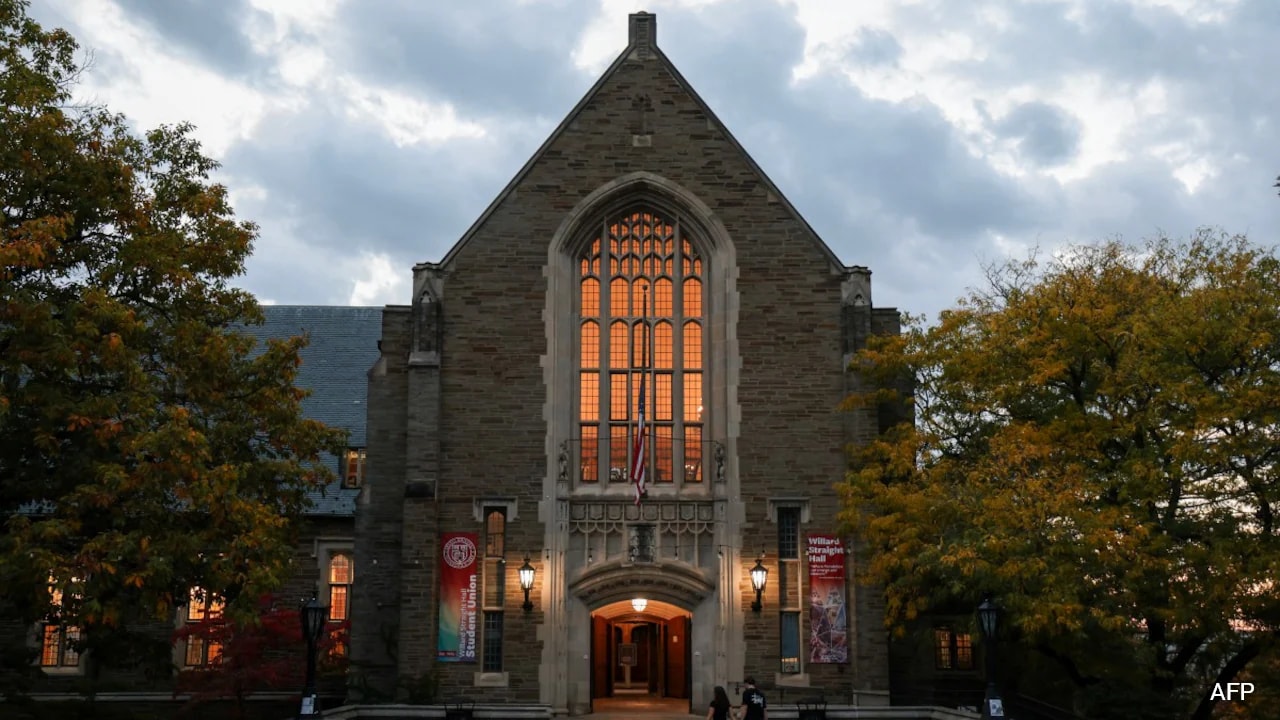
The Cornell Faculty Senate has formally declared a vote of no confidence in the university's senior leadership, delivering a rare institutional rebuke that signals a deep breakdown in shared governance. A no-confidence vote does not legally strip an administration of its executive authority or force immediate resignations, yet it strips away something far more vital in higher education—moral legitimacy. When the academic core of an Ivy League institution publicly states it no longer trusts the people running the budget, campus operations, and external relations, the entire machinery of the university grinds toward a standstill.
To understand how an elite research institution arrived at this flashpoint, you have to look past the surface-level headlines about campus protests and administrative policies. Those events were merely the spark. The dry timber had been piling up in Ithaca for years, stacked high by corporate-style centralization, shrinking faculty influence over academic priorities, and a widening gulf between the boardroom and the classroom.
The Anatomy of a Governance Breakdown
For decades, major American research universities operated on an unwritten social contract. Trustees managed the endowment and long-term capital. Presidents and provosts handled external fundraising and high-level operations. Faculty controlled the curriculum, research direction, and academic standards. That division of labor worked because each side respected the boundaries of the other.
Over the past fifteen years, that boundary dissolved. Across the Ivy League and peer institutions, administrative ranks swelled while tenure-track faculty growth remained relatively flat. At Cornell, professors increasingly found themselves sidelined during critical decision-making processes that directly affected teaching, campus safety, and academic freedom. Policies regarding expressive activity on campus were drafted, revised, and enforced through top-down directives rather than collaborative deliberation.
Trust erodes slowly, then collapses all at once.
When the Faculty Senate moves toward a no-confidence resolution, it is rarely reacting to a single memo or one botched press release. It is responding to a pattern of unilateral action. Senators represent hundreds of tenured and tenure-track professors across diverse colleges—from Agriculture and Life Sciences to Arts and Sciences, Engineering, and Hotel Administration. Getting that notoriously independent-minded group to agree on lunch is difficult; getting a majority to formally repudiate university leadership requires an extraordinary level of sustained institutional frustration.
Why Campus Speech Policies Became the Breaking Point
Every major university crisis needs a catalyst, and at Cornell, the handling of campus protests and interim expressive activity policies served as the ultimate stress test. Following waves of student demonstrations and national political scrutiny, senior administrators implemented strict new rules governing where, when, and how members of the university community could assemble or speak.
To administrators, these measures looked like basic risk management. Donors were threatening to pull funding. Congressional committees were demanding answers. Liability lawyers were warning about campus disruptions and safety hazards. From the perspective of Day Hall—the administrative hub of Cornell's Ithaca campus—tightening the screws on campus demonstrations seemed like the only way to restore order and protect the institution's brand.
Faculty saw something entirely different. Many professors viewed the interim policies as an overreach that chilled academic freedom and bypassed established university assemblies. When disciplinary actions and suspensions were handed down under rules that had not gone through normal shared-governance channels, the backlash intensified. Even faculty members who disagreed strongly with the protesters' political messages found themselves alarmed by the procedural shortcuts taken by the administration.
In academia, process is sacred. You can survive an unpopular decision if the process was transparent and inclusive. You cannot survive a decision that feels imposed by fiat.
The Corporate University Collision
What is happening in Ithaca is a textbook collision between two incompatible management philosophies. Modern university executives are hired largely for their ability to raise billions of dollars, navigate complex regulatory environments, and manage sprawling enterprise budgets. Naturally, they bring corporate crisis-management instincts to the job. When a crisis hits, corporate executives centralize control, tighten messaging, and act decisively to appease shareholders.
The problem is that faculty are not employees in the traditional corporate sense, and students are not customers. A research university is a decentralized confederation of scholars whose primary loyalty is to their discipline and the pursuit of knowledge, not to a brand strategy. When leadership treats the faculty senate as an advisory focus group rather than a co-equal governing body, rebellion is practically guaranteed.
Consider a hypothetical example of how this friction plays out in practice. Suppose a university administration decides to restructure an interdisciplinary academic center or alter campus policing protocols overnight in response to external political pressure. In a corporate setting, the CEO announces the pivot on Monday, and department heads execute it by Wednesday. In a university setting, department chairs immediately demand to see the empirical data behind the decision, question the legal authority of the provost to bypass committee review, and organize a floor debate that dominates local media coverage for months.
Cornell's leadership repeatedly miscalculated this dynamic. By prioritizing rapid containment of external criticism from donors and lawmakers, administrators alienated the internal constituency they actually need to run the university day to day.
What a No Confidence Vote Actually Does
Outside academia, a vote of no confidence often sounds like a parliamentary mechanism that triggers an immediate election or forces a prime minister out of office. In American higher education, the reality is much murkier. Under Cornell's charter and bylaws, formal authority rests with the Board of Trustees. The Faculty Senate cannot fire a president, a provost, or a vice president.
Does that make the vote purely symbolic? Hardly.
In the insular world of elite academia, symbolic power carries heavy operational consequences. First, it severely damages leadership's ability to recruit top talent. Prospective deans, department chairs, and star researchers pay close attention to governance stability before uprooting their labs and families. Nobody wants to step into a leadership role at an institution locked in open warfare between its administration and its faculty.
Second, it complicates fundraising. While some mega-donors applaud tough administrative crackdowns on campus unrest, a much broader base of alumni donors gives specifically to support academic departments, undergraduate scholarships, and faculty research. Prolonged internal turmoil makes development officers' jobs exponentially harder.
Third, a no-confidence declaration puts the Board of Trustees in an untenable position. Trustees generally back their chosen executives during external storms—that is what boards are supposed to do. However, when the faculty formally breaks ranks, trustees are forced to ask whether keeping the current leadership team intact is worth years of institutional paralysis.
The Counter-Argument From Day Hall
To be fair to university executives, running a major research institution over the past few years has been an impossible balancing act. Senior leaders are caught in a vise between irreconcilable demands. On one side, state and federal lawmakers threaten research grants and tax-exempt statuses if administrators fail to clamp down on campus disruptions. On the other side, students and faculty demand absolute protection for political expression and protest.
Administrators at Cornell have consistently argued that their primary obligation is to ensure the physical safety of the campus community and guarantee that classes, exams, and research can proceed without interruption. From their vantage point, waiting months for endless committee debates while campus tensions boil over is a luxury an executive cannot afford. Someone has to make the hard calls when windows are being broken or buildings are occupied, and that responsibility falls on the people sitting in Day Hall, not on tenured professors voting in a faculty senate meeting.
There is genuine merit to that defense. Shared governance is notoriously slow, risk-averse, and ill-suited for real-time crisis response. Yet even granting administrators the benefit of the doubt on emergency decision-making, critics point out that emergency powers are supposed to be temporary. Converting temporary emergency rules into permanent institutional policy without genuine faculty buy-in is where leadership lost the room.
Historical Precedents Across Higher Education
Cornell is far from the first major university to experience this kind of revolt, and history offers a clear roadmap of what happens next. Over the past decade, votes of no confidence have hit leadership teams at institutions ranging from the University of Southern California and the University of North Carolina to Harvard and Columbia.
The outcomes generally follow one of two trajectories. In some cases, the board of trustees issues a staunch vote of support for the president, and the administration attempts to wait out the anger. This approach rarely restores genuine harmony; instead, it produces a lame-duck era where major strategic initiatives stall and faculty committees stonewall administrative proposals until the executive eventually steps down quietly a year or two later.
In other cases, the vote serves as a wake-up call that forces a structural reset. Boards step in to mediate, interim policies are sent back to joint faculty-student-administration task forces, and communication channels are rebuilt from scratch. Even then, the scars linger for years.
The Structural Flaws Nobody Wants to Fix
Focusing exclusively on individual personalities in Day Hall misses the deeper structural rot infecting American higher education. Replacing one administrator with another will not fix a governance model that is fundamentally out of alignment with modern realities.
Universities have grown too large, too financially complex, and too politically exposed to be run entirely by consensus. At the same time, they cannot be run like top-down corporations without destroying the intellectual culture that makes them valuable in the first place. Until boards of trustees and faculty senates establish clear, binding rules for how crisis decisions are made—and how quickly emergency measures must expire—these collisions will keep happening.
Right now, Cornell sits at the center of that unresolved tension. The Faculty Senate has spoken clearly, putting its institutional weight on the line to declare that the current trajectory is unsustainable. Whether the Board of Trustees treats this vote as a passing political storm or a legitimate governance emergency will determine how long the paralysis in Ithaca lasts.


