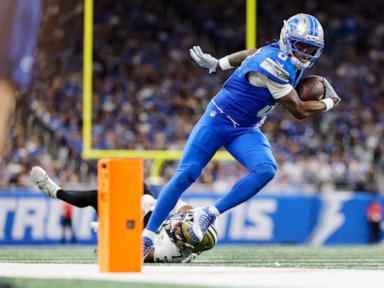
The Detroit Lions spent three seasons hiding in plain sight behind a two-headed monster. Jahmyr Gibbs and David Montgomery functioned as an asymmetric threat matrix, pairing Gibbs' electric open-field acceleration with Montgomery's short-yardage brutality. Opposing coordinators spent entire weeks building defensive fronts designed to solve that specific partnership. Then the offseason arrived, Montgomery departed in a trade to the Houston Texans, and the organization handed the keys entirely to Gibbs.
The primary question facing Detroit is not whether Gibbs can accumulate statistics, but whether absorbing the heavy workload of a traditional primary back will alter the explosive efficiency that made him elite.
Historically, modern professional offenses view the bell-cow running back position through a lens of cautious nostalgia. Teams want volume until that volume destroys the player. During his first three years, Gibbs operated on a pitch count that maximized his touches while preserving his lower extremities. He played roughly 56 to 57 percent of the offensive snaps in his initial years, sharing the stage and keeping his body fresh. That number ticked upward to 67 percent, and now, operating as the undisputed focal point of the backfield, that snap share faces an inevitable rise.
To understand the mechanics of this shift, one must examine how Detroit structures its run concepts. Under previous iterations of the offense, Montgomery absorbed the punishing interior dives against stacked boxes, softening the defensive line so that Gibbs could exploit stretched secondaries on outside zone runs and delayed screens. Without Montgomery absorbing those high-collision reps, Gibbs takes on a different physical tax. Every extra carry into the A-gap changes the recovery timeline for a back whose primary weapon is lateral elusiveness.
Football analysts often treat touches as a linear equation. More carries equal more yards. Reality is far more brutal.
Consider a hypothetical example to illustrate backfield wear. A running back who logs twenty total touches per game faces roughly four to six direct collisions with defenders outweighing him by thirty pounds. Over a seventeen-game schedule, scaling those touches from fifteen to twenty-five per contest adds nearly a hundred high-velocity impacts. For an explosive runner, those hits accumulate in the hips and ankles, subtly stripping away the top-end burst that turns a four-yard gain into an eighty-yard touchdown.
Head coach Dan Campbell and the offensive coaching staff understand this arithmetic. The introduction of new offensive coordinator Drew Petzing signals an tactical evolution rather than a simple carbon copy of previous play-calling sheets. Petzing inherits a weapon who finished near the top of the league in scrimmage yards and touchdowns, meaning the playbook will not shrink. Instead, it must adapt to how defenses choose to deploy extra defenders in the box now that the threat of a bruising partner has vanished.
Opposing defenses no longer have the luxury of guessing which back is on the field. When Montgomery checked into the game, defensive coordinators anticipated heavy personnel packages and interior runs. When Gibbs subbed in, the geometry of the field changed. Defenses had to respect the pass-catching threat out of the backfield. By consolidating those distinct roles into a single player, the Lions lose a layer of disguise. Defensive linebackers can read the offensive formation without second-guessing tendencies based on personnel groupings.
Gibbs himself has addressed the transition with quiet confidence, acknowledging the heavier burden while noting that carrying the load is familiar territory from his collegiate days at Alabama. Yet the professional game extracts a distinct toll. The speed of linebackers closing rushing lanes leaves zero margin for hesitation. When a back loses a fraction of a second in his decision-making due to fatigue, plays that once gained six yards stall out at the line of scrimmage.
The success of Detroit's offensive philosophy this season hinges on two variables: the interior offensive line's ability to win upfront without a power back, and Petzing's creativity in manufacturing space. If the blocking scheme can consistently create clean initial paths past the defensive front, Gibbs can use his vision to bypass heavy contact entirely. If the blocking breaks down, the team will quickly discover the hidden costs of relying on a single playmaker to carry an entire running game.
The partnership that defined the franchise's recent resurgence is gone. What replaces it will determine whether the offense maintains its elite tier or grinds down under the weight of expectation.