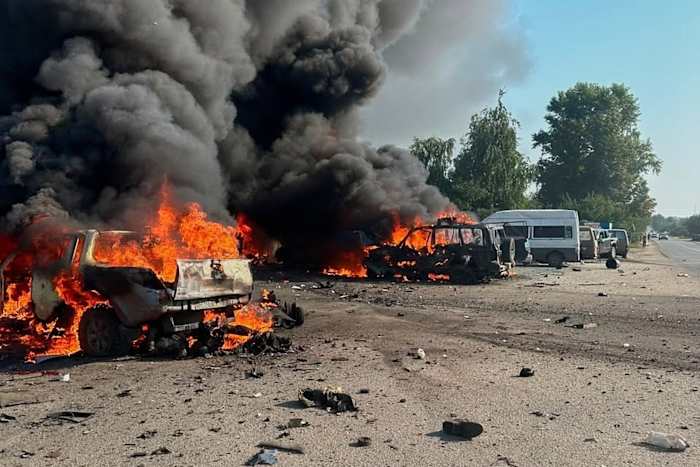
The radar screens inside Moscow air defense command did not blink until the metallic hum was already overhead. On a Tuesday night that proved decades of military doctrine obsolete, a coordinated swarm of Ukrainian long-range strike drones punctured the capital's perimeter, detonating against high-rise residential towers and triggering panic across the elite districts of the Russian capital. Simultaneously, hundreds of miles away in a quiet Ukrainian village, Russian cruise missiles obliterated a civilian grocery market, snuffing out ten lives in an instant. This is the grim arithmetic of modern attrition. As the conflict grinds past its grueling milestones, the center of gravity has shifted. The war is no longer a localized trench contest fought solely in the muddy fields of the Donbas. It has arrived at the doorstep of the Russian political class, carried on the wings of cheap, autonomous technology that completely changes how superpowers defend their home territory.
For months, Russian state television assured its viewers that Moscow remained an impenetrable fortress. Anti-air batteries—Pantsir-S systems bolted onto rooftops and sophisticated S-400 installations ringing the beltway—were marketed as an absolute shield. The reality on the ground exposed the hollowness of that propaganda.
The Asymmetry of Cost and Geography
Building an air defense network capable of protecting a continent-sized nation is mathematically impossible. A single S-400 interceptor missile costs millions of dollars. The long-range loitering munitions hitting the Russian heartland, fabricated from off-the-shelf commercial electronics and fiberglass composite frames, cost a fraction of that figure. When defense economics dictate that the defender must spend a thousand times more to destroy an incoming threat than the attacker spends to launch it, fiscal exhaustion becomes inevitable.
Military analysts have watched this dynamic unfold with mounting fascination. The strategic goal of the long-range drone campaign targeting Moscow is not to achieve a military breakthrough or destroy hardened command bunkers. The objective is psychological and structural. By bringing the concussive shock of war directly to the urban centers of the aggressor nation, the calculus of public tolerance shifts. When Muscovites are jolted awake by anti-air fire and burning debris falling onto their streets, the abstract concept of a distant "special military operation" transforms into a daily reality.
The tactical execution requires precision engineering and complex routing. Ukraine's domestic defense sector has rapidly scaled the production of uncrewed aerial vehicles capable of flying hundreds of kilometers past electronic jamming boundaries. These systems rely on inertial navigation and pre-programmed terrain-following software to bypass dense networks of radio-frequency suppression. Electronic warfare remains a formidable obstacle, but the sheer volume of low-altitude vectors overwhelms traditional radar filtering logic.
The Brutal Retaliation Cycle
Air superiority and long-range strike capabilities are answered in kind by indiscriminate counter-strikes. While drones buzz the glass facades of Moscow financial hubs, Russian strategic bombers continue their grim routine from bases deep within the federation. The strike that killed ten civilians in a provincial Ukrainian village serves no discernible military purpose. It is a punitive measure designed to terrorize non-combatants and break civilian morale.
This reciprocal violence highlights the core tragedy of the current phase of the war. As battlefield lines stabilize due to minefields and entrenched artillery positions, both belligerents rely heavily on standoff weaponry.
- Strategic Standoff: Cruise and ballistic missiles launched from Caspian Sea vessels or strategic airframes.
- Tactical Penetration: First-person view (FPV) drones chewing up armor at the front lines.
- Strategic Harassment: Long-range autonomous platforms probing capital air defenses.
The intersection of these three vectors creates a terrifyingly volatile environment where civilian infrastructure acts as the primary sponge absorbing the impact of technological escalation.
+-------------------------------------------------------------+
|                THE ESCALATION FEEDBACK LOOP                 |
+-------------------------------------------------------------+
|                                                             |
|   [Ukrainian Long-Range Drones] ---> Target: Moscow Capital |
|                |                                            |
|                v                                            |
|   [Russian Retaliation]       ---> Target: Village Markets  |
|                                                             |
+-------------------------------------------------------------+
The Logistics of Long-Range Strikes
Executing a strike against a heavily defended capital requires more than just pointing a flying bomb at a set of GPS coordinates. Electronic interference from powerful Russian jamming stations can sever a drone's connection to navigation satellites miles before it reaches its target. To counter this, engineers have integrated advanced optical terminal guidance systems. These systems capture images of the target area during the final seconds of flight, matching them against onboard databases to guide the warhead autonomously into high-value structures without human intervention.
The production lines for these weapons do not resemble traditional tank factories. They are distributed networks of small workshops, university labs, and clandestine assembly plants scattered across Western and Central Europe and Ukraine. This decentralization makes them virtually immune to preemptive counter-strikes. If one assembly node is discovered and destroyed, three more spring up in empty warehouses or suburban garages within a fortnight.
Russia's response has been frantic, involving the physical deployment of air defense systems onto government rooftops and industrial facilities across Moscow. Images of heavy military hardware hoisted onto administrative buildings offered a surreal visual commentary on the state of national security. A nation that once projected global military dominance now finds itself playing an anxious game of defensive catch-up against an adversary with a fraction of its baseline industrial capacity.
Strategic Implications for the Future of Conflict
The events unfolding across the skies of Moscow and the villages of Ukraine mark a permanent turning point in military history. The era of the untouchable superpower homeland is officially over. Commercial technology has democratized long-range precision destruction. Any state, or even well-funded non-state actor, can assemble a fleet of autonomous strike vehicles capable of crossing international borders and bypassing billions of dollars worth of legacy radar architecture.
Military budgets worldwide are currently undergoing frantic revisions. Traditional procurement programs heavily weighted toward manned fighter jets and massive naval destroyers are being re-evaluated in light of how effectively cheap aerial drones dismantle perceived air superiority. When an air defense battery costing a hundred million dollars can be neutralized or bypassed by a swarm of autonomous devices built for the price of a luxury sedan, institutional inertia ceases to be an option for military planners.
As the smoke clears from the latest round of explosions in the Russian capital and rescue workers sift through the rubble of provincial markets, the trajectory remains fixed. The technology will only grow more autonomous, the ranges longer, and the cost per strike cheaper. There is no diplomatic off-ramp currently visible that can halt this technological momentum, leaving both nations locked in a mutual descent where every escalation breeds an even deadlier response