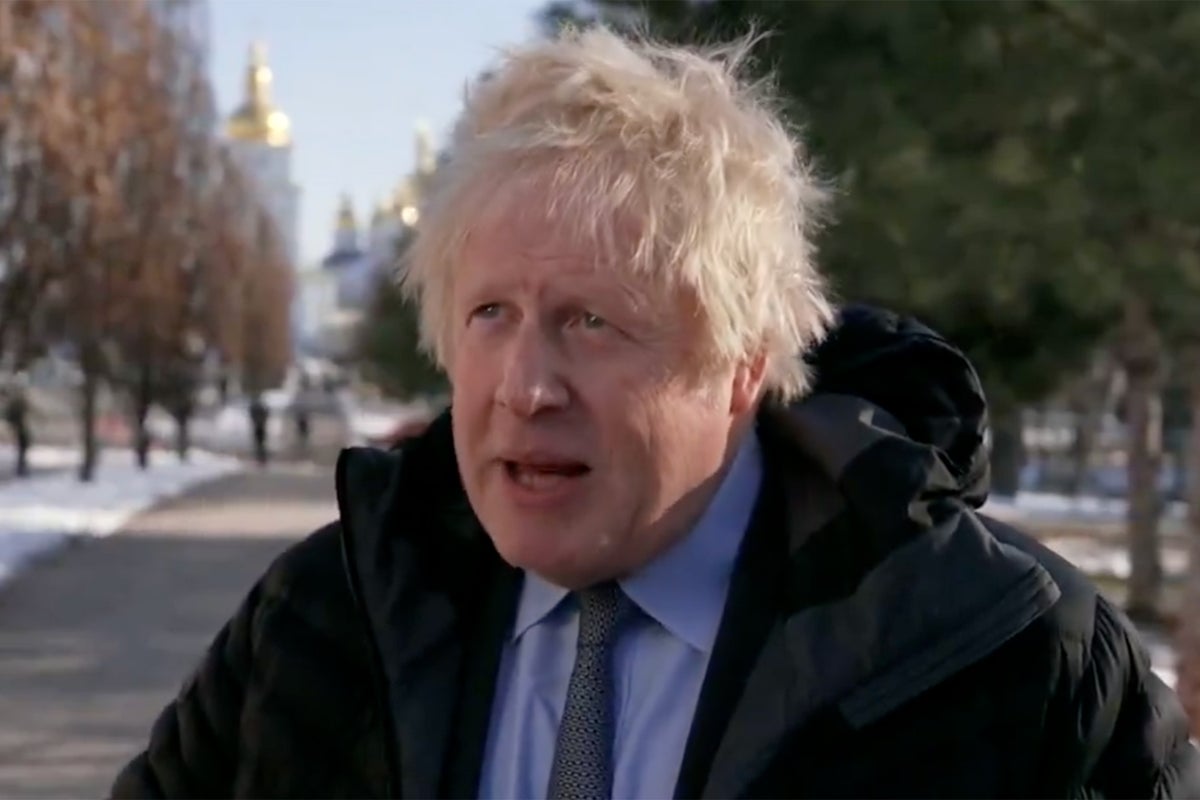
Former British Prime Minister Boris Johnson narrowly escaped a Russian drone strike while traveling inside Ukraine, prompting a fierce public rebuke of Vladimir Putin and highlighting the extreme vulnerability of high-profile visitors in active war zones. During a trip to the front-line regions, a Russian unmanned aerial vehicle targeted the vicinity of Johnson’s convoy, forcing emergency evasive maneuvers and underscoring how commercial and military drone technology has eliminated traditional diplomatic safe zones.
The incident wasn't an isolated stroke of bad luck. It was a predictable collision between old-school political diplomacy and the hyper-transparent, algorithmic reality of twenty-first-century warfare. For decades, visiting heads of state and former leaders operated under an unspoken set of rules. Even in active conflict zones like Iraq or Afghanistan, VIP movements were shrouded in heavy operational security, electronic jamming bubbles, and massive physical perimeters.
Today, those perimeters are shrinking. Cheap, first-person-view (FPV) drones and long-range loitering munitions do not care about diplomatic immunity or historical prestige. They care about thermal signatures, cellular metadata, and the sudden appearance of armored SUVs on rural roads.
The Mechanics of a Modern Near-Miss
When Boris Johnson travels to Ukraine, he does not move quietly. His presence is an intentional information operation, designed to signal unwavering Western solidarity and keep the war on the front pages of British and international newspapers. That visibility is precisely what makes him a prime target.
Russian reconnaissance units operate continuous surveillance grids miles behind the immediate line of contact. Using high-altitude fixed-wing drones like the Orlan-10 or Supercam, operators scan major transit arteries for anomalies. A multi-vehicle convoy of heavy, Western-style armored vehicles moving at high speed stands out immediately against the backdrop of standard civilian and military traffic.
Once a high-value convoy is spotted, the kill chain accelerates rapidly.
- Detection and Tracking: High-altitude reconnaissance drones lock onto the convoy's visual and thermal profile, relaying real-time coordinates back to a tactical command post.
- Signal Interception: Electronic warfare units monitor the local electromagnetic spectrum for spikes in encrypted radio traffic or foreign mobile phone handshakes, confirming that the vehicles carry VIPs rather than standard logistics troops.
- Munition Tasking: A nearby loitering munition—such as a Lancet drone—or an armed quadcopter team is vectored onto the convoy's predicted path.
- Terminal Guidance: Even if the convoy enters an area covered by local electronic jamming, modern Russian drones increasingly rely on optical target-lock systems. Once the operator designates the vehicle on their screen, the drone's onboard computer guides it to impact without needing a continuous radio link.
In Johnson's case, the margin between a routine diplomatic photo-op and an international crisis came down to seconds, vehicle armor, and the split-second decisions of his security detail.
Why Putin Targets Visiting Western Figures
Critics often ask why Moscow would risk the massive geopolitical fallout of injuring or killing a former British Prime Minister. Wouldn't an assassination of a prominent NATO figure trigger an overwhelming military response?
That logic relies on Cold War deterrence theory, which no longer dictates Kremlin decision-making. From Moscow’s perspective, the strategic calculus looks entirely different.
First, there is the issue of plausible deniability. Modern drone warfare is inherently chaotic. If a loitering munition strikes a convoy ten miles from the front line, Russian state media can effortlessly claim it was a legitimate military target—a command vehicle or a troop transport—and that the Kremlin had no idea a foreign dignitary was inside. Proving deliberate intent to assassinate a specific individual amidst thousands of daily drone strikes is nearly impossible.
Second, a near-miss achieves almost as much psychological impact as a direct hit. By demonstrating that Russian forces can reach out and touch one of Ukraine's most vocal international backers, Moscow sends a chilling message to every other Western politician, defense contractor, and aid official considering a trip to Kyiv or Kharkiv. It raises the political and personal cost of showing up.
The Johnson Factor
Boris Johnson occupies a unique space in the Kremlin's pantheon of adversaries. Long before he left Downing Street, Russian state television painted him as the primary architect of Western resistance, blaming him for sabotaging early peace talks in Istanbul in the spring of 2022.
For Putin, Johnson is not merely a retired politician. He is a symbol of the Anglo-Saxon resolve that derailed Russia's initial invasion plans. Targeting his convoy—or simply allowing a strike to happen in his immediate vicinity—serves as a visceral reminder that Moscow has a long memory.
Johnson’s reaction after the incident was entirely in character. Rather than retreating from the spotlight, he used the near-miss to hammer home his core thesis: that Putin only understands strength, and that Western hesitation on air defense and long-range weapons directly endangers everyone on the ground.
The Failure of Traditional VIP Security Protocols
To understand how a former Prime Minister ended up within striking distance of a Russian drone, you have to look at the structural flaws in how VIP security is currently managed in Ukraine.
Diplomatic security teams, whether from the UK’s Royalty and Specialist Protection (RaSP) unit or private executive protection firms, are trained to counter traditional threats. They excel at route reconnaissance, counter-ambush driving, ballistic protection, and medical evacuation. Their playbooks were written for environments where threats come from sniper fire, improvised explosive devices (IEDs), or suicide bombers.
Those playbooks are dangerously outdated in an era of ubiquitous unmanned warfare.
| Traditional Threat Vector | Modern Drone Threat Vector | Security Vulnerability |
|---|---|---|
| Ambush / Small Arms | Top-down loitering munitions | Heavy side armor does not protect thin roof plating. |
| IEDs / Mines | Fiber-optic or AI-guided FPVs | Ground-penetrating radar and route clearance are useless against aerial threats. |
| Sniper Fire | High-altitude thermal surveillance | Concealment behind terrain features fails against overhead sensors. |
| Kidnapping / Assault | Swarming multi-drone attacks | Counter-assault teams cannot engage targets flying at 100 mph overhead. |
Even the best electronic warfare (EW) jammers mounted on VIP SUVs are no longer a silver bullet. While jammers flood the radio frequencies used to control standard commercial drones, engineers on both sides of the conflict have adapted. Drones now hop across frequencies automatically, operate on custom non-standard bands, or utilize inertial navigation systems to fly through jammed zones blind until they reach their target.
Furthermore, turning on a high-powered vehicle jammer acts like a massive flare on the electromagnetic spectrum. To a Russian signals intelligence operator, a vehicle blasting out powerful radio noise is screaming that it is carrying someone important.
The Propaganda War Over Front-Line Visits
There is an uncomfortable truth that diplomatic planners rarely discuss in public: front-line visits by Western politicians carry a heavy operational burden for the host nation.
Every time a high-profile figure like Johnson travels near active combat zones, the Ukrainian military must divert scarce resources to keep them alive. Air defense units have to be placed on heightened alert. Local electronic warfare teams must shift their coverage to protect the VIP's corridor, potentially leaving regular infantry units exposed. Intelligence officers have to scrub local communications and monitor Russian chatter for signs that the visit has been compromised.
Yet Kyiv continues to welcome these visits, and politicians continue to make them, because the strategic payoff is deemed worth the risk.
The Optics of Solidarity
When Western public attention drifts toward domestic economic issues or other global crises, a dramatic dispatch from Ukraine resets the news cycle. Photos of a former British Prime Minister wearing body armor, standing amidst rubble, or surviving a drone strike generate millions of impressions. They create political pressure on current governments in London, Washington, and Brussels to approve delayed aid packages.
Johnson understands the mechanics of media attention better than almost any contemporary politician. By immediately calling out Putin after the near-miss, he transformed a terrifying security failure into a powerful narrative about Russian aggression and the urgent need for more Ukrainian air defenses.
However, this dynamic creates a dangerous incentive structure. To get the most compelling visuals and the strongest media impact, politicians are pushed closer and closer to the zero line—the contested gray zone where drone density is highest and survival margins are thinnest.
What Happens When a VIP Actually Gets Hit?
The near-miss involving Boris Johnson serves as a stark warning of a scenario that defense officials in London and Washington dread: the death or severe injury of a major Western political figure on Ukrainian soil.
If that drone had struck a few meters closer, the geopolitical consequences would have been immediate and unpredictable. While a former Prime Minister does not trigger NATO’s Article 5 collective defense clause, the domestic political fallout in the United Kingdom would have been explosive. Public demand for direct retaliation—whether through long-range missile strikes on Russian launch sites or the deployment of British air assets to enforce a no-fly zone over western Ukraine—would have reached a fever pitch.
Moscow knows this, yet the decentralized nature of drone warfare means that the Kremlin does not always have tight command-and-control over every strike. A junior Russian drone commander operating in the Donbas or Zaporizhzhia sector might spot a convoy, identify a high-value target, and launch an attack to earn a battlefield promotion long before a general in Moscow ever weighs the diplomatic consequences.
The New Rules of Conflict Diplomacy
The era of the safe, tightly choreographed war-zone visit is over. As long as the skies over Ukraine remain saturated with cheap, lethal autonomous systems, every kilometer traveled outside of deeply fortified bunkers carries an irreducible risk of sudden death from above.
Security agencies are scrambling to adapt. New protocols now emphasize radical decentralization: splitting convoys into smaller, unmarked civilian vehicles rather than using conspicuous armored SUVs; enforcing strict digital silence by stripping staffers of personal smartphones days before travel; and deploying mobile, short-range kinetic interceptors alongside traditional jammers.
Ultimately, however, technology cannot completely solve a problem rooted in geography and physics. As long as Western leaders choose to walk the ground in Ukraine to prove their commitment, they are stepping into the exact same lethal environment that Ukrainian soldiers endure every hour of every day—where the buzz of an approaching motor in the sky is the only warning you get.