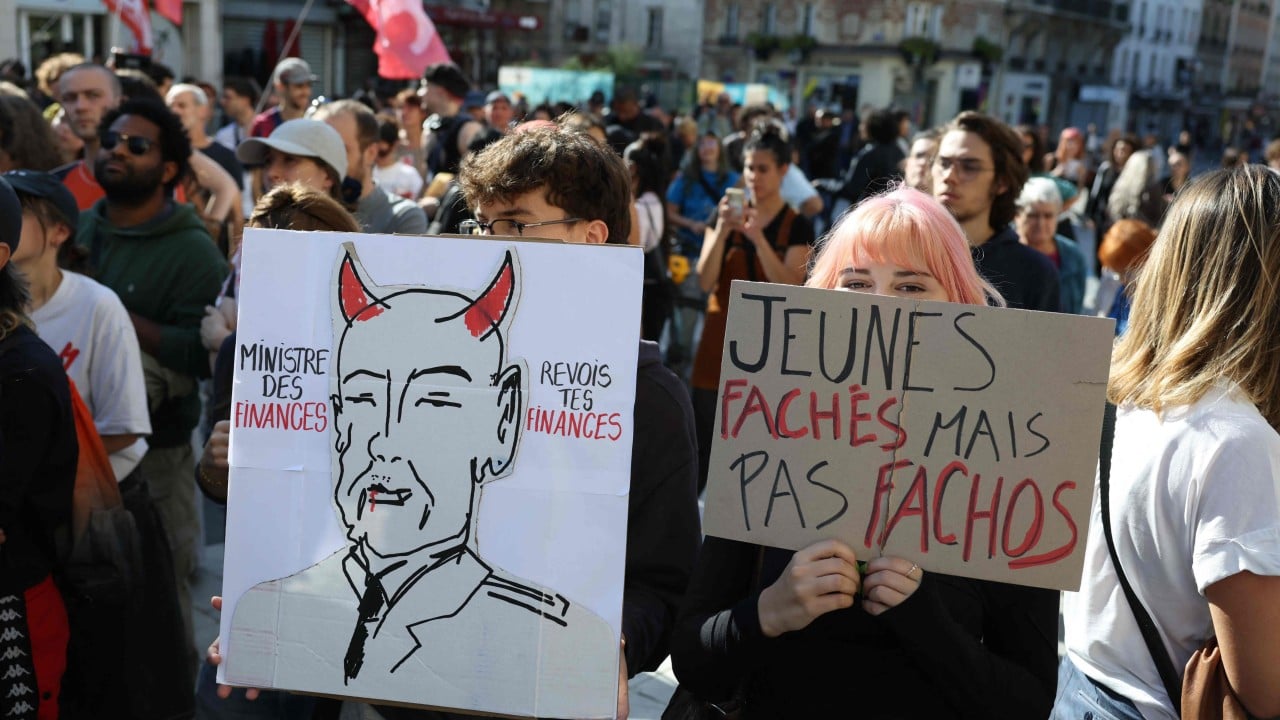
When hundreds of high schools across France shuttered their gates, the official narrative from government ministries attempted to frame the disruption as routine youthful agitation. That explanation collapsed under the weight of burned barricades, tear gas in the suburbs of Paris, and a student mobilization that rapidly paralyzed administrative regions from Créteil to Marseille. What began in mid-September as a localized pushback against staff shortages and overflowing classrooms mutated into a national fracture. The Republic was forced to confront an uncomfortable reality: its educational infrastructure is buckling, and the generation expected to sustain it has stopped believing the promises made from government offices.
To understand why this wave of unrest achieved critical mass so quickly, one must look past the burning bins and examine the structural decay eating away at public lycées. Classrooms designed for twenty-five students routinely house thirty-five or more. Teaching positions sit vacant for months because the Ministry of National Education cannot recruit or retain qualified educators under current pay scales. During recent summer heatwaves, students sat through examinations in unventilated rooms where indoor temperatures breached forty degrees Celsius. These are not abstract grievances born of adolescent rebellion. They are daily humiliations experienced by teenagers whose parents were promised a meritocratic republic built on equal educational access.
The state's response relied on familiar playbooks of containment and crowd control. Riot police deployed outside institutions like Lycée Voltaire, firing tear gas and flash-balls to clear blockades built from wooden pallets and overturned trash receptacles. Thousands of minors were detained in sweeping operations that civil liberties groups condemned as heavy-handed and disproportionate. Yet every time law enforcement cleared a barricade at dawn, another appeared twenty miles away by noon. The decentralized nature of the movement stymied traditional negotiation tactics. There is no single union boss to invite into a gilded ministerial room for closed-door compromise, because the leaders are seventeen-year-old high school seniors coordinating through encrypted messaging apps.
Beneath the immediate anger over broken infrastructure lies a deeper structural anxiety regarding the future. For years, the gateway to French higher education has been mediated by Parcoursup, the centralized algorithmic portal that assigns graduating students to universities. Critics have long argued that the system functions as a black box, crushing student aspirations without clear human accountability. When high school students lock their school doors, they are rebelling against an entire lifecycle of administrative indifference. They see an economy with stagnant wages, a housing market locked to young professionals, and a political class insulated from the realities of working-class suburbs.
Political opportunists on both extremes of the spectrum have attempted to capture the momentum, seeking to channel adolescent fury into electoral leverage ahead of upcoming national cycles. Yet the students themselves have largely maintained a cynical distance from professional politicians. Their demands remain brutally practical: fix the leaking roofs, hire the missing teachers, and stop pretending that statistics on paper reflect the reality of a crumbling classroom.
As the calendar turns and the government scrambles to inject emergency funding into problem areas, the fundamental fracture remains unhealed. A state cannot police its way out of an institutional decay that took decades to manufacture. Until Paris addresses the root causes of educational degradation, every barricade cleared today is merely an adjournment of tomorrow's confrontation.