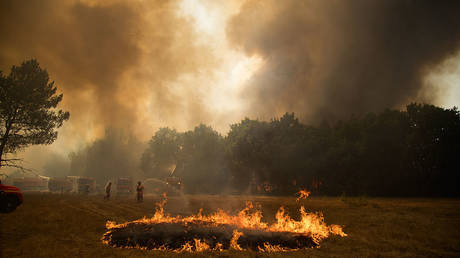
The statistics arrive with the cold weight of an official communique. French law enforcement agencies have detained 420 people—including 166 minors—in connection with the catastrophic summer wildfires that have scorched more than 300,000 acres across the country. It is a massive sweep, executed under intense political pressure as the state attempts to assign accountability for the worst ecological devastation France has seen since the Second World War.
Yet beneath the state-sanctioned narrative of swift justice lies a troubling reality. A closer examination reveals that the vast majority of these detentions do not involve malicious, fire-obsessed arsonists plotting in the shadows. They encompass ordinary citizens, construction workers, and vulnerable individuals caught in a sweeping administrative dragnet.
State officials want a culprit. They have chosen to find hundreds of them.
The Anatomy of a Mass Detainment Strategy
When forests burn at historic scales, public panic follows immediately. Political leaders face an inevitable interrogation from citizens and opposition parties alike. Why were the firebreaks unmanaged? Why were aerial resources stretched thin? Why did the state fail to anticipate the trajectory of the infernos?
To counter these systemic criticisms, Paris shifted the aperture of the debate toward human agency. The argument deployed by the French Interior Ministry relies on a stark factual baseline: roughly nine out of ten forest fires in France are triggered by human activity.
That statistic is scientifically accurate. It is also dangerously reductive.
Human activity encompasses everything from a calculated act of arson by a serial pyromaniac to a stray spark from an angle grinder on a rural construction site, or a discarded cigarette butt flicked out of a car window on a bone-dry afternoon. By lumping deliberate malice and catastrophic criminal intent together with simple, tragic negligence under a single broad headline of "wildfire offenses," the state constructs an inflated ledger of criminality.
Of the 420 individuals detained by early August, only a fraction face charges of intentional arson. Consider the case widely publicized by prosecutors in the southeastern Var region: a 23-year-old man accused of deliberately igniting ten separate fires over a five-day period. That fits the traditional definition of an arsonist. He faces up to 15 years in prison and a fine of 150,000 euros.
Multiply that clear-cut case by hundreds of ambiguous situations, however, and the judicial machinery begins to wobble.
The Human Cost of Expedited Justice
Legal defense attorneys and civil liberties advocates are pushing back against the speed and severity of the government's response. Speed is rarely the ally of rigorous jurisprudence. When prosecutors are under pressure to show results, procedural safeguards tend to blur.
Muriel Gestas, a French lawyer who has represented multiple individuals caught in the wildfire sweeps, has voiced astonishment at the sheer volume of immediate prosecutions. She has pointed out cases where vulnerable individuals, including a homeless person and a person with severe autism, were handed rapid jail terms for allegedly dropping cigarette butts.
A three-year prison sentence for a minor vegetation fire that scorched only a few square meters of brushwood may satisfy a thirst for retribution on evening television broadcasts, but it raises serious questions about proportionality. When a society begins treating accidental negligence with the same moral fury reserved for calculated destruction, the rule of law undergoes a quiet distortion.
Furthermore, the inclusion of 166 minors among the detained points to an aggressive enforcement posture that targets youth without necessarily weighing the systemic failures that leave rural and semi-rural areas defenseless against minor sparks.
Major newspapers like Le Monde have questioned whether local police have had the physical time to properly examine the evidentiary trail for each of these hundreds of files. The lack of transparency regarding specific charges—such as the exact legal threshold separating criminal intent from situational carelessness—shields the Ministry's statistics from rigorous outside verification.
The Convenient Mirage of Individual Blame
To understand why this strategy is dangerous, one must look at what it obscures. Climate conditions across southern Europe have fundamentally shifted. Extended droughts, unprecedented heat domes, and dry winds create an environment where a single microscopic spark can transform into an unstoppable wall of flame within minutes.
For decades, forest management experts have warned that France—like much of the Mediterranean basin—suffers from chronic underinvestment in brush clearance, preventive controlled burns, and resilient infrastructure. The landscape has grown denser and drier, packed with fuel waiting for an ignition source.
Human error has always existed. People have dropped cigarette butts and operated heavy machinery near dry grass for generations. What has changed is not human carelessness, but the ecological margin for error.
By focusing the national conversation almost exclusively on the individual holding the cigarette or operating the welding torch, the state effectively deflects attention from its own institutional shortcomings. It is easier to prosecute a homeless man or a careless builder than it is to completely overhaul national climate adaptation policies, modernize archaic forestry management systems, or adequately fund rural emergency services.
Bordeaux prosecutor Renaud Gaudeul defended the hardline approach to Le Monde, arguing that the conditions for charges of endangering lives are legally met when anyone lights a barbecue or discards a cigarette in a vulnerable woodland.
Legally, that interpretation may hold. Practically, it transforms a vast portion of the rural population into potential criminal suspects the moment dry season warnings go into effect.
The Fallout for First Responders
Perhaps the most ironic twist in this wave of detentions is the collateral damage inflicted upon the very people tasked with fighting the flames. Among those caught in the investigative web are local volunteer firefighters.
In a bitter paradox, investigators have occasionally cast suspicion on members of local emergency brigades operating in fire-prone regions, operating on the fringe theory that rogue emergency workers might spark fires to secure overtime or feed a psychological compulsion. While rogue firefighters do occasionally appear in criminal records globally, casting a wide net of suspicion over local heroes degrades morale precisely when communal solidarity is most required.
When volunteer firefighters—who spend weeks inhaling smoke and risking their lives for nominal pay—realize that their own communities and local police view them as primary suspects rather than frontline defenders, the institutional fabric begins to fray.
The Road Ahead for Judicial Accountability
The French government has signaled that it will not relent. The political payoff of appearing tough on wildfire perpetrators is simply too high. Television screens filled with handcuffs and mugshots project an image of absolute control, masking the reality that the fires themselves were largely governed by meteorological forces far beyond the reach of any police precinct.
As these hundreds of cases move through the courts, a major test awaits the French judiciary. Will judges blindly rubber-stamp the emergency-season arrests to maintain a unified political front, or will they demand tangible proof of malicious intent before locking away citizens for years over accidents?
The answer will determine whether this summer's legal crusade is remembered as a triumph of public safety or a systemic overreaction fueled by political desperation. The ashes are still cooling across the French countryside, but the wreckage of these hurried prosecutions is only beginning to surface.
:max_bytes(150000):strip_icc()/ar-American-Cheese-taste-test-horizon-4x3-54cc339550cd44b9a818c17bdfd5428d.jpg)