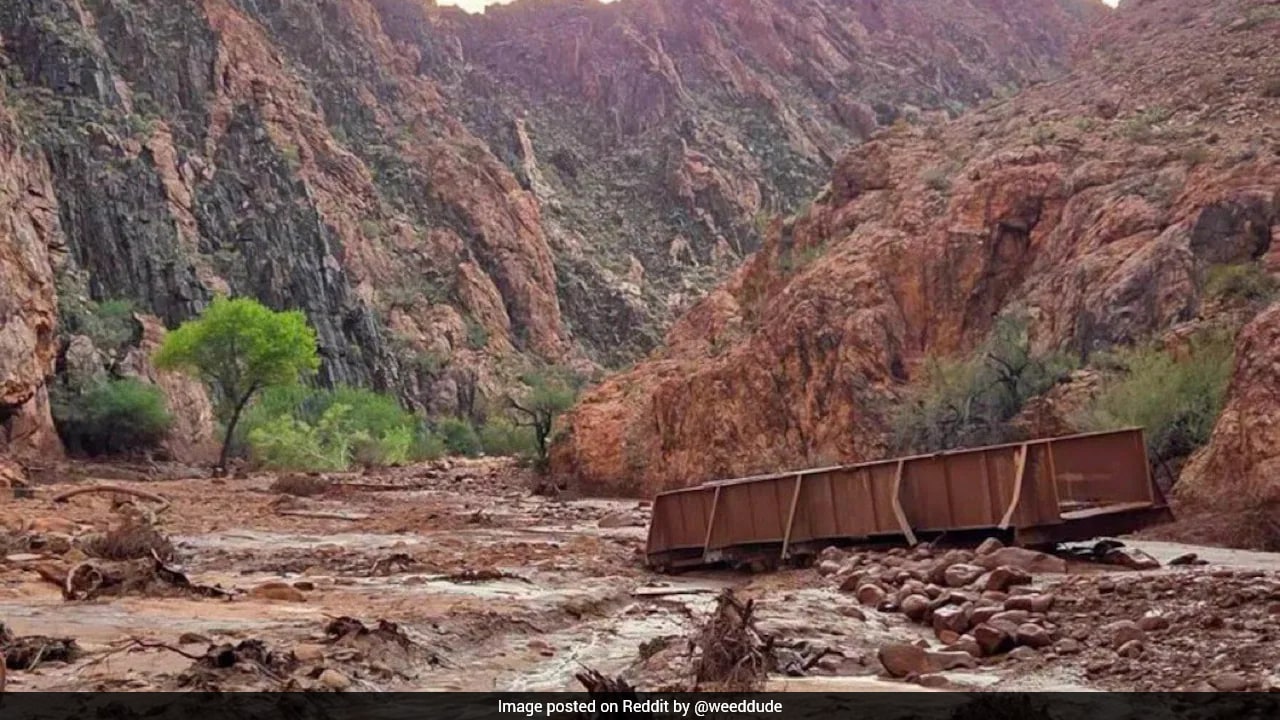
A sudden wall of chocolate-brown water roared through Arizona's Bright Angel Canyon on a Saturday afternoon, leaving roughly 15 people unaccounted for, more than 60 hikers airlifted to safety, and the inner canyon's critical utility network in ruins. When severe weather struck the Kaibab Plateau, dumping up to an inch of rain in less than half an hour, the steep terrain acted as a frictionless chute. Water rushed down into Bright Angel Creek, gathering boulders, mud, and remnants of footbridges into a destructive slurry that eventually spilled into the Colorado River.
This disaster is more than a story of bad weather over a famous landscape. It exposes the brutal vulnerability of deep-canyon infrastructure and the systemic tracking failures that happen when backcountry permits meet sudden environmental violence.
The Mechanics of a Canyon Trap
Ask any hydrologist who has spent years monitoring the Colorado River basin, and they will tell you that inner-canyon weather defies standard prediction models. When severe storms drop heavy precipitation onto the high-elevation Kaibab Plateau, the water has nowhere to soak. Decades of baked earth, bare rock, and severe elevation drops turn precipitation into a vertical freight train in minutes.
The storm on August 29 produced a surge that transformed a placid creek bed into a raging torrent known locally as "the Box".
- Instant Runoff: Drop rates of half an inch to an inch in thirty minutes mean immediate saturation and zero absorption.
- Debris Loading: The rushing water picks up massive boulders, structural steel, and timber, turning the flood into a battering ram.
- Geomorphic Shifts: The sheer power of the water widened creek beds and carved entirely new river rapids, permanently altering the inner canyon geography.
Hikers caught in the corridor described a sudden darkening of the water, followed immediately by roaring walls of sound and walls of mud tearing through campsites near Phantom Ranch. For the 62 individuals rescued by the Arizona Department of Public Safety helicopters, survival meant scrambling up steep walls or finding high ground before bridges vanished.
The Accountability Black Hole
The most alarming aspect of the Grand Canyon emergency is not just the physical devastation, but the agonizing uncertainty surrounding the missing. National Park Service officials initially flagged roughly 20 people as potentially unaccounted for, later revising that working figure to about 15.
Why is it so difficult to know who is in the canyon?
Backcountry logistics in America's premier national parks rely heavily on self-policing, paper permits, and decentralized check-ins. Walk-up permits, multi-day itinerary changes, and satellite camp-to-camp travel mean that a hiker's exact location at any given hour is often an educated guess. When a bridge is swept away and a campground is buried under tons of silt, park rangers are left cross-referencing reservation databases with frantic calls from relatives outside the park.
This information vacuum turns rescue operations into needle-in-a-haystack recovery missions. Search teams cannot deploy safely while subsequent thunderstorm warnings threaten fresh flash floods and rockfalls. The canyon walls hold onto their secrets long after the water recedes.
A Utility Lifeline Shattered
Beyond the human toll, the flash flood dealt a devastating blow to the park's physical backbone. The torrent obliterated nearly all footbridges spanning Bright Angel Creek, completely severing pedestrian access across the inner corridor. More critically, the raging debris knocked out the Transcanyon Waterline.
This pipeline is the sole hydration source for roughly six million annual visitors and the hundreds of permanent residents who live and work below the rim. Ironically, this exact utility system had been the focus of a massive, multi-year $208 million infrastructure overhaul designed to secure the park's water future.
A single afternoon of intense meteorological violence proved that underground or surface-level piping crossing active creek beds remains acutely vulnerable to catastrophic geomorphic resets. Park authorities immediately halted overnight lodge stays and enforced strict water conservation mandates, demonstrating how quickly modern tourism infrastructure collapses when ancient geological forces reclaim their space.
Weather windows across the American Southwest are growing increasingly erratic, squeezing intense volumes of water into shorter time frames. As recovery crews sift through the debris fields near Crystal Rapids and appeal for public tips on missing backpackers, the illusion of control over the national park system's wild interior has been washed away.


