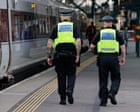
The statistics released by the Office of Rail and Road are unambiguous. Recorded assaults across Great Britain’s rail networks have climbed to a staggering peak of nearly 25,000 incidents annually, representing a fifth-spike in a single reporting period. Headlines have predictably cycled through the standard expressions of shock, blaming alcohol, societal fraying, or thin blue lines on the platforms. Yet beneath these macro figures lies an operational failure of corporate design, institutional passivity, and a fragmented security infrastructure that treats front-line workers as expendable collision buffers.
To understand why Britain's trains are becoming increasingly volatile spaces, one must look past the aggregate numbers and examine the structural decay of station governance.
The Economics of Unchecked Platforms
Modern railway operation in Britain functions under a relentless pressure to strip overheads. Station staffing has been systematically hollowed out through ticket office closures, centralized monitoring, and the widespread reliance on unstaffed or part-time barrier lines. When a commuter walks onto a rural platform or an urban transit hub late at night, the probability of encountering a visible, authoritative presence from the British Transport Police (BTP) or trained railway personnel has plummeted.
Criminal behavior thrives in environments perceived as ungoverned. The rational actor theory of crime posits that offenders weigh the probability of apprehension against the potential reward. On the modern rail network, that probability approaches zero for low-level harassment, common assault, and verbal abuse. A passenger can spit on a conductor or shove a fellow commuter with a high degree of confidence that no officer will materialize before the next stop.
Consider a hypothetical scenario played out daily across the network: a commuter challenges an individual evading a fare on an automated barrier line. Without backup, physical separation, or immediate enforcement capability, the staff member is entirely isolated. The architecture of modern stations—designed for frictionless, high-volume throughput rather than secure containment—means there is nowhere to retreat.
The Myth of the Better-Reporting Defense
Industry apologists frequently point to an increase in reporting mechanisms as the primary driver behind the surge. The argument suggests that apps, text services, and campaigns encouraging victims to log incidents simply capture offenses that previously went unrecorded.
This claim collapses under close scrutiny. While digital reporting tools have marginally lowered the friction of logging a crime, they do not invent the underlying hostile interactions. Conductor reports of physical attacks, head-butting, spitting, and explicit threats have surged past 11,000 incidents on mainline services alone. Workers wearing body-worn video cameras—once a specialized tactical tool, now standard issue for frontline staff—are documenting an escalation in raw hostility that defies any statistical sleight-of-hand.
When a train manager with two decades of service states that the baseline level of abuse is unlike anything seen in previous decades, dismissing the trend as an artifact of better paperwork is an administrative evasion of duty.
The Failure of Outsourced Enforcement
Compounding the crisis is the fragmentation of security responsibilities. Private security firms often manage station gates and platform crowd control under low-margin procurement contracts. These private guards frequently lack the legal protections, training, and institutional backing afforded to statutory police officers. They occupy an ambiguous space where they are expected to manage volatile public interactions without the authority to detain effectively or the structural safety net of a national force.
When private contractors face aggressive behavior, high turnover rates and minimal retention mean that institutional memory vanishes. New, inexperienced guards rotate through high-risk environments with little preparation for de-escalation or crisis management. The system relies on cheap labor to manage expensive social decay.
Restoring Order to the Line
Reversing this trajectory requires abandoning the administrative fiction that warning posters and text-line campaigns constitute a security strategy.
First, train operating companies must abandon the reduction of frontline staff as a metric of financial efficiency. Visibility is a physical deterrent. A staffed station with active human oversight alters the psychological calculus of potential offenders.
Second, the legal framework protecting public transport workers requires radical overhaul. Assaulting a rail worker performing their statutory duty must carry mandatory sentencing enhancements that signal absolute institutional zero-tolerance. At present, the judicial follow-through on reported rail assaults remains notoriously weak, with a tiny fraction resulting in meaningful prosecution or custodial sentences.
If the network continues down its current trajectory, public transport will complete its retreat into a fragmented, high-risk utility avoided by anyone with viable alternatives. The tracks are there, the rolling stock is moving, but the social contract binding passengers and operators in mutual safety has derailed.