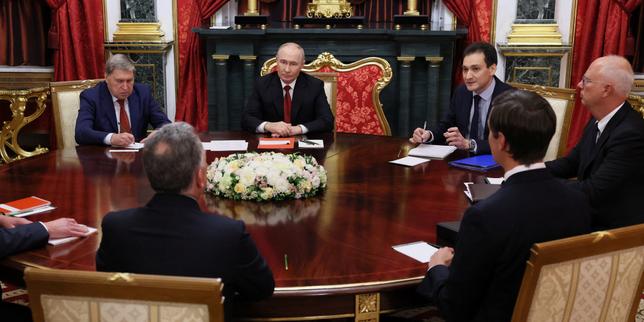
U.S. special envoys Steve Witkoff and Jared Kushner arrived in Kyiv on Sunday following an extensive, three-hour closed-door meeting with Russian President Vladimir Putin in Moscow. Tasked by the White House to push an elusive peace proposal to end the grinding war in Ukraine, the high-level delegation faces a deeply entrenched diplomatic chasm. While temporary localized airstrike halts were coordinated to secure safe passage for the negotiators, the structural foundations of a lasting settlement remain heavily disputed.
The Moscow Summit and the Limits of Goodwill
The marathon session inside the Kremlin laid bare the sheer distance between Washington's ambitions and Moscow's strategic expectations. Kremlin foreign policy aide Yuri Ushakov characterized the discussions as substantive and constructive, noting that the American envoys outlined several new conceptual avenues for a political settlement. Yet, tangible progress proved elusive.
Putin made certain to anchor the talks in the reality of battlefield dynamics, emphasizing the ongoing advances of Russian forces in the combat zone. Rather than signaling a willingness to compromise on maximalist territorial objectives, the Russian leadership reiterated that any durable agreement must address what Moscow defines as the core systemic triggers of the conflict.
Beneath the diplomatic pleasantries, the structural mechanics of a ceasefire remain a point of profound friction. Moscow has consistently dismissed temporary freezes in fighting as tactical maneuvers designed purely to allow adversary forces to rearm. Consequently, the three-hour exchange yielded no immediate breakthrough on the most volatile issues, including disputed regional boundaries and the long-term security architecture of Eastern Europe.
Shifting Realities on the Ground
As Witkoff and Kushner transition their shuttle diplomacy from the Kremlin to the halls of power in Kyiv, the human and economic cost of the protracted conflict continues to mount. Recent weeks have witnessed an escalation in high-intensity aerial campaigns. Waves of advanced long-range munitions and automated drone strikes have targeted critical logistics, energy networks, and municipal infrastructure on both sides of the frontline.
In Ukraine, these persistent bombardments have disrupted supply chains, generated severe food distribution bottlenecks, and forced civilian populations into frequent daytime air raid alerts. Meanwhile, domestic economic pressure inside Russia has intensified due to sustained strategic strikes on key fuel refineries and consumer logistics hubs. This mutual capability to inflict deep economic and infrastructural pain serves as the grim backdrop against which Sunday's meetings in the Ukrainian capital take place.
The Kyiv Reception and Strategic Calculations
President Volodymyr Zelenskyy's administration approaches the arrival of the American delegation with carefully managed expectations. Ukrainian leadership has repeatedly stressed its readiness to explore genuine, viable pathways toward peace, provided those options do not demand capitulation or the formal surrender of sovereign territory defended at staggering human cost.
The primary objective for Kyiv during Sunday's discussions is to ground the American proposals in the observable realities of the destruction wrought by Russian forces. By bringing Washington's representatives directly into the capital, Ukrainian officials aim to demonstrate the immediate impact of ongoing aggression and press for security guarantees that prevent future incursions.
Yet, the personal animosity between the primary leadership figures involved continues to complicate structural negotiations. Diplomatic channels must navigate not only incompatible territorial claims but also deeply rooted political distrust that resists easy mediation.
The immediate window for this diplomatic push remains narrow. As localized airspace agreements wind down and military commands prepare to resume standard operational postures, the outcome of the discussions in Kyiv will determine whether Washington's current mediation framework possesses any actual viability or joins the long list of diplomatic efforts stalled by irreconcilable strategic objectives.