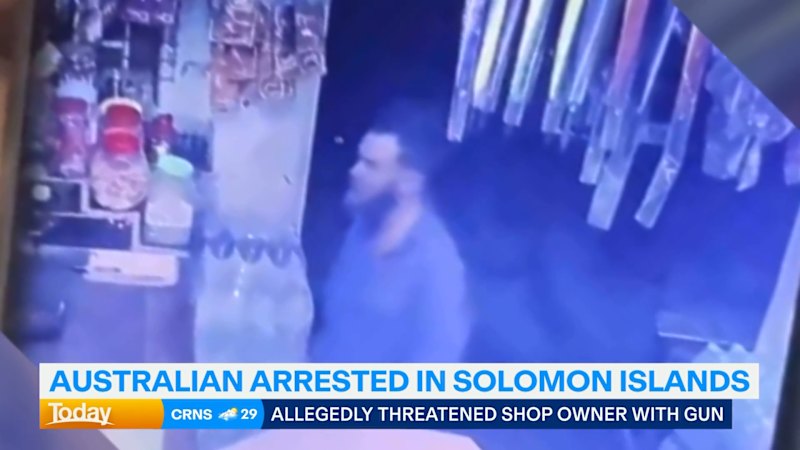
An Australian national was taken into custody by the Royal Solomon Islands Police Force following an aggressive confrontation near the Vura intersection in east Honiara. The suspect allegedly brandished a weapon inside a commercial establishment, terrorizing local merchants before fleeing the immediate perimeter. When law enforcement intercepted his vehicle moments later, he refused compliance and met officers with escalating hostility. Tactical operators deployed less-lethal ordnance—specifically beanbag rounds fired from a Remington 870 shotgun—to neutralize the threat. Subsequent searches of the vehicle yielded no firearm, though investigators recovered narcotics paraphernalia associated with methamphetamine and marijuana consumption.
This localized altercation unmasks deeper institutional anxieties running through the South Pacific. Headlines rarely dwell on the complex friction points between transient expatriates and domestic security agencies in developing island nations. Yet, incidents of this nature expose systemic vulnerabilities that stretch far beyond a single violent outburst on a municipal roadway.
The Logistics of Transnational Drift
Foreign nationals operating outside their domestic legal frameworks often assume a dangerous sense of insulation. Small island developing states present unique structural challenges for local police infrastructure. Vast maritime boundaries, limited surveillance budgets, and thin administrative footprints create fertile ground for erratic behavior and organized criminality alike.
When an outsider decides to test the boundaries of a sovereign island nation, the strain placed on local responders is immediate. The Royal Solomon Islands Police Force operates with constrained resources compared to its federal counterparts in Canberra. Responding to a volatile subject brandishing suspected weaponry requires precise tactical calibration. The decision to use less-lethal beanbag rounds prevented a fatal outcome, but it also underscored the constant tactical guessing game officers must play when confronting unverified threats.
Contraband Pathways and Regional Blind Spots
While the physical weapon vanished before the vehicle search concluded, the discovery of drug paraphernalia points toward a darker undercurrent. The South Pacific has long transitioned from a quiet tropical backwater into an active transit corridor for international narcotics syndicates.
Porous borders make it remarkably easy for transient individuals to slip between jurisdictions while carrying bad habits and illicit substances. Investigators are now tasked with determining how the suspect established his local footprint, who supplied his access, and whether his presence links to broader illicit distribution networks moving through the archipelago.
[Transient Expatriate Entry] ---> [Local Infrastructure Stress] ---> [Enforcement Intervention] ---> [Systemic Vulnerability Exposed]
Local communities bear the brunt of this drift. Business owners in east Honiara are left rattled by an escalation that transforms a routine afternoon into a high-risk tactical theater. Small-scale intimidation often acts as the visible symptom of deeper, hidden rot within regional security arrangements.
Accountability and the Sovereign Response
Commissioner of Police James Aitorea faced the press with a stark message. Law enforcement will not tolerate actions that manufacture public terror or threaten community safety. That rhetoric matters. Pacific policing agencies operate under intense scrutiny from foreign partners, particularly Australia and New Zealand, who pump millions into regional security cooperation programs.
Demonstrating operational competence and unyielding adherence to domestic statute remains vital for maintaining sovereignty. When foreign citizens break the law on island soil, the local judicial apparatus must assert its authority without hesitation. Foreign oversight should support, never supplant, local command structures.
The investigation into the Vura incident continues to unfold behind closed doors. Prosecutors must sift through conflicting witness accounts, digital forensics, and forensic drug findings to build a watertight case.
The suspect remains locked inside a holding facility awaiting formal charges that carry heavy penalties under local legislation. Meanwhile, the wider archipelago watches closely, waiting to see if justice moves with the speed and severity demanded by the commissioner. The fallout from this single arrest will reverberate across diplomatic channels and precinct briefing rooms for months to come.