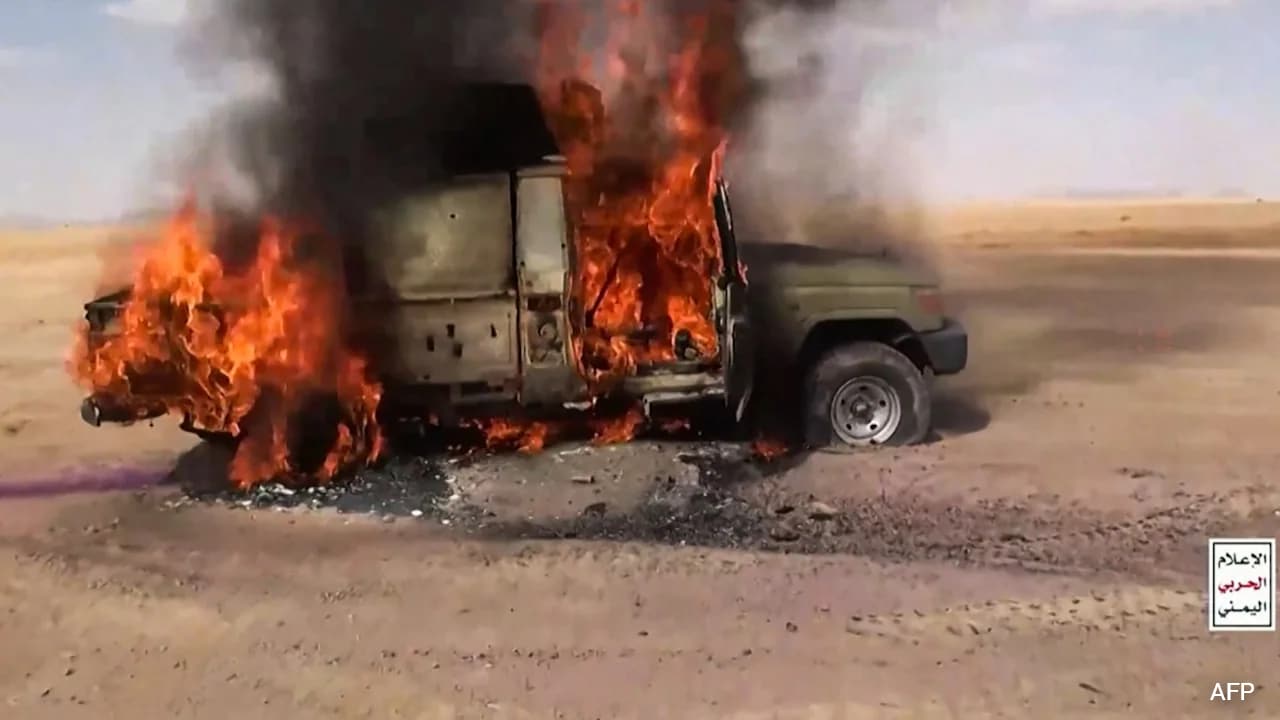
Two people killed and an Indian national injured by falling Houthi drone debris at a Saudi oil facility exposes a quiet flaw in modern air defense. Intercepting a threat in midair is only half the battle. When a long-range unmanned aerial vehicle is shattered over an active industrial complex, hundreds of pounds of spinning metal, unspent propellant, and shrapnel do not politely evaporate into desert air. They fall under gravity toward pressurized storage tanks, high-voltage substations, and the workers keeping global energy markets supplied.
Headline wire stories treat incidents involving Houthi drone debris as near-misses or proof that air defenses worked. That framing misses the real operational hazard. A successful interception prevents a direct warhead detonation on a distillation tower or sphere tank, yet it converts a guided strike into a scattered ballistic hazard across a sprawling perimeter. In energy security and industrial risk analysis, a "successful" intercept that still kills two workers and injures another is not a clean victory. It is a warning that perimeter geometry, interceptor engagement envelopes, and industrial blast protection remain out of sync with low-cost aerial attrition.
Why Falling Debris Is a Structural Hazard Not a Fluke
Watch enough industrial security briefings across the Gulf and a pattern emerges. Facilities spend billions hardening high-value process units against direct hits while leaving transit corridors, maintenance yards, and worker accommodations vulnerable to secondary impacts.
Modern Houthi drone debris carries distinct physical risks depending on how and where the intercept occurs. If a surface-to-air missile detonates a one-way attack drone at low altitude near a facility boundary, the kinetic energy of the intact airframe, engine block, and remaining fuel load is redistributed across a wide footprint. Even without a clean warhead detonation, heavy metal fragments moving at terminal velocity can puncture thin-walled piping, sever instrument cables, or strike personnel moving between shifts.
An interception shifts a target from a guided strike to a random scatter pattern. The risk drops for the primary asset, yet rises sharply for anything sitting inside the drop zone.
Consider a hypothetical example to see how the math shifts on the ground. Suppose an interceptor engages an incoming drone three kilometers upwind of a tank farm. If the engagement happens high enough, wind shear and aerodynamic drag slow lighter fragments, while heavier components like piston engines or batteries follow steeper trajectories. If the engagement happens late and low over an access road or laydown yard, the debris footprint shrinks in dispersion but spikes in impact energy per square meter. Facility operators rarely control the exact point of intercept because air defense batteries optimize for probability of kill, not post-intercept debris trajectories over industrial real estate.
The Economics of Cheap Drones Versus Expensive Interceptors
Anyone who has covered Gulf energy infrastructure over the past decade knows the asymmetry problem. A long-range one-way attack drone costs a fraction of the interceptor missile fired to bring it down. Over time, that cost ratio forces defenders into difficult tactical trade-offs.
When threat volumes rise, air defense commanders must decide which tracks warrant high-value kinetic interceptors and which can be handled by short-range guns, electronic warfare, or lower-tier missiles. Every decision carries friction. Engage too early and you expend scarce inventory on decoys or off-course airframes. Engage too late and you risk Houthi drone debris raining onto active infrastructure or living quarters.
Low-Altitude Radar Blind Spots
Low-altitude flight remains the bread and butter of long-range drones traveling across open terrain and coastal corridors. Earth curvature, desert clutter, and industrial structures create tricky detection geometry for ground-based radar.
By the time a low-flying drone clears a ridge line or masking terrain near a Saudi oil facility, the engagement window is compressed. Reaction times shrink from minutes to seconds. In that compressed window, air defense crews prioritize stopping the airframe before it crosses the fence line, leaving minimal margin to steer the debris path away from populated zones.
The Migrant Workforce Reality
Fatality reports from Gulf energy incidents routinely highlight the vulnerability of foreign workers, including Indian nationals who form a massive share of engineering, operations, maintenance, and logistics teams across Saudi Arabia.
Expats and contract staff often work shifts outdoors, move in buses or light vehicles between compounds and worksites, and occupy temporary or semi-hardened structures near industrial hubs. Blast walls and reinforced control rooms protect critical process machinery and senior operators. Workers moving along service roads or stationed at outer gates face much higher exposure when Houthi drone debris falls unexpectedly.
How Oil Markets Price Debris Versus Outages
Energy traders react violently to confirmed production losses, damaged export terminals, or disrupted shipping lanes. A localized incident producing Houthi drone debris without a sustained barrel shutdown often triggers only a brief risk premium before markets shrug.
That market calm can be misleading. Physical infrastructure damage is only one channel of disruption. Insurance underwriters, marine and industrial risk assessors, and corporate safety officers look closely at repeatability and workforce exposure.
| Risk Factor | Direct Warhead Hit | Falling Drone Debris | Operational Consequence |
|---|---|---|---|
| Primary Target Impact | High potential for severe structural damage | Lower unless hitting sensitive valves or tanks | Process shutdowns or localized fires |
| Debris Scatter Radius | Concentrated blast and fragmentation | Wide, irregular ballistic footprint | Unpredictable hits on roads, yards, and gear |
| Workforce Exposure | High near point of impact | High for outdoor and transit personnel | Casualties, shelter-in-place delays, morale strain |
| Market Reaction | Sharp spike if output drops | Often muted initially | Gradual rise in security and insurance costs |
From an industry analyst's standpoint, the gap between market calm and ground reality is where surprises breed. A facility can keep pumping crude at normal rates while absorbing rising security overhead, stricter shift curfews, longer maintenance turnarounds, and heavier strain on local emergency response teams.
Counter-Arguments and Overlooked Operational Realities
Critics of heavy facility hardening often argue that turning every oil site into a concrete bunker is financially impossible. They have a point. Saudi oil infrastructure spans vast geographic distances with pipelines, pump stations, tank farms, export terminals, and processing plants spread across desert and coastal regions.
You cannot put reinforced concrete roofs over millions of square meters of industrial piping and storage tanks. Trying to do so would distort capital allocation and still fail against large enough kinetic loads.
Another overlooked factor is friendly debris and spent boosters. Air defense engagements do not just break up incoming drones. Interceptor boosters, fragmentation warhead casings, and electronic countermeasures also leave physical traces across the landscape. After an active night of intercepts, recovery teams must sweep wide areas to identify whether a piece of metal came from the attacking drone or the defending battery. Misidentifying debris in the immediate aftermath slows incident investigation and complicates public messaging.
What Actually Reduces Casualties on the Ground
If total interception is imperfect and full bunkerization is impractical, what actually lowers the body count when Houthi drone debris falls near a Saudi oil facility?
- Smarter shelter-in-place protocols: Automated alarms tied to radar tracks—not just visual confirmation of smoke—give outdoor crews vital seconds to reach hardened shelters or low-profile cover.
- Re routing shift movements: Avoiding predictable convoy times and high-exposure perimeter roads during heightened threat alerts cuts transit risk without halting core operations.
- Layered counter-UAS mix: Pairing radar-guided interceptors with short-range air defense guns, directional electronic warfare, and distributed sensors helps break up threats further out from critical infrastructure.
- Transparent incident auditing: Rigorous post-event reviews that track near-misses, debris landing zones, and response lag times turn raw trauma into actionable engineering fixes.
The Unfinished Equation of Modern Air Defense
Two lives lost and another worker injured at a Saudi oil facility underscores a hard truth that defense contractors and energy executives rarely highlight in glossy briefings. Intercepting a drone is a tactical milestone, not the end of the threat chain.
Until air defense doctrine, industrial site design, and workforce protection treat falling Houthi drone debris as a primary hazard rather than an unavoidable side effect, every interception over active energy infrastructure will carry a lingering, unpredictable toll.